Friday, September 9, 2011

Contagion Review


Steven Soderberg’s newest film “Contagion” is a virus film with a premise similar to “28 Weeks Later.” There are scenes of people getting quarantined, scenes of empty rooms and streets, government cover-ups, riots, and so forth. However, instead of being about a virus that causes people go insane and eat flesh, it’s about a flu. People get it the same way you would get a normal flu or cold except it’s deadlier. This makes “Contagion” far more realistic then other virus films because a deadly flu is far more plausible then flesh-eating zombies.

“Contagion” follows the complete evolution of a Bird Flu-like virus, from its very beginnings when a few people get sick, to massive death, and finally to the production of a vaccination. It focuses on multiple groups of people all around the world experiencing it day by day. Even with such a heavy subject the movie doesn’t take itself too seriously. There were plenty of intense sequences of sick people dying and people killing one another for supplies, but then there were light moments, to ease the tension. The film was never too depressing.

The cast is made up of many big-name actors. There’s Matt Damon as Thomas Enhoff, a man whose wife (Gwyneth Paltrow) is one of the first people to get the disease, and who has to try and survive the chaos with his daughter. Then there’s an especially cheeky Jude Law as Alan Krumwiede, a blogger who’s trying to expose the real truth about the virus that the government is trying to cover up. Finally there are a number of different scientists, played by Laurence Fishburne, Kate Winslet, Marion Cotillard and Jennifer Ehle, who are trying to figure out the origin of the virus so they can create a vaccine.

As a whole all the actors did a fine job. None of them were terrible, or necessarily boring but it would have been better if Soderberg had either casted the film with unknowns, or reduced the number of familiar faces because frankly, they get a little distracting. After a while you begin to stop noticing their characters and focus more on the fact that they’re famous. As more and more pop up, from Elliot Gould to Demetri Martin (really?) it became like a game of “spot that celebrity.”

In addition, the script is a little too big. Writer Scott Z Burns has enough stuff here for a miniseries rather then a 105-minute movie. So the film has trouble balancing all the different characters and events, which results in underdeveloped characters.

In spite of that, Burns’s script is still full of informative as well as fun dialogue. There are a couple of good one-liners, like when Elliot Gould’s character is talking to Jude Law’s and he refers to blogging as “Graffiti with punctuation.”

Another thing to note in “Contagion” is its subtle, almost casual approach to the whole sickness. Take for example a scene at the beginning when Ethan’s wife gets the virus and is rushed off to the emergency room, where she quickly dies. Soderberg doesn’t stretch out the scene (not a lot shots of doctors trying to save her), no emotional music is played and Ethan doesn’t start crying right away. The scene feels more natural than if it had been overdramatic because in real life there is no emotional music and people die instantly sometimes. That adds another level of realism to the picture.

In the end “Contagion” is effective in showing a deadly virus outbreak, and talking about health. Though I can’t say it made me want to go wash my hands after seeing it.  I never felt like I was quite there with the characters, experiencing the events with them. Otherwise, it’s a slick, fast-paced thriller that could have been near perfect had it narrowed its range and cut down on the big names.

3 out of 4

Friday, September 2, 2011

A Good Old Fashioned Orgy Review


2.5 stars out of 4

Of all the raunchy comedies to come out so far this year (“Bridesmaids,” “Horrible Bosses,” “The Hangover Part 2”) “A Good old Fashioned Orgy” has the stupidest premise of them all: “Hey! You shouldn’t have a regular life, with a good job and husband or wife. You should just party all the time and have an orgy with your friends.”

It focuses on eight people who have been friends since college. Eric (a cool and confident Jason Sudeikis), Alison (Lake Bell), Sue (Michelle Booth), Adam (Nick Kroll), McCrudden (Zach Galifinakis wannabe Tyler Labine), Willow (Angela Sarafyan), Laura (Lindsey Sloane) and Duquez (Martin Starr). They love to party and ridicule each other for trying to have lives outside of partying.

 But trouble comes when their party house (Eric’s family’s summer home in The Hamptons) is put up for sale. So they decide to have one last celebration over Labor Day weekend. A good old-fashioned orgy…because, you know, regular wild parties aren’t cutting it.

Now, the movie may be stupid but I do give writer/director duo Alex Gregory and Peter Huyck some credit for choosing a bold premise. They’re fully aware of what kind of movie they’re making and they embrace it. They don’t call the film “A Good Old Fashioned Orgy” and then not deliver.

There’s a moment in the film when you think that maybe, they aren’t going to do the orgy and that it’s an elaborate way for these friends to get mad at each other and then make up, and so become closer friends. But the orgy happens all right and it delivers what it promises. There were some funny sexual gags (things I can’t say here) and then there were things that were just awkward.

 The film moves at a nice pace, which is always a good thing in these kinds of movies.  It follows a clear path and has a clear destination to reach. There’s a quick scene at the beginning that establishes where the characters work and come from and then it’s off to The Hamptons for multiple parties, getting the idea for the orgy, planning it, and then the big moment. It never goes around in circles.

While some were better than others, the entire cast worked surprisingly well with one another, with Sudeikis and Bell being the standouts.  And more often than not they were responsible for making the jokes funny. Also, there was a nice balance between males and females, no gender completely dominated the picture and they were all on the same level as one another.

However, “Orgy” still suffers from one major problem, which is that it doesn’t have heart. It tries to have emotion. In the beginning we see that Eric doesn’t get along with his father but that’s never again addressed. And towards the end the friends have an explosive back and forth about their friendship but it gets resolved too quickly. It’s like Gregory and Huyck were too afraid to slow the movie down and let this drama play out, in danger of making it depressing.

Also, there’s a side romance between Eric and his realtor Kelly (Leslie Bibb) that doesn’t fit in with the rest of the movie. Bibb does the best she can with the material but her character isn’t in the central action. She doesn’t know about the orgy, nor does she ever find out. The point of the movie is that these friends are supposed to be closer after having the orgy, yet Eric and Kelly getting together becomes the more important thing at the end.

Despite all the good things I’ve said about the film I can’t really see a lot of people getting enthusiastic about going to see a movie called “A Good Old Fashioned Orgy.” It’s better than you would think but it’s still incredibly stupid and a bold premise can only go so far.

Tuesday, August 30, 2011

The Debt Review

Watching John Madden’s “The Debt” reminded me just how deceiving movie trailers can be. The theatrical trailer for the movie made it look like a run of the mill spy thriller and combined with a very hokey voice over narration, setting up the premise, it was enough to turn me off.

As for the actual movie itself? On one hand it’s much better then the trailer makes it out to be. Madden’s directing is sleek and the story stays on track, not sagging in any places. It also yields some good performances and certain parts of it are very intriguing.

With that said, the script by Mathew Vaughn and Jane Goldman, is very uneven. It tries to balance two interconnected storylines, one taking place in 1997 and the other in 1966, resulting in rushed plot lines and underutilized characters.

The film begins promisingly in 1997. A former Mossad special agent Rachael Singer (Helen Mirren) is at a party for a new book, written by her daughter Sarah (Romi Aboulafia, the woman in the trailer doing the narration) about her and two other agent’s dangerous mission in 1966 to capture a sadistic Nazi war criminal Vogel (a wonderfully evil and chilling Jesper Christiansen) and ultimately killing him. But she isn’t happy.

Next, the film goes to 1966 Berlin, where young Singer (Jessica Chasten) and her two other comrades, Stephan (Marton Csokes) and David (Sam Worthington) have to live together to capture Vogel and bring him back to Israel to pay for his crimes.

This part of the film is the weakest. Granted, the three young actors do the best they can (Chasten and Csokes especially).  But the problem is that this is the stuff they gave away in the trailer and at the book party. We know what’s going to happen, therefore there’s not much suspense. Scenes where Rachael has to face Vogel to confirm his identity aren’t as tense as they should be.

Also there’s connection missing between the three characters, which I suppose is intentional considering they’re spies but the three spend so much time together that you’d think there would be some eventually. Granted a romance does ensue between Rachael and Stephan but they don’t have any chemistry.

Now, if you can get past this lengthy flashback, a fairly clever twist reveals that things didn’t go exactly according to plan for the agents and for twenty years they’ve had to live a lie. As an old woman Rachael, along with older Stephan (Tom Wilkinson) have to make things right.  The “debt” aspect of the movie comes into play and proves to be the far more interesting portion since you don’t know what direction it’s headed in.

And it’s no surprise that the agents are more interesting when they’re older. Wilkinson and Mirren are as radiant as always but the real show stealer is Ciaran Hinds as old David. After seeing Worthington deliver yet another bland performance it was a relief to see Hinds put so much life and emotion into the character, considering David is the one that is most effected by the lie and hates Vogel the most.

If only there was more of him because sadly, all three of the veteran actors are underused, (especially Hinds) and because the movie spends so much time on the flash back the rest of the movie ends up being rushed. In fact the ending is especially hurried and underwhelming. It would have been better if the mission were shown in smaller vignettes, instead of one big flashback. It might have added a little more mystery to story and given the better actors more screen time.

So, if “The Debt” teaches us anything, it’s that movies can be better than their trailers. Though, considering the movies flaws, that isn’t saying much.

Friday, August 19, 2011

The Whistle Blower Review

http://www.filmofilia.com/wp-content/uploads/2011/07/whistleblower_m.jpg

Larysa Kondracki’s powerful new film “The Whistle Blower,” takes a harsh and disturbing look at sex trafficking, a major global problem that doesn’t seem to be getting any better.

There were parts in this movie that made my skin crawl and blood boil. We see the emotionally scarred and beaten down faces of young sex slaves recovering in a filthy shelter. The look on a Ukrainian mother’s face as she finds out that her sister’s husband sold her daughter into slavery. And the very graphic rape of a girl who tried to escape her captors. It’s an ugly and sometimes frustrating movie but in a positive and compelling way. And the fact that it’s based on the true story makes it all the more gripping.

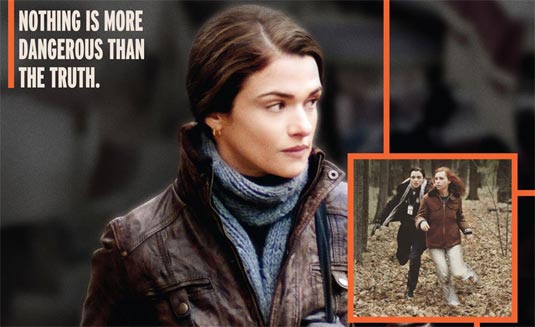
The center of the film is Rachel Weisz playing Katherine Bolkovic, a Nebraskan cop who takes a job as UN Peacekeeper in Bosnia only to uncover a major sex trafficking scandal. Bolkovic is good hearted, determined to do her job and make a difference, even if the people around her could care less about anything.

Once again, Weisz has proven that she can play a strong woman on screen, whether her role is a serious one as in this movie, or one as silly as “The Mummy.” She isn’t overdramatic yet she isn’t bland.  She makes us feel for her and what she is doing. And with most of the main characters being slimy men she holds her own against them, such as when her raid of a bar holding sex slaves is broken up by corrupted U.N officials. She stands her ground, fighting back.

The structure of “The Whistle Blower” is standard conspiracy/cover up theory fare. When Bolkovic discovers the gruesome sex trade operation she does an awful lot of running around from place to place, getting into heated arguments, trying to get abused and frightened women to testify, searching through documents to get to the bottom of things. There’s even a scene where Bolkovic puts rape pictures and documents on a corkboard and stares intently at them to try and find a connection.

And of course, the cover up is everywhere. The Bosnian policemen are corrupt, as are the low level U.N Peacekeepers and the high up officials. It’s Katherine vs. the world. Except for a few kind hearted U.N officers, like Peter Ward (David Strathairn) and Madeleine Ross (Vanessa Redgrave in a cameo), no one can be trusted. But dammit, Katherine is still determined to get the sex slaves the justice they deserve, even when she’s threatened and stripped of her credentials. And we’re rooting for her every step of the way.

 Weisz’s performance and the shear intensity of the content are more then enough to make up for the fact that the movies structure is formulaic. And watching the film, I constantly got the same feeling I get when I watch a vigilante movie: I wanted Bolkovic to go Charles Bronson on the whole bunch of crooked officials.

For being a first time director, Kondracki does surprisingly well at bringing out the grimy viciousness of the movie’s environment. Toward the beginning when Bolkovic goes to a bar that is a known sex trafficking hangout, she uncovers an utterly gross and dank holding room, littered with used condoms and beer bottles. It’s a little hard to stomach.

The ending of the film is bittersweet. On one hand some progress is made but on the other it’s still not a completely satisfying ending. But since this is a story based on a real problem going on in the world. It’s less important to have a happy Hollywood ending and more important to bring this problem to our attention so it can be addressed.

Conan the Barbarian Review

https://blogger.googleusercontent.com/img/b/R29vZ2xl/AVvXsEjF3clXXHBPb1S1EkrxcFq8zPWnho5IUn23XnPLQOujOuZtHYQORC9zJrX3FAZZih66_7HV5ZE-H78d0ydijojzUe1c4sh7yVTIa-yS6q0ENtvn6JdeCEuS8AxRK4QrBQ4EbzfzvP3xX8Qy/s1600/conan_2011.jpg

As it usually goes with remakes, there’s always one big question looming: Why do one? I can see why they wanted to do a remake of John Milius’ 1982 fantasy action film “Conan the Barbarian,” because if you’ve seen it you’ll know that it is ridiculously campy and outdated.

More importantly, it was the movie that launched Austrian actor/body builder/ politician Arnold Schwarzenegger’s career and it’s difficult to hate something with The Governator in it. But Schwarzenegger and campy fun can only go so far.

The 2011 remake, directed by Marcus Nispel, is sleeker and has much more action and gore. Though that isn’t a compliment. It is an incredibly boring action movie that might as well be a video game. You’re better off just seeing the original.

  “Game of Thrones” star Jason Momoa plays Conan (the muscle bound barbarian on a mission to avenge his father’s death) and frankly it’s just not the same without Arnold. Momoa gives it his all no doubt, with his flowing hair and chiseled body, but he takes the role a little too seriously. Schwarzenegger played Conan “seriously” but with hints of jolly giddiness and did these random outrageous things like punching a camel.

Meanwhile Momoa spends the whole movie with the same grimacing look on his face, talks in a low gravelly voice and does no outrageous things. Granted, he does talk more than Arnold does but with scriptwriters Thomas Dean Donnelly, Joshua Oppenheimer and Sean Hoods’ awkward and silly dialogue to spout, he should have kept his mouth shut.

 “Conan the Barbarian” is essentially a revenge fantasy. The evil Khalar Zym (Stephan Lang, playing a far less interesting villain compared to James Earl Jones’ Thulsa Doom) has killed Conan’s father Corin (Ron Pearlman) when Conan was a child.

One thing I did like in this film, compared to the original, is that Nispel does a good job of establishing the story. He emphasizes young Conan as an ambitious warrior and stretches out Corin’s death, giving us a reason to really hate Khalar (as we’re supposed to do in revenge movies) and root for Conan.

However, when we get to the main plot with Momoa the movie becomes nothing but action. When Conan and his companions aren’t fighting, they’re getting ready to fight. One thing that surprised me about the original was that there wasn’t as much fighting as there could have been, whereas here it’s Action! Action! Action! There’s no time for the movie to rest. So by the end when Conan confronts Khalar in their final battle it isn’t satisfying. The movie is an hour and fifty minutes and yet nothing much happens.

The biggest difference between this one and the 82’ version is that (because of 3D) Nispel’s is much more flashy and in your face. The opening prologue is so busy and bursting with colors and visual effects that you’re overwhelmed and your eyes don’t know where to focus. Although compared to most 3D movies, “Conan” utilizes the 3D very well. Some of the battle scenes (like one in the beginning that involves young Conan) are fluid and full of energy. Even so, the battle scenes become so repetitive that in the end it doesn’t matter how good they look.

Knowing Hollywood I wouldn’t be surprised if they’re going to make a sequel to this new “Conan.” After all, they made one to the original entitled “Conan the Destroyer,” which unfortunately goes overboard on the silliness. It shows us that back then Conan was all right one time around but too much a second. The new “Conan” film shows us that one remake is far too much.

Wednesday, August 17, 2011

Griff the Invisible Review


Leon Ford’s “Griff the Invisible” wears a very good disguise. It sets itself up as another one of those “pathetic-loser-dresses-up-like- super-hero-to-help-make-a –difference” movies, like the 2009 Mathew Vaughn film “Kick Ass.” In the opening scene our “hero” and loveable loser Griff (Ryan Kwanten) is in his apartment sitting by some high-tech computers, monitoring the street for crime, when all of a sudden he sees a woman being stalked by two scary looking men.

The film cuts to the next scene. Griff has put on his super hero suit (a black and yellow one, that looks sort of similar to Batman’s) and is running down the street, where he confronts the criminals and beats them up. The scene is like something out of a Batman film, with cheesy superhero music playing in the background. It’s exhilarating. But when day comes, Griff is in regular clothes, going to his boring office job, where his co-workers look him at as an outcast.

After that opening, we’re expecting another “Kick Ass” superhero vigilante movie, when in fact “Griff the Invisible” turns out to be a far more complex drama/comedy about how we view the world, our place in the universe and the superhero in all of us.  Unlike “Kick Ass” we don’t see how Griff gets his high-tech gadgets, or his suit, or his motive for fighting crime. He doesn’t have a partner per se and he doesn’t fight an arch nemesis.

Technically, the antagonist in the movie is society. Griff’s family, co-workers and his bosses keep telling him that he needs to fit in and be normal but Griff would rather be invisible and stick to fighting crime. As the movie goes on it becomes less about Griff putting on the suit and fighting crime and more about him finding himself.

 For the most part, “Griff the Invisible” is a cross between an indie romantic comedy and a dark delusional fantasy. Parts of the film are focused on Griff’s relationship with a woman named Melody (Maeve Dermody), who’s a perfect match for Griff because she is also odd and an outcast. She spends her days questioning things like protests and testing theories like trying to walk through walls.

Dermody and Kwanten bring a certain timid, awkwardness to their roles (Dermody in particular). The two of them share many intentionally uncomfortable scenes together (a trademark of indie comedies) but they’re convincing and you ultimately care for them.

However, for the rest of the time the movie blurs the line between dream and reality.  It’s often difficult to tell whether any heroic deed that Griff does is real or imaginary. In the opening scene, Griff can run like The Flash and beat up criminals with ease but in a later scene, when he’s in his regular clothes he is easily beaten up by a guy from his work. We see him put on an invisibility cloak in his apartment but later on we see it isn’t invisible at all.

Griff wants to disappear and go to other dimensions but really he’s already living in two different worlds. One where he is a masked crusader of the city and the other where he’s nobody and is treated badly. Now, some people might find this to be annoying and confusing, but it gives the film more depth, instead of being another “Kick Ass” and in the end it’s the better movie.

Does the movie have problems? Sure. The films’ pacing is a bit slow and stalls at places. Also it doesn’t quite know how to come to an end but the actors do a sufficient job, there’s a nice balance between funny and seriousness and it leaves you with a few things to ponder afterwards. And if a movie can do that, then it’s effective.

Friday, August 5, 2011

Senna Review


For the most part, documentaries are only as good as the subject they cover. Aryton Senna, a Brazilian Formula One racecar driver is the subject of Asif Kapadia’s new film “Senna” and he’s one of the most fascinating subjects I’ve seen in a documentary in recent months, and one that I’m sure most of the general audience doesn’t know about.

Senna’s story isn’t rags to riches. He didn’t have a rough childhood to overcome.  He doesn’t become internationally famous, only to lose it all to drugs or imprisonment. His story is simply that he loved to race and even though he got caught up in the politics of the sport, he never let it discourage him.  At one point in the film someone asks him amidst a conflict “Why don’t you just quit now?” and Senna replies, “Because I can’t.”

 Senna is a man of many depths who goes through major changes, and Kapdia’s documentary does a fantastic job of chronicling these events, from his claim to fame at the 1984 Monte Carlo Grand Prix, to his tours with different Formula One race teams (like the British team McLaren), to his untimely death at age 34 in 1994.

In the beginning of the film during the opening credits, we see stock footage of Senna in his early years of racing. He’s young, good looking and always has a big smile on his face. He’s enjoying his life every day. But as the movie goes on and Senna becomes more famous and more entangled in the politics, we see a different side of him and that smile fades.

We see a side of him that’s naïve and doesn’t know as much about the sport as he thinks he does. A man who strives for absolute perfection, who even after becoming a three-time world champion is still not satisfied. And we see a man who has such a strong belief in God that he thinks he’s invincible…and who ultimately is not.

Much like the 1970 documentary “Gimmie Shelter” about a disastrous Rolling Stones concert, “Senna” is nothing but archival footage, consisting of TV interviews, family home movies, and coverage of the races, mixed with audio interviews (instead of the typical face interviews) with family, sportscasters and friends. Now, these kinds of archival documentaries can be tedious, as was the case in  “Gimmie Shelter” But Kapadia’s film is well edited and organized, and moves at a breezy pace with plenty of interesting and rare footage.

 However, while the audio interviewing technique is unique it still would have been helpful to have the typical headshots, so you could see the interviewee’s facial language as they make their comment. Also, sometimes when a non-English speaker needed subtitles, you were too busy reading to watch the footage.

The best part of the entire movie is the rivalry that ensued between Senna and fellow McLaren team member Alain Prost. Prost is a veteran racer who feels threatened by Senna and the fact that he’s a rookie coming in on his team. Instead of the interviewees retelling the feud, we get to see it unfold and evolve through the actual footage. As the two talk about each other in TV interviews you can see the tension in their faces and hear it in their words, even as they say positive things.

 The film does expect the audience to know somewhat about Formula One racing. People who don’t know about the sport may be a little confused about the rules and how a race is won, which is important considering that most of the conflicts involve Senna getting screwed over or disqualified because of technicalities. But even with this drawback it still shouldn’t stop you from enjoying this movie.  You’ll be glad you came to know something about this truly Complex and all around good man.