Thursday, July 16, 2015

Ant-Man Review (2015)


Peyton Reed’s “Ant-Man,” the next film in the Marvel Cinematic Universe, (MCU) is both a pleasant surprise and kind of frustrating. On the one hand, there are some clever aspects and we’re introduced to a new character that serves as a nice change of pace for MCU superheroes and for a franchise that’s beginning to get increasingly bland in terms of story and character. On the other hand, the movie is kind of a mess. With the script being penned by four people--Edgar Wright, Joe Cornish, Adam McKay and Paul Rudd—the film feels overcrowded. The final product is somewhat hindered by derivative plot points and superfluous characters. “Ant-Man” is entertaining but also exhausting.

What “Ant-Man” has going for it is the bizarre factor. Burglar Scott Lang (Paul Rudd) is recruited by Dr. Hank Pym (Michael Douglas, who looks like he’s having a ball) to don a red leather suit that allows him to shrink down to the size of an ant. Along with that, he can control actual ants using his mind. No kidding. I won’t try to explain the science behind this, the movie doesn’t even explain it that well. Lang also gets his own carpenter ant that he can ride around on and we see him putting little metal helmets on about one hundred ants so he can command them in battle like a strange little General Patton.

A dude who controls ants? It’s just as absurd as it sounds but at least it’s something different. I’m not sure how useful an army of ants would be in a larger more serious superhero battle but for the purposes of this movie it’s ridiculous enough to work.  

Rudd is his usual likable self. If you’ve seen any of his films before then you’ve seen his performance here, which works in “Ant-Man’s” favor. It’s as if his schlubby everyman character from “This is 40” was suddenly thrust into the world of Marvel superheroes. It’s an unusual combination that’s pulled off.

Our hero’s super small size also gives the film's action sequences a much-needed change in perspective. The underwhelming San Francisco setting is given extra dimension--a normal everyday bathtub becomes a threatening, awe-inspiring wave simulator. The first time Lang shrinks down (where he goes on a wild ride through the floor of his apartment, in between the mammoth stomping feet of people at a party and eventually out on to the chaotic streets ) is disorienting and exhilarating. It may be the first truly thrilling action sequence from an MCU movie I’ve seen in a long time because it's something fresh. Furthermore, the lighting fast way in which Lang switches back and forth between his ant size and normal size to fight baddies makes for a nice alternative to the (muscular) man on man “destruction everywhere” melee we’re usually exposed to.


The main problem with “Ant-Man” is the over plotting and unnecessary/one dimensional characters. The main villain Darren Cross (Corey Stoll) is frustratingly one note. Within five minutes of meeting him, his menace is already turned up to eleven. There’s a redemption side plot between Lang and his young daughter and Pym and his grown up daughter Hope (Evangeline Lilly). Both are poorly developed and because of the movie’s commitment to comedy, neither relationship resonates very deeply. Bobby Cannavale’s role as a cop could have been axed entirely without any affect and Michael Pena as Lang’s friend can be funny but even his dim witted sidekick shtick begins to wear thin. All of this makes for mostly pointless clutter in the narrative.

Additionally, the ending is a tedious drag, which is disapointing considering the rest of the movie moves along so quickly. Similar to “Man of Steel,” I’d say there are about four different climaxes—a heist, a fight, another fight, and another fight. Good stuff’s in each one but there’s simply too much. It needed to be condensed.

“Ant-Man” certainty surpassed my (low) expectations, turning out to be far more bizarre and entertaining than I though it would be. Edgar Wright (“Shaun of the Dead,” “Hot Fuzz”) was originally tapped to direct the film but left due to creative differences and you can definitely see traces of his influence in some of the gags, the frenzied editing and quick pacing. Reed (who directed “Yes Man”) clearly doesn’t have the same comedic panache as Wright but as a director brought on at the last minute he does a competent job. In the end, it’s the script that needs more fine-tuning and editing.

C+


Monday, July 13, 2015

Stung Review (2015)


Benni Diez’s “Stung” is the low budget, goofy, creature feature you would expect it to be and nothing more.  It’s mildly entertaining while you watch but instantly evaporates once the end credits role.

Contaminated wasps terrorize a get-together happening at a country mansion. For whatever reason the frantic guests stand around in the midst of the swarm for upwards of five minutes, even though they could easily run into the house. Nobody ever knows what to do during a horror movie.

From there, Diez keeps things simple and claustrophobic. When the five remaining party attendants hole up in the basement of the mansion it becomes “Night of the Living Wasps.” The mini wasps lay eggs in the humans, at which point car sized wasps burst out of them in the vein of “Alien.” It’s going to be a long night, folks.

And well…that’s about it. It’s difficult to review a movie like “Stung” because there isn’t much to say. The screenplay by Adam Aresty is underwhelming, yielding no real surprises in terms of narrative. You can see every major revelation, trope and plot point coming-- the initial outbreak, the climactic scene in the wasp nest, a budding romance between two “unlikely” people, the final stinger--no pun intended--and the final final stinger. The dialogue often feels strained; most of the attempts at quips and comedic one-liners end up falling flat and feeling forced. The premise of the movie is already so ridiculous that there’s no need to try overly hard to be goofy and self-aware.

The characters are skin deep, although at least they’re somewhat likable and don’t spend whole movie making stupid decisions. The two young leads, Julia (Jessica Cook) and Paul (Matt O’ Leary) turn out to be capable, resourceful survivalists. There’s also Clifton Collins Jr. as Sydney, a weirdo with a humpback doing his very best Crispin Glover impression, which makes for a few funny moments. The rest of the humans are just wasp fodder.

Not surprisingly the special effects are the best part about “Stung.” As far as I can tell, all of the stuff involving the giant wasps—except the flying scenes—is done with practical effects. Lots of colorful, sticky wasp goo is shed throughout. The scenes in which the mega wasps break out of their human hosts are awesomely disturbing. And, in a nice added touch, the human heads often remain attached to the front legs of the wasps.


However even these practical effects, cool as they may be, only provide surface level thrills that wear off quickly. In fact, the whole movie wears off rather quickly. Only the most dedicated B monster movie connoisseurs will want to watch “Stung.”

C-

Thursday, July 9, 2015

Testament of Youth Review (2015)


At the beginning of James Kent’s “Testament of Youth” the Armistice has been signed, ending World War 1.  Though our protagonist, Vera Brittain (Alicia Vikander) isn’t celebrating. As she makes her way through crowded London streets she looks beaten down and dazed. By this point, the war has practically taken everything from her. In real life, Brittain became a Pacifist after experiencing the horrors of The Great War first hand. Based on her memoir of the same name, “Testament of Youth” carries a strong anti-war message. However, Kent handles it with subtlety and compassion, slowly easing into it, instead of starting with suffering right away. Additionally, he keeps the focus of the movie on Vera and her evolution as a character.

We flash back to the time before the war, a better time.  The cinematography by Rob Hardy is lush and sparkling, bringing out the beauty of the spa town of Buxton where Vera lives with her parents and older brother Edward (Taron Egerton). Here, she lives a privileged but uneventful life; besides Edward she has no companionship. Most of the time she’s cooped up in the house, writing poetry and dreaming of a better life. These initial twenty minutes are all about Vera’s resistance to the conventional roles women were forced into and her desire to stand out (Brittain was also a feminist). Her petite figure makes her look fragile and weak on the outside, but on the inside she’s audacious and resilient.  She wants to go to Oxford, not settle down and get married.

Although, things change rather quickly when Edward brings home school chap Roland, (Kit Harrington) a fellow poet and before long sparks begin to fly between them. On the film’s theatrical poster their relationship is front and center, which is misleading. Not only is “Testament of Youth” not a romance movie but the Roland-Vera relationship is probably the least interesting aspect and the way Kent handles it partly undermines Vera’s character.

She ends up getting into Oxford but when Roland goes off to war she drops out and becomes a war nurse in London. Now, it’s not unreasonable that someone would drop of out of school to help the war effort but in the movie we’re given the impression that Vera drops out primarily because of Roland—if she wasn’t involved with him she would have stayed at Oxford. A decision like this doesn’t feel in keeping with the slightly stubborn, independent-minded Vera we were introduced to in the beginning. While Roland is certainly dashing and handsome, their relationship doesn’t have enough substance for us to believe Vera would give up her hard fought space at Oxford for him.

Yet, in the long run, “Testament of Youth” isn’t about their relationship but a character study of Vera—showing her change from a privileged naïve girl living in Buxton to a hardened, world-weary survivor of the war. As we later find out, her relationship with Roland primarily serves as the first stop in her loss of innocence. Those looking for a breezy period romance will be sorely let down. The second half of the picture serves up a harsh dose of wartime reality-- effectively shattering the pretty upbeat tone of the first half. Even Hardy’s cinematography becomes greyer to reflect this bleak change of pace.

Kent, to his credit, handles this transition with restraint. Instead of bombarding us with wartime suffering right away, he takes his time. At first the changes are small; Roland and Vera continue their happy, passionate romance while newspaper headlines announcing Archduke Ferdinand’s assassination warn us of impending doom. When Vera receives some tragic news over the telephone, Kent lets the scene play out in dreadful, stomach churning silence as Vera goes into shock. The movie avoids melodrama at all costs, making the picture’s shift in tone more believable.

Except for occasional flashes showing the depleted, muddied faces of soldiers on the front, we experience the wartime horrors from Vera’s point of view as she works in the overcrowded, disgusting hospitals. Kent doesn’t shy away from showing us the gruesome, ugly costs of war—a long shot showing Vera walking around a large field filled with injured soldiers is overwhelming and devastating. At the same time, because of Kent’s gradual and subtle approach, the movie never feels exploitive. Its anti-war message doesn’t come across too heavy-handed, making the scenes of suffering all the more resonant.

“Testament of Youth” stumbles at a few places along the way but it still packs quite an emotional punch. And it’s all anchored in a magnificent performance from Vikander. As Vera, she expresses a wide range of emotions over the course of the movie. Vikander makes her into a well-rounded, three-dimensional human being. When Vera becomes an outspoken opponent of war we believe it because her transformation has been captured with so much depth and detail. By the end we’re just as emotionally drained and dazed by the war as she is.


B 

The Gallows Review (2015)


The horror film genre is full of dumb teenagers who make bad decisions; there are so many you could populate a second earth. However “The Gallows”—yet another found footage feature-- may contain the dumbest teens of any horror movie. They’re so dumb, so unlikable and thin as construction paper. They may as well be wearing big, bright neon signs that read: “Here I am! Kill me now! I’m not going to make a single smart move!” Although, the movie itself—written and directed by Travis Cluff and Chris Lofing—isn’t much smarter.

Twenty years ago, a small town high school put on a play called “The Gallows,” wherein one of the actors died in a freak accident when the play’s prop gallows malfunctioned.  Now, the current students are reviving the failed show…because that’s a smart decision. For whatever reason, the football team and the cheerleaders are forced to participate, which is how we’re introduced to our three dummies.

The first, Ryan (Ryan Shoos) is the worse because he’s also a massive, massive prick. That’s it. That’s the extent of his character. Within five minutes of meeting him you already hate him. He doesn’t stop talking and he blames others for his stupid mistakes. Also, did I mention that he picks on the theater kids? No joke. At one point he hurls a football at the stage manager, knocking him down and shouting “nerd!” You read that right: a modern day horror movie that features a jock picking on a nerd. Apparently we’ve been transported back to the eighties.  There’s also the sensitive jock—but still dumb as rocks—Reese (Reese Mishler) and Ryan’s blond cheerleader girlfriend Cassidy (Cassidy Spilker). Calling these teens “hollow shells” would be to sully hollow shells.

Anyway, where was I? The three are sick of doing the play, so Ryan proposes they break into the school that night and destroy the set, therby cancelling play the following evening. Uh-huh. And yes…the movie treats Ryan’s “plan” one hundred percent seriously. Not surprisingly, the other two bozos agree.  Now keep in mind that since this is found footage, this all being recorded. That means when the three break into the school, they’re recording all of their vandalism, essentially indicting themselves. I’m just going to let that sink in for a moment. The found footage gimmick has been stale for a while now, but this is the stupidest, flimsiest, most worthless use of the style I’ve seen.

Sure, Ryan is selected to be the play’s videographer but that doesn’t explain why he would continue filming. And it doesn’t explain why the characters bring multiple cameras into the school later that night. The filmmakers don’t even bother to give the whole, “I’m making a documentary” excuse. The found footage angle in “The Gallows” is entirely worthless.

I haven’t even gotten to the actual horror movie stuff because there isn’t much to say. The filmmakers came up with about five, maybe ten minutes of interesting material and then must have forgot they had seventy minutes left to fill. The three, along with one of the drama geeks Pfeifer (Pfeifer Brown) get trapped inside the school with an angry ghost. The stupid characters continue to make one stupid decision after another—splitting up, going down creepy corridors, etc. They restate obvious plot points and realizations constantly, and we get a lot of “Did you see that?”  “Are you seeing that?”  and “What is that?” Any attempt at a dramatic moment is completely undercut by the stupidity of the characters, terrible dialogue and horrendous acting. I laughed a great deal during “The Gallows,” though probably not when I was supposed to.

The picture primarily relies on cheap, ineffective jump scares that wear off immediately. Overall the horror in “The Gallows” is uninspired and lazy. The ending is somewhat clever but feels undeserved. Again, it’s as if the filmmakers came up with a solid premise, wrote a solid ending and then realized, “Oh shit! We need to write the rest of the screenplay!”


“The Gallows” is a dumb, bad movie, filled with dumb, bad characters deserving of every bit of punishment that comes their way. However, I can’t flunk the movie entirely. There is some unintentional fun to be had. The audience at the preview screening I attended was in to it, knowing full well how dim witted it was. My advice would be to wait and rent it. Watch with a group of friends and a couple cases of beer and bask in the sheer stupidity.

D

Wednesday, July 8, 2015

Self/Less Review (2015)


Tarsem Singh’s “Self/Less” is a high concept sci fi movie that doesn’t realize its full potential. What if, when close to death, one could transfer one’s consciousness into a younger body and continue living? Our greatest minds could continue to do great work, if only they weren’t hindered by their aging bodies. It’s a fascinating idea handled with shaky execution. Singh opts for a more traditional “on the run” action movie, with a confused protagonist hunting for the truth and a seemingly endless barrage of movie henchmen.

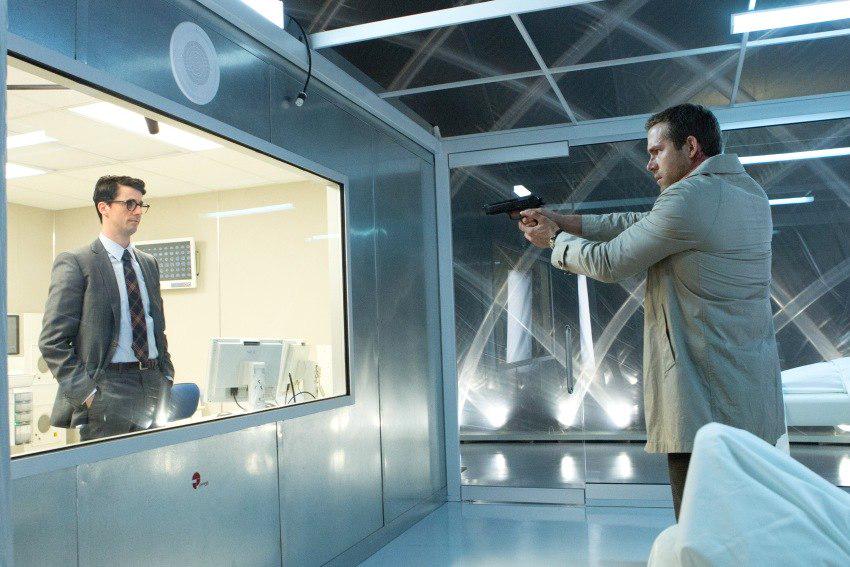
Ben Kingsley—doing what sounds like a gravelly Brooklyn accent; whatever it is it sounds incredibly phony—stars as Damian, a billionaire architect on his deathbed. He hears about an organization that performs a new medical procedure called Shedding. After coughing up blood one too many times and having a few meetings with the organization’s leader Albright (Matthew Goode) Damian decides to go for it.  He wakes up in a new body (Ryan Reynolds) and for a while it’s all fun and games. In a slickly directed and edited montage we see Damian take his new body out for a test run, making love to a plethora of girls and partying in various New Orleans clubs. However, he begins to see flashes of old memories that aren’t his, which eventually leads him to discover the ugly truth of his new body’s origin.

These opening forty five minutes or so are strong and Damian’s a-ha moment underlines the fundamental dilemma with a procedure like Shedding: the young bodies have to come from somewhere. Shedding is elitist, not just because wealthy people are the only ones who can afford it but also because it asserts that one person’s life is more important than someone else’s. At one point Albright says that all medical advancement requires some sacrifice; while there is a kernel of truth in his sentiment, nobody gets to decide that one person’s life is more important than another, especially when it results in the “inferior” person’s death.

Plus, the fact that Albright profits from the procedures makes things even murkier.  Not only does he believe certain people should keep on living at the expense of others but he’s making a lot of money in the process. Doesn’t sound fair to me. Albright is the most compelling character in the entire movie and Goode plays him with his usual relaxed charm and wit, along with menace.

At about the halfway point Damian, accompanied by Madeline (Natalie Martinez) and Anna (Jaynee-Lynne Kinchen) the wife and daughter of Mark--the body Damian now inhabits—go on the run from Albright and “Self/Less” turns into an extended chase scene. Damian has a Jason Bourne moment when he realizes his young body is capable of hand-to-hand combat and Albright’s organization is the kind of organization that only exists in movies. They’re extremely secretive, yet they have a full army of professional foot soldiers and “clean up” crews to make sure their patients don’t get out of line.  As the movie goes on, the action aspect becomes more prominent and the action set pieces themselves get increasingly ridiculous--flame throwers, car crashes, gun fights, more flame throwers!-- creating tonal confusion.  All of which somewhat undermines the high concept sci fi material introduced at the beginning. “Self/Less” has an intriguing sci fi premise but it’s wrapped in a silly, run of the mill action/thriller.

Reynolds is an odd casting choice. While he excels at the more awkward comedic moments near the beginning—Damian getting used to his new body—he simply doesn’t have an action star presence. I don't understand why he keeps getting casted in these types of movies. He’s not very smooth or intimidating and he can’t aptly convey Kingsley’s seasoned gravitas.  


There are other issues; Damian has an estranged daughter, an underdeveloped relationship that could have been jettisoned entirely. And when you throw an innocent mom and daughter into a PG-13 action movie you know nothing bad will happen to them, which eliminates some tension. While the quieter tender moments between the three feel authentic, during the action sequences, Madeline and Anna just get in the way.


On the whole, “Self/Less” is a mild disappointment. Singh has a great concept on his hands but the screenplay (by David and Alex Pastor) takes the underwhelming, popcorn action movie path. It’s not a bad movie but there’s no reason to see it right away.

C+