Showing posts with label Chris Pine. Show all posts

Thursday, June 1, 2017

Wonder Woman Review (2017)


Lets get the hyperbole out of the way, shall we? Patty Jenkins’ “Wonder Woman” (the fourth film in the D.C. Extended Universe) is the best DC superhero film since “The Dark Knight.”

Now let me qualify that statement a bit: being the best DC superhero film since “Dark Knight” isn’t exactly a high mark to clear. “Suicide Squad” and “Batman v Superman” are miserable, overstuffed slogs and “Man of Steel” is good until that trainwreck of a last third. However, DC’s recent slump doesn’t diminish the high quality displayed in Jenkins’ picture. “Wonder Woman” isn’t merely passable or mediocre, it’s drastically better than those other lackluster flicks.

Jenkins emphasizes character over spectacle while the narrative is coherent and focused. It doesn’t tease upcoming DCEU films and the script by Allan Heinberg doesn’t clog the movie with unnecessary side plots or excess McGuffins to give the illusion of depth. Additionally, “Wonder Woman” is a lot of fun--charming and silly in equal measure. It combines the goofy, mythical otherworldliness of “Thor” with the period combat/espionage film dynamics of the first “Captain America” and lightly touches on the horrors of war and the struggles women face in society.

Through a flimsy flashback-framing device (that opens and closes the film with terribly ham-fisted voice over) we’re transported to the lush, dislocated island paradise known as Themysciria where a race of Amazons live in peace. Wonder Woman, aka Diana (Gal Gadot) is the most restless and headstrong of them, desperate to become a warrior and protect others from danger. She gets her chance when U.S. solider Steve (Chris Pine) crashes his airplane near the island. Steve is doing spy work for the British and warns the isolated Amazons about World War 1 and its threat to humanity. Diana decides to accompany Steve on his mission (going to the chaotic Western Front) hoping to singlehandedly stop the war and bring peace.


However, things aren’t so simple and in this regard “Wonder Woman” is a poignant coming of age film. Diana is fierce and self-assured, boldly marching into any harry situation. And unlike the pessimistic Batman or the latest mopey incarnation of Superman, she’s brimming with optimism. Though she’s also incredibly naïve and unprepared for the fact that humans, especially men, are a violent species that crave war and conflict. Her initial plan to stop the Great War is noble but somewhat simplistic, not taking into account the complexities and messiness of war. She’s never seen a village full of women and children cruelly gassed. This harsh reality has a tremendous effect on Diana, ultimately leaving her mature and slightly jaded.

This is admittedly gloomy material but Jenkins’ never lets said gloominess totally dominate the picture. “Wonder Woman” touches on the horrors of war and the cruelty of humanity while giddily embracing its pulpy comic book origins at the same time. Diana may not be able to fully comprehend the messy and gruesome nature of human conflict but she is a super being from a mythical realm--meaning she can do things the average solider can’t. At one point Diana heroically charges across No Mans Land to attack a German trench and free a French village, eventually inspiring fellow soldiers stuck in the trenches. Not a bad ally to have. Instead of spending all her time sulking about how awful humanity is Diana is proactive; killing plenty of Germans with her patented glowing lasso and shield, trying her hardest to remain optimistic and slice through the dense politics and convolutions of human conflict.  

On top of that, “Wonder Woman” playfully mocks rigid societal codes and structures, like The Patriarchy. The sequence in which Diana and Steve are in London to prepare for their mission is rife with great fish-out-of-water humor. Diana being puzzled by and then criticizing silly, misogynistic societal norms is a joy to watch. For example, her priceless reaction to the fact that women aren't allowed to be apart of high-level strategic meetings. Related to this spirited ribbing is the superb chemistry between Gadot and Pine-- their repartee and comedic timing are impeccable.


Pine, with his cocky and dopey performance, may be at his very best but Gadot is the star here. While her performance is occasionally shaky, (this is her first leading role) overall the relative newcomer holds her own, injecting Diana with ferocity, compassion and effortless wit. Jenkins keeps the film’s focus squarely on Diana and her evolution from bright-eyed Princess to grounded warrior.

The picture can be very clunky and heavy-handed at times, (ala the superfluous flashback-framing device) spoon-feeding fairly obvious plot points, themes and character arcs. Making matters worse, the last act is a mess. It’s the only time Jenkins really loses control of the project and things become incoherent. The final hero-villain showdown is an exhausting muddle of ugly CGI destruction (the CGI throughout looks third rate) and the villain himself is overly generic and one dimensional. It's the same old story:  good third acts and compelling villains are difficult to pull off in superhero movies.  Spectacle and cliche briefly snuffs out character and narrative clarity.

Nevertheless, “Wonder Woman” is an empowering, self contained, character driven, all around entertaining superhero origin film that more than adequately sets up the Amazonian Princess for future films.


B 

Wednesday, August 10, 2016

Hell or High Water Review (2016)


David Mackenzie’s “Hell or High Water” is a lean, character driven crime thriller seasoned with bits of humor to temporarily ease the tension and the occasional moment of abrupt, brutal violence to put us back on edge. The film derives additional freshness and urgency through its setting and atmosphere.

“Hell or High Water” is set in small towns scattered across Texas--small towns that are slowly fading away do to the recession. Boarded up buildings, deserted properties, signs that read: “closing” and “property of the bank” dominate the film’s mise en scene.  And through the unsubtle comments of the residents in these dying towns, one can feel a lot of anger and resentment towards the banks.

It’s in this environment of economic depression and pent up anger that the film’s narrative emerges. Two brothers, Tanner (Ben Foster, menacing and delightfully unhinged) and Toby (Chris Pine, a little more mild mannered and cunning, but intimidating when he needs to be) have taken up bank robbing to pay off their outstanding debts to the bank. In the vein of Bonnie and Clyde or John Dillinger they drive from small town bank to small town bank, hitting the cash drawers. The picture is essentially an extended chase between the brothers and a pair of Texas Rangers/ longtime friends, Marcus (Jeff Bridges) and Alberto (Gil Birmingham).


But if you’re expecting a fast paced, adrenaline fueled action film about cops and robbers then look elsewhere. Instead the mood is often casual and easygoing, as if a bank-robbing spree is no big deal. The brothers have come to terms with being outlaws; the film skips the “planning” stage and the moral and ethical questioning. Meanwhile, the townsfolk feel more anxiety and animosity towards the banks than the bank robbers (the implication that the banks are the bigger crooks can be felt loud and clear) and our Rangers are surprisingly cool and unhurried. Instead of being passionate lawmen determined to catch the outlaw, they seem to be doing it more out of obligation.

In other words, the dramatic stakes feel low most of the time, which is peculiar for a crime thriller about bank robbing but also appropriate when considering the situation. The townsfolk don’t care because it’s not their money being taken (that’s being taken by the banks; again the message is loud and clear, maybe too loud at times) and the bank doesn’t really care either because the brothers are stealing from the cash drawer only. Of course, two men can’t just go around robbing banks, hence the Marshal’s patient pursuit (the FBI isn’t even interested). Through the arduous and somewhat outdated method of in person bank robbery, the brothers find a way to get back at the system without greatly affecting it or the livelihood of those around them.

The relaxed nature of “Hell or High Water” and its straightforward story allow Mackenzie and screenwriter Taylor Sheridan (“Sicario”) to focus more on character rather than plot. The picture is impeccably paced—leisurely without being to sluggish. Sheridan’s tight, focused screenplay has a schedule to keep (the brothers have to keep moving after all) but it allows the interactions between the characters to play out in an unhurried fashion. The film switches back and forth between The Rangers and the brothers as they converse with each other--planning their next move or just chitchatting about whatever crosses their mind. These calm, quiet dialogue driven scenes make up a lot of the movie.


“Hell or High Water” thankfully doesn’t have extensive plot exposition and there aren’t any flashbacks. What we learn about all four primary characters we learn through present conversation and action, as well as details at the various pit stops they make (at one point, the brothers briefly visit Toby’s ex wife and two kids). Though Mackenzie and Sheridan also trust in their audience by not over explaining. When we first meet each pair there’s already an established foundation between them--a sense of trust and familiarity, a repartee. These are characters that have known each other for quite some time and had a life outside of the film. Instead of having to formally set up a narrative, Mackenzie and Sheridan drop us into the middle of one that’s already in progress.

Pine and Foster convincingly play charming, down to earth brothers and their reasons for turning to crime does come from a genuinely good place. However it takes courage to essentially be an outlaw and both Toby and Tanner have no problem carrying out nastier, more unforgivable deeds later on in the film without looking back. In fact they can be straight up cold-blooded at times, giving them moral complexity.  

Bridges slips comfortably into his role, playing a cleaned up, more refined (and significantly less drunken) version of Rooster Cogburn from “True Grit.” He has such a comforting, likable onscreen presence here as an experienced and highly intelligent Marshall who’s just getting sick of the job (he’s retiring soon). This is the best Bridges has been since, well, “True Grit.” Meanwhile, Birmingham holds his own with Bridges--giving a playful performance with an undercurrent of wisdom and world-weariness.


The picture really picks up steam near the end; things get out of control for the brothers and blood is shed.  Though the movie never goes off the rails and it closes on a tense, nonviolent verbal confrontation (rather than say, a gun fight) that both brings the narrative to a satisfying close and leaves things partially open.

“Hell or High Water” may not reinvent the wheel but it’s an exceptionally made character driven crime film that’s as relevant and urgent as it is entertaining.


A- 

Thursday, July 21, 2016

Star Trek Beyond Review (2016)


“Star Trek Beyond” is the third film in the most recent “Star Trek” film series (the first two being “Star Trek” and “Star Trek Into Darkness”) but it feels like its own standalone action feature. You don’t have to be well versed in “Star Trek” lore, or even that familiar with those first two installments to enjoy it. And thankfully it isn’t trying to set up future movies. Good sequels are self-contained, telling a complete and satisfying story. They fit neatly into the franchise while at the same time standing apart. “Star Trek Beyond” stands apart.

The narrative is simple and straightforward. There aren’t any major surprises or events that will significantly affect the characters or the stories in future installments, which eliminates some element of surprise. But as an isolated, old school action film “Star Trek Beyond” is both exhilarating and entertaining.

The movie also flies by.

For a two-hour picture “Star Trek Beyond” feels like 90 minutes, and that’s a good thing. It’s easy for two-hour action films to become bloated and laborious. Star Trek Beyond” is just the opposite; it’s lean, slick and focused. After a brief introductory section (that can’t last more than ten minutes at the most) the inciting incident is quickly and clearly established and the crew of The USS Enterprise is off on their next mission. Incoming director Justin Lin maintains this snappy pace throughout-- the picture is almost always in motion; the characters (and the audience) have to keep moving with it.


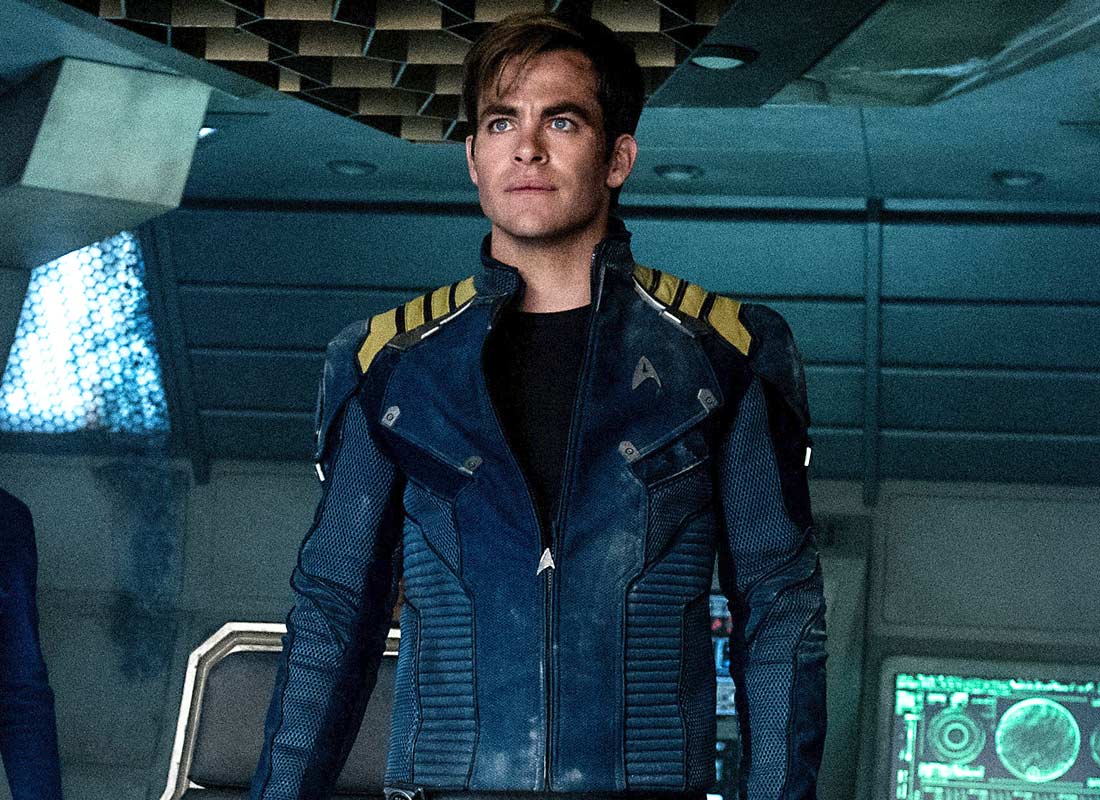
“Star Trek Beyond” “starts with the intriguing premise that being the captain of cool spaceship that flies around the galaxy looking for new life forms (to join the United Federation of Planets) can get boring after a while. (Well, I guess if your full time job is in space its bound to get a little stale). That’s just how James T Kirk (Chris Pine, oozing charisma like sweat) feels. He’s burned out—stuck in a repetitive routine. However, in no time, “Beyond” takes a sledgehammer to that “routine” by stranding the entire crew on a foreign planet.

Suddenly the job isn’t so boring now.

On the planet, Kirk, Spock (Zachary Quinto), McCoy (Karl Urban), Scotty (Simon Pegg) and the rest of The Enterprise are hunted by the lumbering reptile-like Krall (Idris Elba) and his army. The crew is thrown into a strikingly unfamiliar and disorienting situation that forces them to survive outside the accustomed and comfortable confines of the ship. I found this scenario to be pleasantly refreshing considering how much of “Star Trek” takes place on the ship in space. I’ll take people running around on a planet over one spaceship shooting at another spaceship any day. Maybe that’s just me.

Unsurprisingly, the cast is phenomenal; the strongest element of the new franchise by far.  This time around everyone is allowed to be quick witted and courageous in equal measure. The screenplay by Pegg and Doug Jung is the funniest of the three films and all the primary crewmembers get to trade witty screwball-esque banter with one another while also kicking butt. I can’t say any of them go through a significant character arc (well, Kirk does, though it’s obvious from the get go) but they’re fun to be around and they instantly win you over with their charm.

There’s a lot of action in this film-- a lot of destruction and explosions and beams of energy. There are a couple of epic, extraordinary action set pieces (Lin and co. take full advantage of the big screen). At the same time, there are scenes that feel redundant and tedious. That tends to happen in action heavy movies. But because the characters are so vibrant this didn’t bother me nearly as much. Strong, likable characters go a long way.

My only major reservation with “Beyond” is that sometimes the silliness dilutes the more serious happens in the film--like death. There’s a surprising amount of death (including one scene towards the end that’s shockingly disturbing for a PG-13 blockbuster) that’s casually shaken off. The movie moves so quickly that sometimes an intense death scene is followed by two characters cracking jokes. I’m not saying the film needs to come to a screeching halt but a few brief moments where the characters stop and seriously acknowledge the death and loss would have been nice.

I have a few other minor issues, namely that things become predictable during the last third when yet another major city is threatened with destruction. Yet, in the moment “Star Trek Beyond” is a lot of fun and a highlight in this otherwise underwhelming summer blockbuster season.

B