Showing posts with label Joaquin Phoenix. Show all posts

Tuesday, April 17, 2018

You Were Never Really Here Review (2018)


Grade: B+

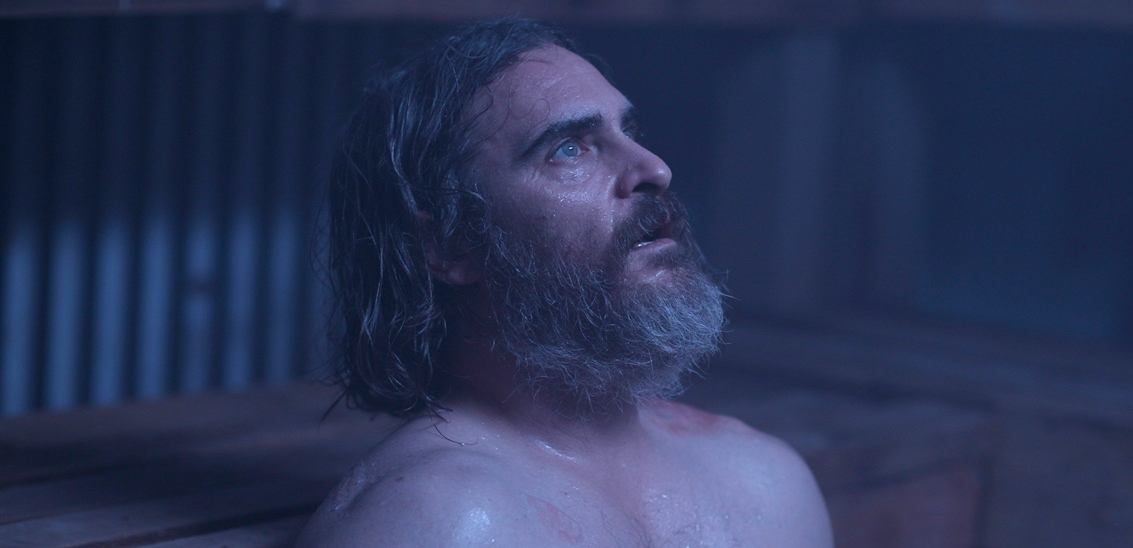
I wouldn’t want to mess with Joe, the protagonist of Lynn Ramsey’s feverish, psychological crime flick “You Were Never Really Here.” He’s got a large, bushy beard and long hair that he often keeps in a bun. His body is bulked up and covered in scars. A former war vet, Joe (played by Joaquin Phoenix) now works as a tough guy for hire—mostly rescuing little girls from underground sex clubs. Wielding only a hammer, Joe dishes out pain with such mechanical finesse; he’s been around enough violence for it to just bounce off of him.

Yet, I also spent much of the film wishing I could give Joe a great big hug. Maybe it’s his soft, gentle voice or his propensity for spacing out or that he straight up breaks down in tears at a couple points. This guy needs help… and a friend. Phoenix has such a knack for playing menacing, unhinged characters that also give off a nonthreatening and vulnerable aura. For Joe, violence is both second nature and a burden.

Right away we see how tormented and haunted he is. Traumatic memories, from his childhood, his war days and past rescue missions, flash on the screen in disorienting and suffocating fashion. Joe continues to be violent in a futile attempt to suppress these painful visions. “You Were Never Really Here” is a claustrophobic, nightmarish film about an individual whose mind and body is trapped in a seemingly endless cycle of violence.


Based on a terse novella by Jonathan Ames, “You Were Never Really Here” follows Joe over the course of an intense few days. After a spending some quality time with his ailing mom (who has her own traumatic background), he’s hired by New York Senator Albert Votto (Alex Manette) to rescue his teenage daughter Nina (Ekaterina Samsonov) from a local sex club. Joe buys a new, shiny hammer from a hardware store and then drives to a nondescript town house at the dead of night. He breaks into the house with ease and makes his way through its mostly barren interior.

 In the film’s best-shot sequence, Joe takes out security guards and clients with swift precision before finally reaching Nina’s room. Ramsey and cinematographer Thomas Townend capture the action in long shot, via black and white surveillance cameras that line the ceilings. When Joe makes quick work of a random customer in a bedroom, a little girl (not Nina) wanders out into the hall.

The sequence has an austere, chilling sense of detachment. There’s nothing exciting or romanticized about the vile stuff that’s going on in this place or Joe’s actions. All of this icky stuff is brutally matter of fact. “You Were Never Really Here” is affectively gruesome and disturbing without being excessive. In fact in most cases, Ramsey emphasizes the build up and gory aftermath more than the actual violence.



Joe easily finds Nina and they escape the house of evil but things quickly dissolve into chaos. Joe is yanked into a conspiracy involving corrupt cops and politicians that leaves a trail of suffering and violence behind. At times, “You Were Never Really Here” resembles a combination of “Taken” and John Boorman’s splintered, elliptical Neo-noir “Point Blank” but much bleaker than both those films. The ominous flashbacks are brief enough that they don’t interrupt the picture’s flow, while Johnny Greenwood’s eerie score (an unsettling, off kilter mix of synthesizer, strings and percussion) accents the disarray.

Of course, Ramsey isn’t really interested in plot. She doesn’t dig too deep into the conspiracy or draw the girl rescue narrative out like “Taken” did. It resolves itself pretty quickly and she lets the audience put the remaining pieces together. No, Ramsey keeps the picture’s focus on Joe’s damaged psyche. How much more of this suffering can he take before he snaps? Is there any way for him to break out this destructive cycle?

Ramsey provides an answer to that question of sorts, which turns out to be a pleasant surprise. The main problem with Ames’ book is that it’s missing an entire final act, concluding on a frustratingly open-ended (i.e. unfinished) note. Ramsey fixes that, partly by giving the character of Nina far more agency and presence than Ames granted her. She’s strong-willed and resourceful. And the two wounded souls form a poignant, remedial bond. It’s harder to heal when you’re going at it alone.   The movie even suggests that Joe needs Nina more than she needs him.


The final outlook is refreshingly optimistic and empowering. Satisfying, while still somewhat open-ended.  Samsonov gives such a mature, understated performance that I wish Ramsey had given Nina a couple more scenes, either by herself or interacting with Joe, to further strengthen their relationship.


 Overall, “You Were Never Really Here” lacks the character and thematic depth of Ramsey’s last effort, “We Need to Talk About Kevin,”--another hallucinogenic, terrifying movie about coping with trauma and evil.  But it succeeds as an intense examination of the mental and physical toll nonstop violence can have on someone.

Thursday, July 30, 2015

Irrational Man Review (2015)


In “Irrational Man” Woody Allen turns Fyodor Dostoevsky’s dense philosophical novel “Crime and Punishment” into a light modern-day mystery/romance. The film addresses a number of interesting philosophical ideas-- mainly existential choice (the freedom to choose) as well as randomness and chance and how those ideas interact with each other in real life. Unfortunately, Allen’s script doesn’t explore these concepts in any great depth—the movie often feels like a bland philosophy lecture. On top of that I just couldn’t buy the central relationship between its two protagonists.

Joaquin Phoenix plays Abe, a philosophy professor who takes up a summer teaching job at a small town college. He’s painfully misanthropic, disillusioned and seemingly on the verge of suicide. Why? Because the world is unfair and he feels he can’t make any meaningful impact. Things change when he befriends one of his students, Jill (Emma Stone) and when they’re out one day, he happens to randomly eavesdrop on a conversation concerning a judge that’s abusing his powers  Hearing this, Abe has an a-ha moment and decides to commit a rather drastic act, a decision that gives him a new lease on life.

This almost one hundred and eighty degree turnaround in Abe’s attitude is the first problem “Irrational Man” runs into. Abe decides to commit this act primarily for selfish reasons; he’s not going to sit back and accept the unfairness of this situation, he’s going to take action. In his mind he’s exercising his freedom to choose and feels doing this act will make the world a better place. While this philosophical reasoning is interesting Abe’s change comes too abruptly. He becomes a different man, happy and relaxed. He’s so sure in his decision that there’s no convincing him otherwise, a change in demeanor I just simply couldn’t believe.

Additionally, after his a-ha moment Abe becomes a rather stale, one-sided character. Like Abe, part of Ralskolnikov (the protagonist of “Crime and Punishment”) does believe his existential act is just and beneficial but there’s another part of him that’s racked with guilt and paranoia. He even becomes physically sick. That other side of Ralskolnikov (the side that makes him multilayered) is missing from Abe. You’d think that as a professional thinker, Abe would consider the repercussions of his actions and have that moral debate in his mind but he doesn’t. He practically shuts his brain off. There’s not much more character development after his turning point and Abe ceases to be a compelling character.


Another problem with “Irrational Man” is it deals with its philosophical ideas, themes and almost everything else in such a heavy-handed, surface level way. For starters, the fact that Abe is indeed a philosophy professor dealing with this big existential crisis feels too on the nose, too obvious. On top of that, between the hindsight voiceover testimonials from Abe and Jill, scenes depicting Abe giving lectures on concepts acted out in the movie and the various philosophical discussions between characters throughout, the film doesn’t leave much for the viewers to dissect afterwards. Everything is left out in the open. To hammer home the “Crime and Punishment” angle further we get a scene where Jill finds Abe’s personal copy of the novel with the judge’s name written in it.

In a scene early on during a lecture, Abe discusses the difference between philosophy in class and applying philosophical ideas to real world situations. In classrooms, you’re dealing with highly theoretical situations that may not fully apply to real life. It’s ironic then, that the picture itself takes such a textbook, didactic approach to its “real life” situations. The only thing missing would be to have Allen himself, standing off to the side of each scene, with a Philosophy 101 textbook open, breaking the fourth wall and instructing us on how a particular philosophical concept applies to the scene at hand.

Finally, the most frustrating aspect of “Irrational Man” is the relationship between Abe and Jill. From the get go Jill is infatuated with Abe; he even rejects her advances at first. She says she’s “in love” with him multiple times. Why is she so in love with him? At the beginning, Abe is a miserable, alcoholic, uncaring schlub and yet she can’t get him out of her mind. We’re told by others that he can be “charismatic--” not once is he charismatic. Jill says he has lots of problems but he’s “brilliant.” We don’t see this brilliance because he goes from being miserable to upbeat and one note. And anyway, not all brilliant people are necessarily sexy. In other words, I didn't buy their romantic relationship for a second and I found it particularly maddening that Jill is the one who lusts so hard after Abe. It sort of feels like an old cynical writer’s fantasy: cute, smart, funny, young Emma Stone lusting after the extreme misanthrope!


"Irrational Man" flat lines and fails to make good use of its meaty concepts. The ending is too quick, wrapping things up too neatly and again, not giving the audience anything to chew on. All in all, the picture is mostly a skin deep, heavy-handed philosophy lecture.

D+