Monday, June 26, 2017

Baby Driver Review (2017)


Perhaps the best thing about Edgar Wright as a filmmaker is that he really uses the medium. Unlike, say, Judd Apatow, who’s enamored by the long winded riffing between two experienced comedians (interactions that are generally captured in boring medium and close up shots) Wright shrewdly marries editing, action choreography, sound and cinematography together to create zany, genre blending experiences.*  Yes, his hyper, always-moving style can sometimes feel relentless and wear thin (particularly during the third act) but for the most part they make for a fun time at the movies. Wright’s latest film, “Baby Driver” is no exception.

“Baby Driver” is exuberant, fast paced and tightly scripted. There’s not much in the way of fat—no scene goes on longer than it needs to. The picture isn’t just a collection of jokes and improve-y back and forths poorly glued together to resemble a feature length film. Wright firmly believes in narrative and structure to keep things organized and the action moving. Story and character come first, while the humor flows effortlessly out of them. “Baby Driver” keeps to a meticulous and playful comedic rhythm, sort of like a classic screwball comedy with more music, heavier cutting and a lot more action.

Wright also likes working within established genres. “Baby Driver” embraces a well-worn sub genre of the crime film—an expert criminal trying to get out that dangerous life but that life wont let him leave. In this case, that expert criminal is a young (talented) getaway driver known as “Baby” (Ansel Elgort). A good kid who mostly means well, he works for the master criminal Doc, (Kevin Spacey) doing jobs to pay off a debt he acquired years ago. Once he finishes paying off said debt, Baby wants to leave, especially after meeting diner waitress Debra (Lily James) but this proves to be more difficult than he thought.


“Baby Driver” is Wright’s hyper screwball take on films like “Thief” and “Drive.” It’s kinetic and cartoon-y, with a palpable undercurrent of violence and danger. The criminals that Baby brushes up against, including Bats (Jamie Foxx) and Buddy (Jon Hamm) are cold-blooded and sadistic.

The most inventive thing about “Baby Driver” is the way it uses music and sound. Baby’s most prominent characteristic is that he’s always listening to music on his IPod, to drown out the constant ringing in his ears caused by a childhood accident. As a result, Baby structures his entire life around the music he’s listening to, including his getaway driving. In one scene, just as the crew he’s working with is about to pull off a bank-robbing job, Baby makes them wait temporarily so he can sync it up with a song. Music is his way of dealing with his personal trauma as well as a method for maintaining order among disorder. He makes this dangerous life just a little more tolerable.

 Almost every scene is scored with some pop or rock song, which in turn informs everything else in the frame. The editing, the blocking, the choreography and all the individual Foley sounds are synched to whichever song Baby decides to play, making for vigorous, carefully constructed symphonies of action and sound. In another scene, an entire gunfight is synched to the song “Tequila.” (Wright is one of the few directors who can make a gunfight or a car chase funny). In this regard, “Baby Driver” is Wright’s manic, clever take on the musical.


Admittedly,  “Baby Driver” lacks the emotional and character depth of Wright’s best films. Outside of Baby, the other characters are thinly developed and his relationships, with Doc, Debora, or his deaf guardian Joseph (CJ Jones) aren’t as poignant or fleshed out as the bromantic bonds in films like “Hot Fuzz and “Shaun of the Dead.” Wright’s frequent collaborators Nick Frost and Simon Pegg are absent from this outing, both in front of and behind the camera, which can be felt.

Additionally, the picture goes off the rails during the last act; the action begins to get a little repetitive and tedious while the narrative loses focus. It takes a peculiar outlaw-lovers-on-the-run turn involving Baby and Debora that doesn’t quite work. The way Debora gets thrown into the central criminal action is too far fetched. In fact the romantic angle overall, while cute, feels a bit shallow and forced.

Even so, “Baby Driver” is a lot of fun and continually demonstrates just how great a comedic (and action) filmmaker Wright is. Lesser Wright is still worth experiencing on a big screen.

B


*
Here is an excellent video essay the goes into further depth about Wright’s filmmaking and the way he creates humor: https://www.youtube.com/watch?v=3FOzD4Sfgag


For the record, I don’t hate the Apatow style of filmmaking but I vastly prefer Wright’s method.

Sunday, June 25, 2017

Okja Review (2017)


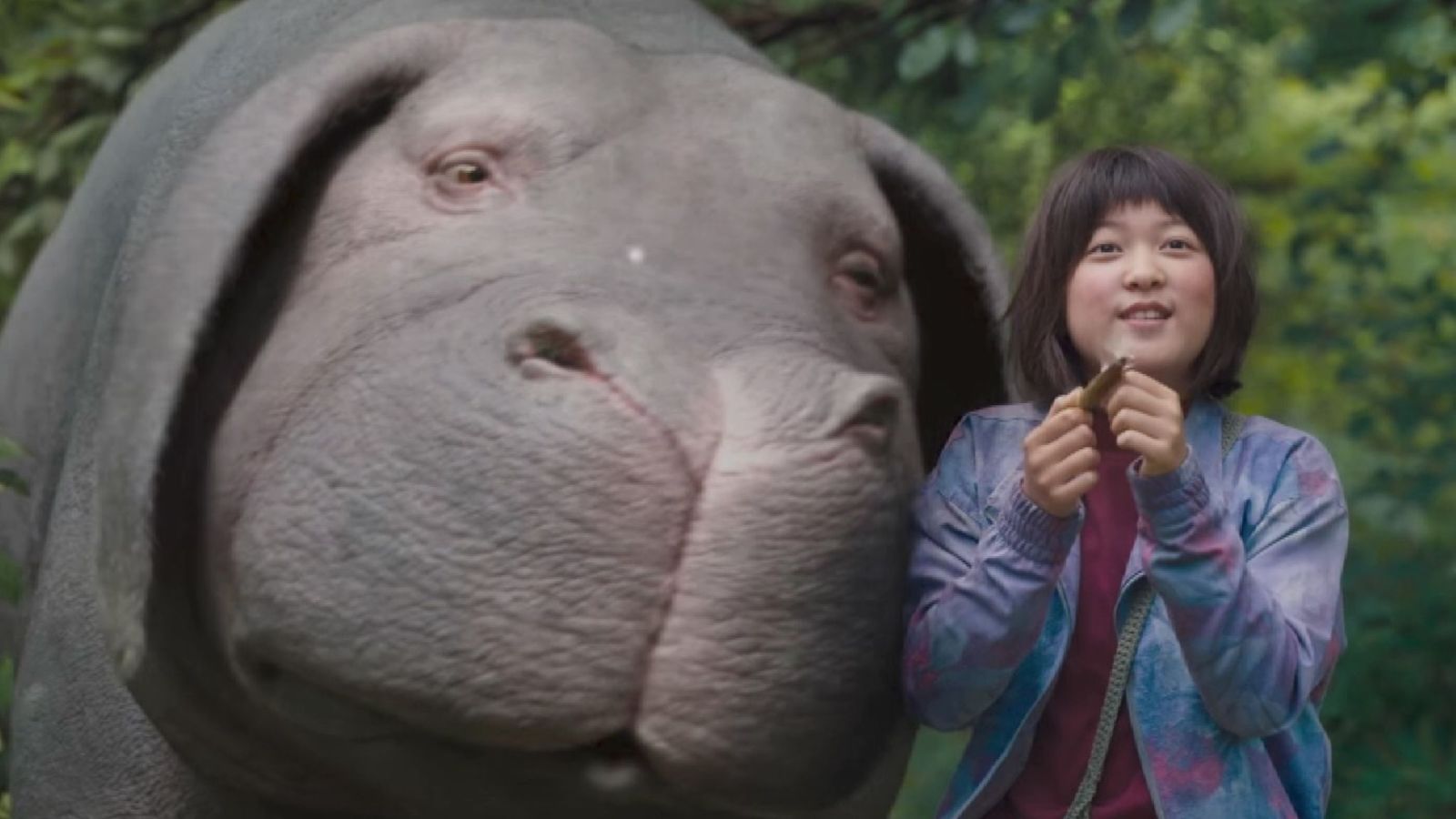
At its most basic level, “Okja” is a “child-and-their-lovable-pet” film. In the mountains of South Korea, Orphan Mija (Seo-Hyun Ahn) lives an isolated, carefree life with her guardian Hee Bong (Hee-Bong Byun) and her adorable pet Okja-- a giant “Super Pig” that resembles a pig crossed with a Hippopotamus. Mija and Okja run around together, eat persimmons, go swimming in waterholes and take naps together. Cute.

When a movie involves animals, it doesn’t take much for the audience to be engaged. Seriously, just throw a dog or cat on the screen for a second and I’ll feel all warm and fuzzy inside. Okja is a gentle, benevolent creature, so of course we love her immediately. However, “Okja” has greater ambitions beyond being a simple tale of a girl and her creature, which is good but it also prevents this core relationship from being as poignant as it should be.

Directed and co scripted by Bong Joon Ho, (“Snowpiercer, “ “The Host”) “Okja” is a scathing commentary on capitalism’s icky underbelly. It’s about exploitation and selling out and how crucial a role marketing/branding play in distorting and repackaging the ugly truth behind certain capitalistic enterprises. Okja was created in a lab (along with thousands of other Super Pigs) by multinational corporation Mirando as a new kind of livestock to be used for meat. As a marketing ploy, twenty-six Super Pigs were sent to twenty-six different farmers from around the globe (one of those farmers being Hee Bong) to be raised, to create the illusion that these creatures were found in nature and farmed in a free-range environment.


 “Okja” also tackles the controversial abusive practices used in factory farming and our collective complicity in it. For audiences, this may be the film’s hardest issue to confront. Most of us don't want animals to be abused, even if they’re being used for food but due to socioeconomic factors we often have to keep supporting these corporations that employ abusive slaughter practices. The film does a good job of being critical while also acknowledging the difficulty in stopping it altogether. As long as there’s a demand for cheap meat, these hasty, abusive practices will continue.

Considering all these weighty issues, the film could have been excruciatingly didactic in the wrong directors hands but Joon Ho handles the material with sincerity and evenhandedness, organizing the material in a fast paced, energetic adventure structure. When the company comes to collect Okja, plucky Mija venturing into to Seoul and eventually traveling to New York to get her beloved pet back.

Joon Ho takes the material seriously, letting the social commentary sting and make you uncomfortable at times, while also allowing for nuttiness and playful mocking. The script is injected with plenty of offbeat humor (the gags involving a group of animal rights activists are among the best) and Joon Ho populates the film with giddily eccentric supporting characters. Tilda Swinton is a delight as peppy but wildly insecure Lucy Mirando, the current CEO of Mirando and the creator of the Super Pig project. Meanwhile, Jake Gyllenhaal gives a bizarre, out of left field performance as Johnny Wilcox, a former animal reality TV show host who’s now shilling for Mirando. Joon Ho avoids turning these characters into evil, one-dimensional, money obsessed caricatures. Both are seemingly good people with good intentions that are ultimately compromised by desperation and the pressure to achieve success and make money. We see this very prominently in Wilcox, an animal lover who, in tough times, sells his integrity in order to survive.


Unfortunately, the core relationship between Mija and Okja sort of gets lost in all this other stuff. Due to the film’s kidnap-and-rescue structure, we get few intimate moments between the two (outside of the beginning section in rural South Korea). They spend a majority of the film separated. Ultimately, the movie becomes more about the people and the activity surrounding Mija and Okja rather then Okja and Mija; the corporation that wants Okja (and later Mija, in another marketing ploy) or the animal rights group that wants to expose Mirando’s sinister practices to the world.

This is all well and good but as a result, the bond between Mija and Okja feels underdeveloped and neglected. In fact, it becomes the least memorable part of the film and both Mija and Okja remain fairly one-dimensional. Okja is cute and lovable in a surface level way-- she doesn’t have much personality, partly because we don’t see much of her after she gets captured.  It would have been better for the film to spend more time with just Okja and Mija instead of quickly separating them. There’s plenty in “Okja” to make it worth a watch but this is still a disappointing hiccup.


B- 

Wednesday, June 14, 2017

47 Meters Down Review (2017)


Listen, if you’re stuck in a shark cage at the bottom of the ocean and your oxygen is slowly running out and large, menacing sharks are lurking in the area looking for a snack but you’re also able to have a schmaltzy heart to heart (we’re talking about a full on conversation here) with your sister, then your predicament isn’t nearly as dire as it should be.

Yet, that’s the scenario Lisa (Mandy Moore) and her sister Kate (Claire Holt) find themselves in in Johannes Roberts “47 Meters Down.” The submarine heart to heart is a glaringly awful mid movie moment—an unnecessary attempt to strengthen the sisters’ bond that brings the action to an abrupt halt, spoiling any sense of tension that had been building up before hand. “47 Meters” down is a silly, occasionally exciting survival thriller that gets bogged down by its “human” drama.

The first ten minutes of the picture, pre shark tank, are painful. Lisa and Kate are vacationing in Mexico because Lisa’s boyfriend Stewart (unseen) has recently left her, saying she’s too “boring” for him. Lisa hopes to prove him wrong on this trip. What a lousy, slightly reductive set up; of all the ways you could get a pair of vacationers stranded in a shark cage, “47 Meters Down” picks the one that involves trying to impress a jerk ex boyfriend. It wouldn’t have been so bad if the “getting-over-an-ex” stuff was introduced and quickly dropped but everything Claire and Lisa do in the beginning is prefaced with “this will make Stewart jealous!” including going out on a dilapidated boat and climbing inside a rusty shark cage. That’ll show him!


Roberts and co screenwriter Ernest Riera stress this trite exposition more than they need to, culminating in that momentum stopping underwater one on one, where the sisters talk about Stewart some more and Lisa admits that she’s always been jealous of Claire’s more adventurous, impulsive life and blah blah blah. They’re already trying to survive being forty-seven meters under water, you don’t need them to stop and have a cheesy conversation to make you sympathize with them more. These silly human problems are supposed to be minor in comparison to the intense life or death situation there in.

 As a pure survival thriller, “47 Meters Down” yields a handful of tensely staged, claustrophobic underwater scenes. And to his credit, Roberts uses the sharks sparingly and effectively—relying more on suspense and impending doom rather than gore. However, even the tensest underwater scenes are undercut by too much talking. There’s far too much screaming and characters restating the obvious; it’s the same problem “Gravity” faced but ten times worse. The script is full of terribly cheesy lines of dialogue, delivered in a laughably stilted manner. “I’m so scared!” Lisa yells at one point. Oh, really?


At another point, after venturing outside the cage, Lisa makes her way to the edge of an underwater cliff, with nothing but spine tingling darkness below her. Okay, that’s pretty scary. You know how to make it not very scary? Have Lisa exclaim: “I can’t see what’s below me!” a few seconds later. All this chatting spoils the mood; it would have been better to let the quiet, ominous hum of the ocean dominate the soundtrack, along with muffled screams and the sounds of shark jaws chomping.

47 Meters” eventually breaks down beyond repair when it relies on an act of cinematic deception late in the third act (think “Last Temptation of Christ”) that, as a climax, feels cheap and unearned—an effort to make the film appear more intelligent than it really is.  Even worse, the deception is followed by an underwhelming and pretentiously dragged out resolution sequence.


The film ends with a whimper and we don’t even find out if Stewart was jealous of Lisa and Kate’s vacation. What kind of resolution is that!?

C-

Wednesday, June 7, 2017

The Mummy Review (2017)


Do you like Tom Cruise? Are you a fan of watching the fifty four year old actor play lovably arrogant and charming? Do you love watching him run weird and do his own action stunts? Well, you’ll get all of that in Alex Kurtzman’s “The Mummy,” with an added dose of Cruise looking confused and zoning-out.

Cruise plays Nick Morton, a military operative who also steals treasure and prized artifacts from around the world to sell on the black market. While in Iraq he stumbles upon an ancient tomb belonging to disgraced Egyptian princess Ahmanent (Sofia Boutella). Ahmanent is furious, ready to wreak havoc on the world and plans on using Nick‘s body to bring Set, the Egyptian god of war, to life. Can Nick and ancient artifact protector Jenny Halsey (Annabelle Wallis) stop the vengeful princess? Not if Cruise keeps zoning out and looking confused.

Seriously, about fifty percent of Cruise’s performance is acting bewildered. Ahmanent penetrates Nick’s psyche, manipulating his behavior and freaking him out. Not a bad tactic, by the way. However, after about the fiftieth or sixtieth (only a slight exaggeration) close up of Cruise squinting his eyes in a daze, like he just took a long hit off a joint (as Ahamanent calls to him in a soft, seductive tone) you begin to silently groan from fatigue. We get it he’s under a curse. Perhaps if Cruise had more of a character to play, that we could be come emotionally invested in, I wouldn’t be so hung up on this. Sadly that’s not the case—Nick is the Cruise persona slapped onto a limp piece of cardboard and dipped in a vat of befuddlement.


In fact the film overall often resembles a limp piece of cardboard. It fluctuates between wildly over-the-top monster movie cheese and an excruciatingly dull, muddled action movie. The action itself is mostly underwhelming (a CGI sandstorm enveloping London, a plane crash scene that feels like a reject from a “Mission: Impossible” picture) while the screenplay by David Koepp, Christopher McQuarrie and Dylan Kussman drowns from too much exposition.

From the first frame, when we’re given Ahament’s backstory via bland narration, to the end, when the movie’s themes and flaccid character arcs (Nick learns to be good and selfless instead of conceited!) are bluntly sounded out via bland voice over, every square inch of this movie is explained and explained again. The supporting characters are empty vessels to convey said exposition. Jenny should be a strong co lead but instead she’s reduced to a one note Ancient Egyptian encyclopedia and accessory to Cruise.


On top of that, the film is overstuffed and needlessly convoluted: Ahament is an Egyptian Princess who was buried in Mesopotamia, and the special dagger she needs to kill Nick and in turn summon Set was taken by Crusaders and buried in another ancient tomb under London. Just keep it in Egypt, okay? Making matters worse, the film has to take on the burden of setting up a brand new cinematic universe, which will involve all the classic Universal Studios monsters subtitled: Dark Universe. Yes, you read that right. This means the action comes to a halt midway through where we’re introduced to Dr. Henry Jekyll (Russell Crowe, having a ball) who runs a shadowy organization that specializes in investigating monsters. Needlessly convoluted, a brand new cinematic universe being teased (in the vein of Marvel or DC) and aggressive spoon-feeding--Is that the cinematic equivalent of hell?

Thankfully, the picture never takes itself seriously in the least. It eschews any kind of terror or tension in favor of sheer loopiness. We’re talking about Tom Cruise making out with gross mummies, fighting Crusader mummies under water, Jake Johnson as a snarky zombie communicating with Cruise in his mind and Russell Crowe delivering eloquent but goofy as hell monologues about the nature of evil and unearthing the past. Simply put, it goes ham and this lunacy can be entertaining at times but it never entirely distracts you from the picture’s glaring flaws. Ultimately, silliness and Tom Cruise can’t save this mess of a movie.

D+ 

Thursday, June 1, 2017

Wonder Woman Review (2017)


Lets get the hyperbole out of the way, shall we? Patty Jenkins’ “Wonder Woman” (the fourth film in the D.C. Extended Universe) is the best DC superhero film since “The Dark Knight.”

Now let me qualify that statement a bit: being the best DC superhero film since “Dark Knight” isn’t exactly a high mark to clear. “Suicide Squad” and “Batman v Superman” are miserable, overstuffed slogs and “Man of Steel” is good until that trainwreck of a last third. However, DC’s recent slump doesn’t diminish the high quality displayed in Jenkins’ picture. “Wonder Woman” isn’t merely passable or mediocre, it’s drastically better than those other lackluster flicks.

Jenkins emphasizes character over spectacle while the narrative is coherent and focused. It doesn’t tease upcoming DCEU films and the script by Allan Heinberg doesn’t clog the movie with unnecessary side plots or excess McGuffins to give the illusion of depth. Additionally, “Wonder Woman” is a lot of fun--charming and silly in equal measure. It combines the goofy, mythical otherworldliness of “Thor” with the period combat/espionage film dynamics of the first “Captain America” and lightly touches on the horrors of war and the struggles women face in society.

Through a flimsy flashback-framing device (that opens and closes the film with terribly ham-fisted voice over) we’re transported to the lush, dislocated island paradise known as Themysciria where a race of Amazons live in peace. Wonder Woman, aka Diana (Gal Gadot) is the most restless and headstrong of them, desperate to become a warrior and protect others from danger. She gets her chance when U.S. solider Steve (Chris Pine) crashes his airplane near the island. Steve is doing spy work for the British and warns the isolated Amazons about World War 1 and its threat to humanity. Diana decides to accompany Steve on his mission (going to the chaotic Western Front) hoping to singlehandedly stop the war and bring peace.


However, things aren’t so simple and in this regard “Wonder Woman” is a poignant coming of age film. Diana is fierce and self-assured, boldly marching into any harry situation. And unlike the pessimistic Batman or the latest mopey incarnation of Superman, she’s brimming with optimism. Though she’s also incredibly naïve and unprepared for the fact that humans, especially men, are a violent species that crave war and conflict. Her initial plan to stop the Great War is noble but somewhat simplistic, not taking into account the complexities and messiness of war. She’s never seen a village full of women and children cruelly gassed. This harsh reality has a tremendous effect on Diana, ultimately leaving her mature and slightly jaded.

This is admittedly gloomy material but Jenkins’ never lets said gloominess totally dominate the picture. “Wonder Woman” touches on the horrors of war and the cruelty of humanity while giddily embracing its pulpy comic book origins at the same time. Diana may not be able to fully comprehend the messy and gruesome nature of human conflict but she is a super being from a mythical realm--meaning she can do things the average solider can’t. At one point Diana heroically charges across No Mans Land to attack a German trench and free a French village, eventually inspiring fellow soldiers stuck in the trenches. Not a bad ally to have. Instead of spending all her time sulking about how awful humanity is Diana is proactive; killing plenty of Germans with her patented glowing lasso and shield, trying her hardest to remain optimistic and slice through the dense politics and convolutions of human conflict.  

On top of that, “Wonder Woman” playfully mocks rigid societal codes and structures, like The Patriarchy. The sequence in which Diana and Steve are in London to prepare for their mission is rife with great fish-out-of-water humor. Diana being puzzled by and then criticizing silly, misogynistic societal norms is a joy to watch. For example, her priceless reaction to the fact that women aren't allowed to be apart of high-level strategic meetings. Related to this spirited ribbing is the superb chemistry between Gadot and Pine-- their repartee and comedic timing are impeccable.


Pine, with his cocky and dopey performance, may be at his very best but Gadot is the star here. While her performance is occasionally shaky, (this is her first leading role) overall the relative newcomer holds her own, injecting Diana with ferocity, compassion and effortless wit. Jenkins keeps the film’s focus squarely on Diana and her evolution from bright-eyed Princess to grounded warrior.

The picture can be very clunky and heavy-handed at times, (ala the superfluous flashback-framing device) spoon-feeding fairly obvious plot points, themes and character arcs. Making matters worse, the last act is a mess. It’s the only time Jenkins really loses control of the project and things become incoherent. The final hero-villain showdown is an exhausting muddle of ugly CGI destruction (the CGI throughout looks third rate) and the villain himself is overly generic and one dimensional. It's the same old story:  good third acts and compelling villains are difficult to pull off in superhero movies.  Spectacle and cliche briefly snuffs out character and narrative clarity.

Nevertheless, “Wonder Woman” is an empowering, self contained, character driven, all around entertaining superhero origin film that more than adequately sets up the Amazonian Princess for future films.


B