Showing posts with label Donnie Yen. Show all posts

Thursday, January 19, 2017

xXx: The Return of Xander Cage Review (2017)


“xXx: The Return of Xander Cage” (a sequel to 2002’s “xXx”) is a movie that simply doesn’t care. It’s a big, loud, silly action cartoon wherein there’s no consistent internal logic of any kind; the rules of physics or gravity don’t apply either. It’s a film where one can survive the blast caused by a crashing, malfunctioning satellite. In this world, literally thousands of rounds of bullets are fired yet the only people who seem to die are unnamed foot soldiers. In this world, you can have a massive gun battle in a warehouse, in the middle of Detroit and in broad daylight. The only representations of law enforcement/authority are corrupt government agencies. There are literally no rules in this film.

 “The Return of Xander Cage” takes every action movie cliché/trope you can think of (gunfights, both at regular speed and slo mo, choreographed martial art fights, car and motorcycle chases, Parkour, a cornucopia of sexy ladies who the protagonist can flirt and try to have sex with, and of course a half baked commentary on the dangers of the NSA and Government surveillance) and mixes them together into a thick, greasy action movie stew. There’s little coherence, consistency, or even continuity from scene to scene.

The picture is a series of ridiculous action set pieces and characters’ awkward attempts at quips/ breezy banter, loosely held together by a threadbare plot involving a doomsday device that can take down satellites. Extreme sports athlete Xander Cage (Vin Diesel), a tatted up rebel who plays by his own rules, is recruited by NSA agent Jane Marke (a delightfully deadpan Toni Collette) to recover the device from a supposed terrorist group.


But plot doesn’t really matter here; the action set pieces call the shots. Whenever the story needs to advance it just does. Whenever Xander and his self-assembled crew of one-dimensional mercenaries need to find what they’re looking for (the location of the people who have the device) they just…do, so that the movie can get on to the next action sequence.

When it comes to action, the film is in constant competition with itself. Every action beat seems to have a mind of its own and has the drive to top the previous beat in terms of absurdity, with no regard for the overall film:
“Yeah…jumping off a cable tower and skiing through the jungle is pretty hardcore but you know what’s more hardcore? Surfing with a motorcycle!”
“What about playing Hot Potato with grenades?”
“What about using a dirt bike as a melee weapon?”
“Pffff! Try using a boat as a melee weapon…on land!”
“That’s nothing! How about a fist fight/foot chase right down the middle of a busy street?”

My personal favorite, and one that’s not as outwardly absurd as any of those scenes listed above: At a random beach rave in the Philippines, one of the bad guys (played by international Martial arts star Tony Jaa, delightfully twitchy and eccentric with bleached hair) slowly makes his way through the crowd to shank Xander. So one of Xander’s crewmembers, a DJ named Nicks (Kris Wu) proceeds to play sick beats, causing the crowd to get rowdier and distract the bad guy, allowing Xander to escape. In this crazy action dream world, scrawny DJ’s can be heroes too. A few moments later he chokes a random baddie with his headphone cord. Check and mate, surfing motorcycle!


Unfortunately, from a technical standpoint the action in “Xander Cage” is just as incoherent as the film itself. Outside of a hand-to-hand fight on a plane involving fellow international Martial arts star Donnie Yen the action is shot with confusing shaky cam and choppily edited. It’s chaotic and disorienting; at the end I felt exhausted. It also doesn’t help that the soundtrack mostly consists of blaring, obnoxious techno/Dubstep music that gave me a minor headache. It’s as if the filmmakers are trying to make us experience sensory overload.

In the end, “xXx: The Return of Xander Cage” is sheer madness—a baffling, chaotic collage of action, sexy ladies, and paper-thin characters. But it revels in that madness, which makes it watchable. You can tell everybody involved is having a blast: the director DJ Caruso, the cast. Vin Diesel isn’t a good actor, especially in action movies, but its nice to see him loosen up and have fun for a change. He’s usually so brooding and serious.

I wouldn’t say “Xander Cage” is a good movie either but its madness and scatterbrained nature makes it utterly fascinating.

 Grade: B? C+? D+? F? I really don’t know.  This movie transcends the movie review grading system.
  

Tuesday, December 13, 2016

Rogue One: A Star Wars Story Review (2016)


Perhaps the most surprising and welcome thing about Gareth Edwards’ “Rogue One: A Star Wars Story” is how dark it is, not just in the context of the “Star Wars” saga but also in context of big budget franchise films. Edwards’ film is a prequel—setting up the events of “A New Hope.” We follow the rebellion as they embark on a risky mission to steal the Death Star plans.

“Rogue One” is a bleak and gritty old-school war film set in the “Star Wars” universe. There’s plenty of hope in the hearts and minds of the characters, a key ingredient in rebellions and revolutions, but there’s a lot of pain and suffering as well. As all of the successful (and unsuccessful) revolutions in history have taught us, much has to be sacrificed for serious change. Edwards doesn’t shy away from immersing us in the tragedy and melancholy of warfare.

The stakes are high in “Rogue One”—lives are lost and a lot more lives are at risk. The conclusion is almost shocking in how downbeat it is. Outside of “The Empire Strikes Back,” “Rogue One” is the dourest “Star Wars” film to date. This bleakness raises the stakes in “Rogue One” and also adds considerable weight to “A New Hope”—knowing now about all the destruction and suffering that went on to get these plans into the hands of the rebel high command adds a compelling and gritty layer of depth to the original trilogy.


“Rogue One” gets away with this bleaker tone because it’s a standalone feature. It’s a complete, self-contained vision that isn’t beholden to future films the way a “Marvel Cinematic Universe” (MCU) picture is. The producers behind the MCU are always thinking three or four movies ahead, eliminating the element of surprise and preventing anything substantial story/character wise from going on. The death of a major character can’t happen because that character has already been confirmed for a future installment. This frustrating inevitability has plagued nearly every Marvel film.

“Rogue One” is a prequel to “New Hope” but it has a new set of characters. Established “Star Wars” characters show up in supporting roles and others are mentioned in passing but the movie’s focus is squarely on fresh faces, providing a sense of uncertainty and tension to the proceedings. The broad strokes may be known (we know that the Death Star plans will be stolen) but the fate of these new characters is not certain; anything can happen to them. As a result of all this, “Rogue One” is able to take risks that a film like “Captain America: Civil War” can’t. It can be bleak. Major characters can die, which makes for a more substantial and satisfying flick.


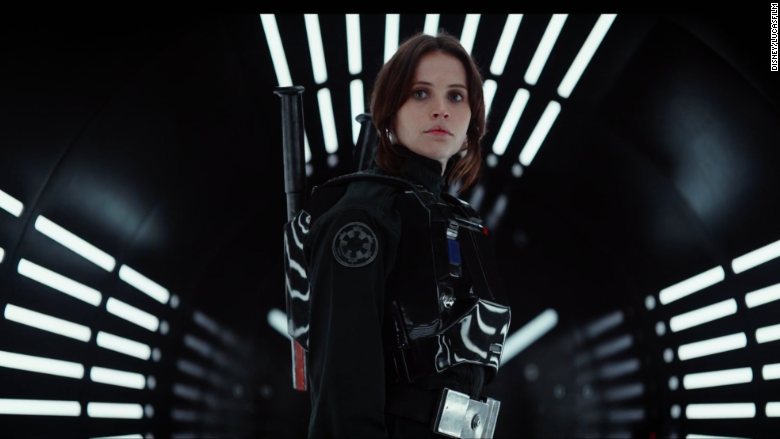
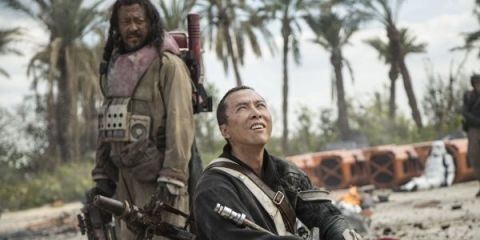
Edwards and screenwriters Chris Weitz and Tony Gilroy assemble a lively and diverse cast of characters— coming from various backgrounds but all equally angry and scarred by the empire.  There’s the intergalactic outsider/criminal Jyn Erso (Felicity Jones, scrappy and assured), who emerges as a leader, and the rebellion soldier Cassian Andor (Diego Luna). Additionally, there’s K-2S0 (Alan Tudyk), a wisecracking imperial droid that’s been rewired. He’s essentially a drier, more militarized version of C3PO and that’s OK with me. Forest Whitaker shows up as a scruffy, grizzled leader of an independent rebel group and an old friend of Jyn Erso. Whitaker’s performance verges on overwrought at times but he has gravitas and his thousand-yard stare is perfectly suited for this battleworn figure. Martial artist and Hong Kong action star Donnie Yen plays a witty blind intergalactic monk and fellow international star Wen Jiang plays his right hand man.


For all the bleakness, the film’s hopeful message of unity through diversity is resounding and timely. We must come together in spite of our differences to defeat tyranny.

From a visual standpoint “Rogue One” is staggering. Edwards has a knack for staging breathless, intense action sequences that take advantage of the big screen format. “Rogue One” is a big film and Edwards is a master of showing perspective; he and cinematographer Greig Fraser compose some truly breathtaking scenes/shots: The vastness of The Death Star as its shadow consumes a tiny Star Destroyer, a shot of the ATAT  (a mighty four legged tank) shown from the perspective of fleeing soldiers during a beach battle.


I particularly love the way Edwards stages the scenes in which the Death Star shows off its destructive powers—on the planet that’s been targeted, a massive, slow moving mushroom cloud of terror and destruction devouring the ground bit by bit, seen from the point of view of the poor inhabitants who will be affected. This attention to size and perspective emphasizes the danger and dread pulsing throughout the film. The Empire is menacing and lethal.

In terms of flaws, the beginning of “Rogue One” is somewhat chaotic and jumbled as it jumps around from planet to planet, introducing its large ensemble and various plot strands. And the film suffers from some cheesy dialogue, something that’s never been strong in any “Star Wars” films, unfortunately. It’s not as fun as “The Force Awakens” and the characters aren’t as easily relatable as the central trio in that film but “Rogue One” is also a much different, darker “Star Wars” movie, a welcome addition to the cannon.  

B+