Showing posts with label Jared Harris. Show all posts

Tuesday, November 22, 2016

Allied Review (2016)


I admire that Robert Zemeckis’ “Allied” doesn’t go the way you expect it to go. Instead of a fun and breezy period spy romance (starring sexy human beings Brad Pitt and Marion Cotillard) it’s more of a somber, straight-faced drama about a marriage in crisis. Nothing wrong with that. However, I still found myself disappointed by the direction the film takes because it ultimately diminishes the impact of its brightest star—Cotillard.

“Allied” starts off as that fun and breezy period spy romance. Ruggedly handsome American spy Max Vatan (Pitt) parachutes into the desert outside Casablanca circa nineteen forty-two, wherein he meets up with French resistance fighter Marianne Beausejour (Cotillard). They pose as a wealthy married couple that gets to mingle with the Vichy French and Nazi high command at swanky parties and assassinate a German ambassador, while wearing fancy clothing.

Stylish but deadly.

This is the first onscreen collaboration between Pitt and Cotillard and they’re damn good together. They have effortless chemistry—he’s stern and quietly charming, while she’s bubbly and can command a room like no other. They’re so good together that you ignore the fact that they first make love in a sparkly CGI sandstorm or sometimes look like they’re in the middle of a Vogue fashion shoot; when I assassinate a Nazi Ambassador with my coworker/lover I hope I look half as glamorous as they do.

Overall, “Allied” is stylish and well made. Don Burgess’ cinematography is glossy like a magazine, the costumes are shiny and Gary Freeman’s production design is neat and clean even out in the middle of dusty Morocco. As silly as the film can be (at one point Marianne literally gives birth in the middle of The Blitz in London) Zemeckis shows restraint during the pivotal dramatic moments. These scenes have a calm and naturalistic feel to them, while the music is kept to the absolute minimum or not used at all, allowing for more tension and authenticity rather than melodrama. Even the sandstorm lovemaking scene isn’t as over the top as it could be.


After their mission is complete, Max and Marianne get married and have a baby—abandoning the dangerous but exciting life of espionage for mundane domesticity. Although they still manage to look more glamorous than you ever will. One day, Max is told by his former boss (played by Jared Harris) that Marianne may actually be a German spy. Oh Mon Dieu! If it’s true Max must be the one to assassinate her.

It all sounds very dramatic, and it is, but those expecting “Mr. And Mrs. Smith” during World War 2 will be disappointed. “Allied” morphs into a much gloomier, emotional drama about a husband trying to come to terms with the fact that his beloved may be the enemy. And this is my main problem with the film: through this transition, “Allied” becomes more about Max rather than both of them, like it was in Casablanca. He gets to look disheveled and act conflicted. He gets to launch his own mini investigation into the matter while Marianne is distanced from us—we only see of her what Max sees, meaning her onscreen time mostly consists of sitting in their house, taking care of their daughter, being a loving wife and waiting for him to come home. I realize that this is done to preserve her true identity and actions until the end but that narrative choice also diminishes her role/character in the process.


This may not have been such a big issue except that Cotillard gives such a fantastic performance and Pitt is somewhat…bland. It’s tolerable at first when he’s playing off of Cotillard in Casablanca but as the film becomes more about him the blandness becomes more noticeable. Pitt’s attempts to be understated and shy usually come off strained and unnatural; there are times where it looks like he’s trying really hard to act. On the other hand, Cotillard is magnetic-- delicately charming and down to earth, fiercely intelligent and tough. You can’t take your eyes off her. Cotillard still makes the most of her limited role later on (during her last scene, a massive lump will probably accumulate in your throat) but her presence is sadly minimized. She’s not as active a character as she was in Casablanca.  

“Allied” is never boring to watch. The Casablanca section strikes a perfect balance between silly and serious, the middle goes in an unexpected but welcomed dramatic direction (despite my problems) and the ending still packs an emotional punch. Yet, because it becomes more focused on Max rather than both him and Marianne, “Allied” never soars to greatness.


B- 

Wednesday, October 19, 2016

Certain Women Review (2016)


Not quite an anthology and not quite a “vignette” film, writer/director Kelly Reichardt’s patient, thoughtful “Certain Women” provides a glimpse into the mundane lives of three hardworking, ordinary women as they demand respect from those around them, try to make their mark on the world and seek out meaningful connections. For the most part, the picture is divided into three segments, each one focusing on a different woman, sort of like a short film.

The brilliance of “Certain Women” lies in Reichardt’s quiet and restrained approach-- an approach that puts all of the focus on character instead of plot and doesn’t talk down to the audience. The film is as understated as they come; Reichardt doesn’t spoon feed or over explain. A lot of the film’s substance is kept bellow the surface, implied through a facial gesture or a seemingly straightforward line of dialogue. While not confusing or intricate in terms of plot (in fact there’s not much in the way of plot), “Certain Women” still requires your undivided attention, as it’s a film about subtle gestures and observation.

Reichardt directs with unhurried grace and the three lead actresses (Laura Dern, Michelle Williams and Lily Gladstone) give impressively understated performances, performances that rely almost exclusively on subtle facial gestures and body language rather than lengthy monologues or dialogue heavy interactions.


The first segment focuses on Laura Wells (Dern), a small town lawyer. One of Laura’s clients, Fuller (Jared Harris, pathetic and heartbreaking. This might be his most tender, soulful performance) has been trying to sue his former employer for workers comp but is unable, making him mentally unstable and increasingly needy. This chapter is characterized by quiet frustration and guilt. You sense that Laura is dissatisfied with the way her career has been going thus far and feels like she isn’t being taken seriously. Fuller insists on meeting with another lawyer (a male lawyer) to tell him what she has been telling him for months.

There are times when Laura herself looks like she’s going to snap, at having to deal with such a needy, frustrating person. During a car ride, Laura has a look of utter irritation and anguish as she silently listens to Fuller complain about his life. Though, she also feels a sense of pity and regret—regret over the fact that she can’t do more to help her client. Again, most of this is implied rather than out rightly stated in the dialogue or action.

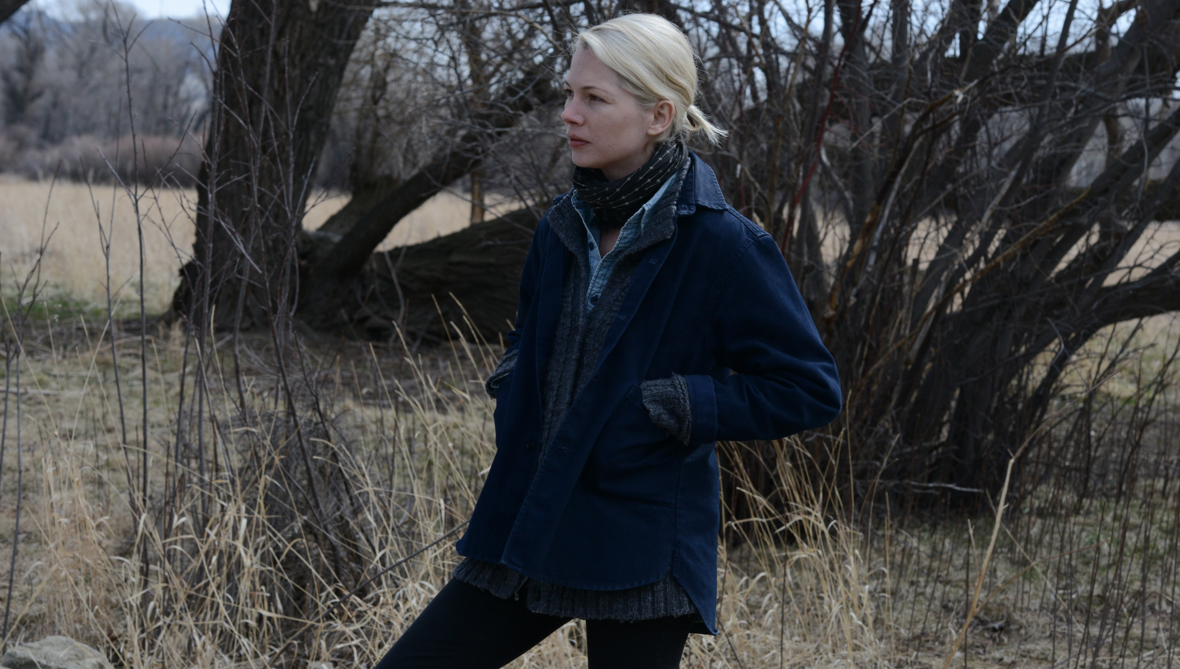
The second segment revolves around Gina Lewis (Williams), who’s currently in the process of building a house on a patch of land she purchased, along with her husband Ryan (James Le Gros) and angsty teen daughter Guthrie (Sara Rodier). This is probably the least compelling section in the entire film. Although Gina’s determination to get the house built and the underlying tension between her and her family is intriguing, the segment ultimately feels incomplete. The other two stories, as understated as they are, still have a sense of dramatic momentum and build to a satisfying conclusion. However, this story feels somewhat flat and anticlimactic.


And then there’s the final story, which is not only the best but also one that would make a great solo short film. It’s a tender, moving meditation on alienation and the distances we travel (literally and figuratively) to find and maintain meaningful connections with other people. An awkward, lonely horse ranch hand named Jamie (Gladstone) goes to a night school class taught by young overworked lawyer Beth Travis (Kristin Stewart). The two eat dinner afterwards at a nearby diner and Jamie develops an attachment towards Beth (whether Jamie’s attachment is plutonic or romantic is left up to you to decide) and keeps coming back to the class. The post class meals become the highlight of her day— giving her something to look forward to other than work.


As someone who’s also shy and often seeks isolation, this story resonated the most. Though I enjoy my alone time, I also greatly look forward to the meetings and interactions with my few companions. Even introverts need connections with other humans once in a while. Hell, we even treasure some of them. Throughout the day, I think Jamie is happy and content to take care of horses in isolation, but when she gets to see Beth, she’s ecstatic. During one night, the look of utter joy on her face as she silently gives Beth a ride on her horse to the diner is beautiful. Of all three stories, this one hit home and held me the entire way through, building to a bittersweet conclusion.

 “Certain Women” won’t be everyone’s cup of tea. Some will find it to be too slow or take issue with the film’s lack of plot. It’s not an easy film to watch, as it requires a lot of work on the part of the audience to find all the details and nuances. But for those who are patient enough, Reichardt’s picture proves to be a fascinating, varied portrait of women in smalltown America.

B+