Showing posts with label Clint Eastwood. Show all posts

Wednesday, June 28, 2017

The Beguiled Review (2017)


What happens when a group of horny, restless people are cut off from the world and stuck in a confined space with little to do? As Sofia Coppola’s delicate and explosive “The Beguiled” shows us, they lose their minds.

Based on the book by Thomas Cullian, (and a remake of Don Siegel’s 1971 film starring Clint Eastwood) “The Beguiled” is a tight, wildly entertaining psychological thriller about repressed desires and primal urges exploding out into the open in tense and often violent ways. It’s mild mannered and chaste, yet scenes drip with sexual tension and crackle with devious energy.  The film is playful, with its sexual innuendos and Freudian undertones, and appropriately restrained—operating with subtlety and nuance. Writer/director Coppola brings precision and intelligence to what could easily be an overly trashy and toothless erotic thriller.

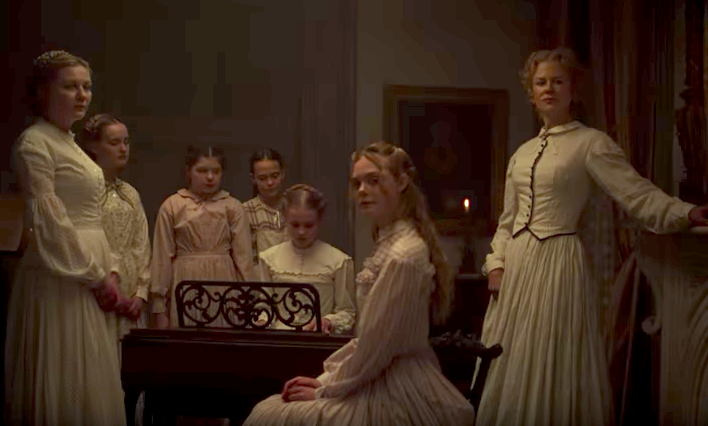
The film is set in Virginia during the last years of the Civil War. At a girl’s school, two women and five girls live an isolated, austere existence. The resilient schoolmarm, Miss Martha (Nichol Kidman) keeps the girls busy with schoolwork, religion and farm labor. Her second in command is Edwina (Kirsten Dunst) and the girls consist of: Amy, (Oona Lawrence) Alicia, (Elle Fanning) Jane, (Angourie Rice) Marie, (Addison Riecke) and Emily (Emma Howard).  “The Beguiled” assembles a superb cast that all give layered, understated performances. Kidman, in particular, shows that she’s one of the best actors working today.


The situation changes when Amy brings a wounded Union soldier, Corporal McBurney (Colin Farrell) through the school’s front gates, disrupting the routine. At first, McBurney is greeted with fear and mistrust but as he spends more time at the school, the women begin to view him as desirable. He has a calm, down to earth demeanor-- sensitive and quietly smooth. First, Edwina and Alicia develop feelings for him and take turns flirting with him in secret. Soon, everyone is enamored by McBurney, which leads to a wonderfully ridiculous dinnertime scene in which they all vie for his attention and affections, without directly coming onto him. McBurney happily obliges. He knows full well the kind of effect he has in this all female setting and slyly plays the women against one another.

However, said playfulness gets out of hand and gradually morphs into to conflict, taking the film down a tensely feverish path. The characters in “The Beguiled” let their silly romantic feelings and urges turn to jealousy, bitterness and even vengeance--bringing out the worst in one another and losing a part of their humanity in the process. When his charming ways eventually backfire on him, McBurney reveals an antagonistic side of his personality that takes us by surprise. Even the stern, deeply religious Miss Martha shows an ugly, spiteful side to her that we didn’t know was there. Coppola’s screenplay avoids clear-cut good guys and bad guys; her characters are at once sympathetic and recklessly petty, their emotions sometimes leading them to exhibit borderline psychopathic behavior.


Additional conflicts and suppressed desires (Edith being unhappy at the school and wanting to leave) make their presence known, causing further internal disarray.  Miss Martha tries to shield her girls from the senseless realities of the war but ugly, senseless conflicts burrow their way in anyway. Coppola directs the picture with such a sure hand, moving the action along at a slow but thrilling pace, like she’s gently stretching a rubber band out, giddily waiting for the right time to let it snap. Coppola’s film is a worthy companion piece to the superb Siegel version and a wickedly thrilling picture on its own.

B+

Tuesday, September 6, 2016

Sully Review (2016)


The most surprising thing about Clint Eastwood’s “Sully” is that it may be the only film I’ve seen featuring a massive commercial plane crash that can’t be labeled a “disaster flick.” To be sure, we do see the plane crash in three different sequences but those expecting an intense, adrenaline fueled disaster spectacle will be disappointed. Instead of using dramatic music and quick cuts, the crash sequences have a calm and leisurely quality to them--mimicking the cool demeanor of the plane’s captain, Chelsey “Sully” Sullenberger (Tom Hanks).

Furthermore, the movie (based on the true story of Sullenberger landing a jet on the Hudson river after both engines blew out and miraculously saving all 155 passengers/crew members on board) is an intimate human drama that focuses more on the aftermath of the flight; Sullenberger’s fight with the National Transportation Safety Board (NTSB) over whether the water landing was the right decision, as well as his PTSD and coming to terms with being viewed as a hero.

 It’s a skillfully made film in a lot of respects but it also left me feeling slightly underwhelmed. I walked out of the theater impressed but also asking myself, “is that it?”

 “Sully” is essentially a Man vs. Technology tale, using a Courtroom Drama-style structure. The NTSB is conducting an investigation into the crash and according to their engineer reports and computer simulations Sully could have successfully flown the plane back to two airports. However, Sully isn’t buying it. He was there and he knew that he couldn’t make it back. Computer simulations don’t take into account human/real world factors like reaction time. He’s got to prove the NTSB and those computer simulations wrong. Goddamn computers!

The film runs a brisk 96 minutes and I appreciate the fact that Eastwood and screenwriter Todd Komarnicki (based on the book by Sullenberger and Jeffrey Zaslow) choose to emphasize a single, significant chapter in the pilot’s life as opposed to trying to tell a bigger, mythologizing biographical tale. There are a few flash backs (one showing Sullenberger as a young Crop duster and another as an Air Force pilot) that could have been axed but otherwise the picture remains tight and focused on Sullenberger’s current dilemma and actions.


Hanks is in top form. At this point he’s become so iconic that he doesn’t really have to do much to win you over. He has such a comforting, likable onscreen presence. Here, he manages to be both restrained and natural; his performance free of any big” over-the-top actor-y moments. The kind that scream: “I want an Oscar!” Aaron Eckhart as Sullenberger’s First Officer/friend Jeff Skiles is also quite good and together they have a strong repartee. There’s a history between them, a sense of trust and camaraderie that’s readily apparent every time they’re onscreen together. We don’t need additional background scenes or flashbacks to develop their bond.

However, as good as “Sully” is there’s a level of predictability and routineness pulsing through much of it that’s impossible to fully shake. Being unfamiliar with many of the details of the crash and being even less familiar with the aftermath, it was still easy for me to predict where it was all going; not just in regards to the overall narrative arc but scene by scene. There’s not much in the way of suspense or tension, even during the plane crash sequences. Additionally, the conclusion is inevitable and leaves little for the audience to chew on. “Sully” simply tells its story and then leaves the room.

The picture becomes so constrained by the courtroom drama/procedural angle of the story that it neglects other aspects such as Sullenberger’s intense emotional and psychological problems. It would have been interesting had Eastwood explored the idea of memory and uncertainty more. At one point, doubt arises over whether or not both engines actually blew out, which would call Sully’s memory and version of events into question. But it’s quickly dropped and the film moves on. Sullenberger is so sure of himself and his actions but our memories aren’t always reliable. Sometimes we distort events to make them fit a narrative we’re trying to craft in our heads. Had the film included more moments of self-doubt and uncertainty, more scenes of Sully grappling with his own psyche, it would have added a layer of much needed suspense to the proceedings and additional character dimension. The movie treats Sully with so much respect (while subsequently demonizing the NTSB) that it leaves little doubt in the viewers mind as to whether he’s telling the truth or not. There’s never a moment where I thought: “are things not going to turn out well for him?”


I have other minor issues, namely that the ultra talented and underrated Laura Linney (as Sullenberger’s wife) is reduced to, “concerned-spouse-on-phone.” Linney does what she can but there just isn’t much for her to do. Her character is one-dimensional.

“Sully” could have been much worse but I think it could have been much better. It’s competently made and well acted but it ultimately plays things safe. With all this considered, it’s a solid film that you can watch in the comfort of your own home a few months from now and enjoy just fine.

 B