Showing posts with label Nichol Kidman. Show all posts

Wednesday, June 28, 2017

The Beguiled Review (2017)


What happens when a group of horny, restless people are cut off from the world and stuck in a confined space with little to do? As Sofia Coppola’s delicate and explosive “The Beguiled” shows us, they lose their minds.

Based on the book by Thomas Cullian, (and a remake of Don Siegel’s 1971 film starring Clint Eastwood) “The Beguiled” is a tight, wildly entertaining psychological thriller about repressed desires and primal urges exploding out into the open in tense and often violent ways. It’s mild mannered and chaste, yet scenes drip with sexual tension and crackle with devious energy.  The film is playful, with its sexual innuendos and Freudian undertones, and appropriately restrained—operating with subtlety and nuance. Writer/director Coppola brings precision and intelligence to what could easily be an overly trashy and toothless erotic thriller.

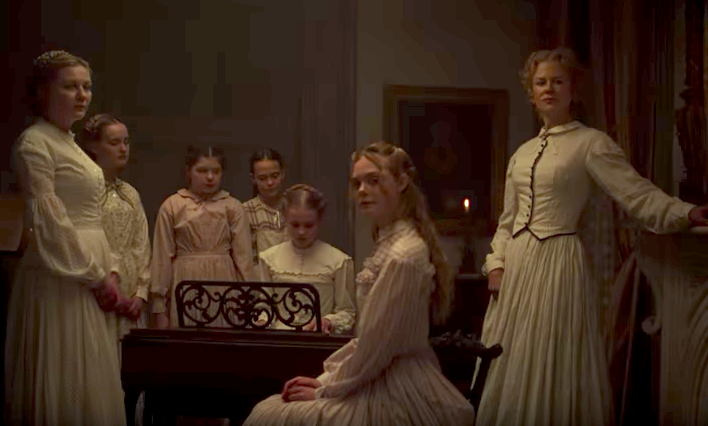
The film is set in Virginia during the last years of the Civil War. At a girl’s school, two women and five girls live an isolated, austere existence. The resilient schoolmarm, Miss Martha (Nichol Kidman) keeps the girls busy with schoolwork, religion and farm labor. Her second in command is Edwina (Kirsten Dunst) and the girls consist of: Amy, (Oona Lawrence) Alicia, (Elle Fanning) Jane, (Angourie Rice) Marie, (Addison Riecke) and Emily (Emma Howard).  “The Beguiled” assembles a superb cast that all give layered, understated performances. Kidman, in particular, shows that she’s one of the best actors working today.


The situation changes when Amy brings a wounded Union soldier, Corporal McBurney (Colin Farrell) through the school’s front gates, disrupting the routine. At first, McBurney is greeted with fear and mistrust but as he spends more time at the school, the women begin to view him as desirable. He has a calm, down to earth demeanor-- sensitive and quietly smooth. First, Edwina and Alicia develop feelings for him and take turns flirting with him in secret. Soon, everyone is enamored by McBurney, which leads to a wonderfully ridiculous dinnertime scene in which they all vie for his attention and affections, without directly coming onto him. McBurney happily obliges. He knows full well the kind of effect he has in this all female setting and slyly plays the women against one another.

However, said playfulness gets out of hand and gradually morphs into to conflict, taking the film down a tensely feverish path. The characters in “The Beguiled” let their silly romantic feelings and urges turn to jealousy, bitterness and even vengeance--bringing out the worst in one another and losing a part of their humanity in the process. When his charming ways eventually backfire on him, McBurney reveals an antagonistic side of his personality that takes us by surprise. Even the stern, deeply religious Miss Martha shows an ugly, spiteful side to her that we didn’t know was there. Coppola’s screenplay avoids clear-cut good guys and bad guys; her characters are at once sympathetic and recklessly petty, their emotions sometimes leading them to exhibit borderline psychopathic behavior.


Additional conflicts and suppressed desires (Edith being unhappy at the school and wanting to leave) make their presence known, causing further internal disarray.  Miss Martha tries to shield her girls from the senseless realities of the war but ugly, senseless conflicts burrow their way in anyway. Coppola directs the picture with such a sure hand, moving the action along at a slow but thrilling pace, like she’s gently stretching a rubber band out, giddily waiting for the right time to let it snap. Coppola’s film is a worthy companion piece to the superb Siegel version and a wickedly thrilling picture on its own.

B+

Wednesday, April 5, 2017

Queen of the Desert Review (2017)


German director Werner Herzog is usually at his best when he tackles ambitious, obsessive, larger-than-life (and a little delusional) explorers and thrill seekers who create their own destiny and try to make a name for themselves whatever physical or psychological cost. Characters that somewhat mirror Herzog’s own drive as an artist and explorer. Sometimes these characters fail miserably, like in the case of “Aguirre: The Wrath of God” or “Grizzly Man,” and sometimes they succeed like in “Fitzcarraldo.” Either way, it’s an unforgettable and hypnotic cinematic journey.

Unfortunately, in the case of his latest picture “Queen of the Desert,” about the life of explorer Gertrude Bell, the journey is mostly just dull and repetitive, which is especially disappointing. Even Herzog’s lesser films are still eccentric and enigmatic enough to hold your interest.

Born to an affluent family, Bell (Nichol Kidman) quickly escaped a life of bland domesticity in England and headed off for the Middle East. At the dawn of the twentieth century she traveled around Greater Syria, Mesopotamia, Asia Minor and Arabia, writing down her observations, working as an archeologist and made lasting friendships and political partnerships with the native people. Eventually her work was used by the British government to establish the countries of Saudi Arabia, Iraq and Iran following the Arab revolt.


 “Queen of the Desert” may be Herzog’s most glossy and romanticized film. The seventy four year old director loves the infinite sun drenched sand dunes (with people on camelback crossing over them) contrasted against the cloudless, baby blue sky. And as the title suggests, Herzog clearly has great affection and admiration for his subject—portraying Bell in such a radiant and glamorous light. She’s intelligent and fiercely independent--traversing this dangerous terrain unescorted with confidence and some stubbornness. At the same time, Bell is graceful and down to earth in her interactions with the local people. She treats them as fellow human beings (with respect and dignity) and not as imperial subjects, or worse, as “the other.”

However, “Queen of the Desert” never finds its footing. This is partly due to the picture’s immense scope and traditional biopic structure; there’s enough material here to fill a three-hour film or a miniseries. But at two hours and eight minutes the picture feels frustratingly abbreviated—mechanically moving through various chapters in Bell’s life without any of them really making an impression. Bell’s expeditions and meetings with different Arab tribes are interesting but far too brief in duration. During one expedition, there’s a great moment where Bell bonds with a Sheik over their shared love of the poet Virgil. But after this quick moment of genuine and unexpected human-to-human connection the action cuts to Bell’s next expedition. It would have been nice to see more of her interactions with this particular Sheik and his people.

The expeditions should be the meat of the film but far too often they fizzle out or get glossed over so Herzog can have more repetitive “Lawrence of Arabia”-esque montages of Bell riding her camel through the desert, or showing her writing in her journal, or pensively staring out into the horizon. Furthermore, the film’s abbreviated nature renders the Arab people that Bell comes into contact with one-dimensional. Even Bell’s trusted assistant/guide Fattuah, (Jay Abdo) who was apparently important enough in real life to warrant his own epilogue in the film’s closing minutes is treated like a thinly sketched acquaintance.


The only material that makes any kind of lasting impression is Bell’s romantic life. Herzog devotes a large chunk of the movie to Bell’s affair with British Embassy secretary Henry Cagdon (James Franco) and later she has an affair (mostly via letters) with British army officer Charles Doughty-Wylie (Damien Lewis). This is all well and good but considering “Queen of the Desert” is about an independent minded explorer it feels weird (and little insulting) that her romantic life is the only resonant aspect of the film.

 Near the end, the picture introduces a potentially interesting wrinkle: the tension between Arab independence and British colonialism. Even after helping them revolt against the Ottoman Empire, Britain still wanted control/influence over that area. After all, they’re the ones who cut up the land and determined the boundaries of those countries. However this intriguing dilemma (and Bell’s own conflicted role in it) comes too late and ends up feeling like an afterthought, another stale bullet point. In its attempt to be a sweeping period romance, a biopic and an epic adventure picture, “Queen of the Desert” is ultimately bland and unfocused.

 C-