Showing posts with label Denzel Washington. Show all posts

Friday, November 17, 2017

Roman J Israel Esq. Review (2017)


Grade: C-

Through two films, writer-director Dan Gilroy already has an attraction to eccentric, persistent loaners who love what they do. In “Nightcrawler,” that loner was Lou Bloom, (Jake Gyllenhaal) a bulgy eyed parasitic wannabe entrepreneur who becomes a stringer in L.A. and proceeds to manipulate/screw over everyone around him. In “Roman J. Israel Esq.” that loner is the titular character, a stubborn and socially awkward Civil Rights lawyer played by Denzel Washington.

Instead of going to trial and arguing cases, Israel is most comfortable performing the behind the scenes duties—the administrative tasks and the mitigation work. He believes in doing things the old fashion way; he works on note cards and rolodexes. He has an old cellphone that he barely uses. Israel eats nothing but peanut butter sandwiches; the kitchen cabinets of his shabby inner city apartment are lined with containers of Jif. In other words, he’s a quirky dude! And he may not always know how to interact with people but he’s passionate about law and wants to make a difference.

Not surprisingly, Washington is in top form. Israel is more timid and clumsy, in how he talks and moves, compared to the characters Washington usually portrays. He’s so good at playing smooth, charismatic cool guys and calm authoritative figures that it’s a bit of a shock at first to see him play this quirky, spectrum-y lawyer. But he brings all of Israel’s idiosyncrasies to life with earnestness and some restraint.
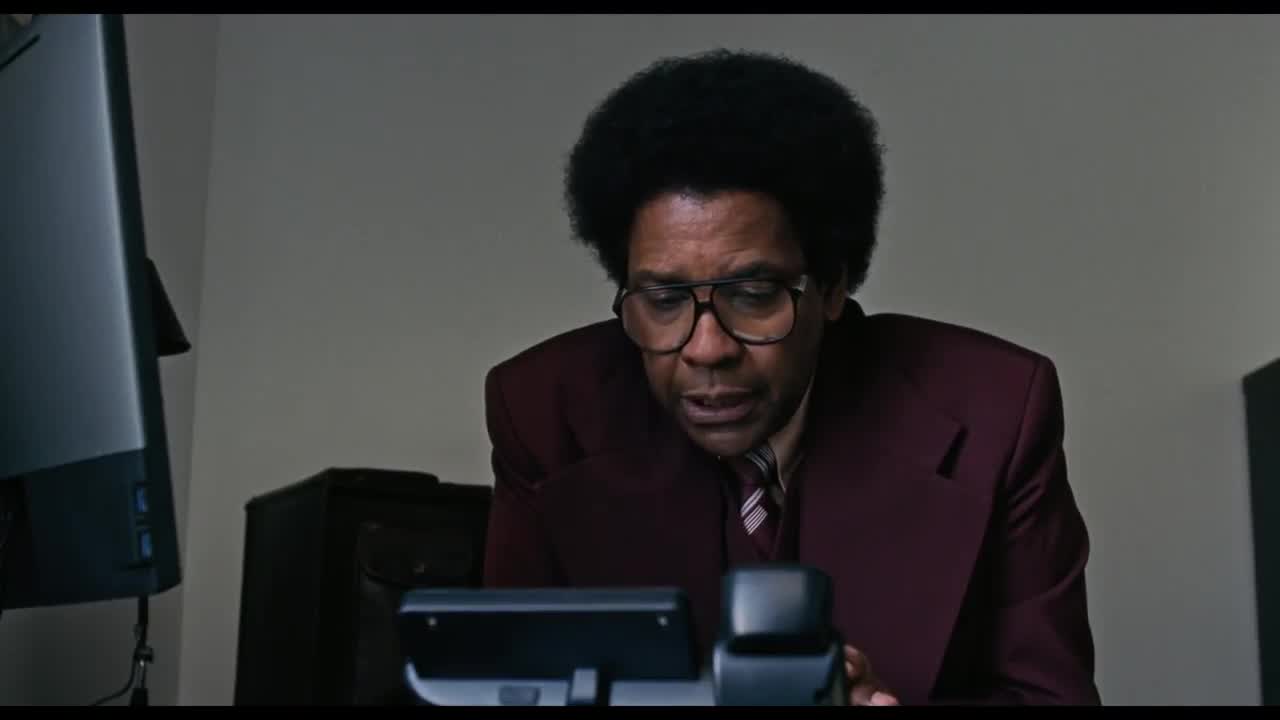


The rest of “Roman” is loaded with potential. Israel’s life is suddenly thrown into chaos when his longtime lawyer partner dies and all of their clients are given over to a cold corporate law firm, headed by cold corporate lawyer George Pierce (Collin Farrell, who may as well be holding his script in his hands during his scenes. He’s positively robotic.). The film’s commentary on the impersonal, “assembly line” nature of corporate law firms is pungent. And Roman’s ongoing mission to fix a flawed legal system that encourages people to plead guilty to crimes they didn’t commit in order to avoid harsher punishment is urgent; as is the moral dilemma Israel soon finds himself in. Does he continue to work and to try and reform the system for little in return, or does he sell out?

Unfortunately, those intriguing subjects and questions are let down by Gilroy’s bland screenplay, which relies more on telling than showing-- draining the film of vitality. In “Nightcrawler” there was a palpable sense of suspense propelling the action forward. We anxiously chomped on our nails and clenched the armrests of our theater seats waiting to see what Bloom would do next. We wanted to know how low he would go and how deranged he would become to achieve personal success. Bloom had a menacing, unpredictable aura about him that made the film endlessly fascinating.


 In “Roman” everything is telegraphed from the start. The narrative and character trajectory is neatly laid out in the opening scene and Gilroy tediously follows that blueprint beat by beat, bluntly explaining plot points and character motivations before reaching the predictably tragic conclusion. Even worse, the script is longwinded and verbose in a way that’s obnoxiously self-satisfied. Gilroy’s dialogue is riddled with clunky and pretentious metaphors that would even make Oliver Stone roll his eyes. The movie doesn’t need to be suspenseful in the way “Nightcrawler” was but it doesn’t need to be so heavy handed in its storytelling. “Roman J. Israel Esq.” has good intentions with its subject matter and Washington is magnificent but the overall execution here is underwhelming and unconvincing.


Tuesday, December 20, 2016

Fences Review (2016)


I think we can all agree that Denzel Washington has been consistently strong for a while now even when the movies themselves haven’t been very good. Washington has primarily been in mediocre action films of late (“The Magnificent Seven,” “The Equalizer,” etc.) but he manages to bring a sense of authority and charisma to each one, always making him compelling to watch. He makes the most of his characters even when the writing isn’t there to support them.

In “Fences” (an adaptation of August Wilson’s Pulitzer Prize winning play) Washington is given a juicy, nuanced role to sink his teeth into, resulting in his best acting work in years. As the working class husband/father Troy Maxson, Washington’s performance is one of unfiltered swagger and bombastic charm. Though Washington also cuts deeper, revealing a flawed, world-weary man fraught with insecurity and bottled up emotional trauma.

Troy is a man who loves to talk. In a film that’s driven by dialogue his voice can be heard the most, sometimes not allowing others to get a word in. Whether it’s politics, race, his job as a sanitation worker or baseball he has seemingly unlimited opinions to spout. Troy has a knack for spinning compelling yarns, like when he playfully tells a familiar story about his three day struggle with pneumonia to his wife Rose (Viola Davis) and friend Jim Bono (Stephen Henderson), making the experience more dramatic than it probably was. It’s captivating to watch. If you were you to run into him in a bar you could listen to him to talk all night.


However, through all his talk, through Troy’s need to dominate whatever conversation he’s in, an aggressive, abusive personality reveals itself. He can be downright cruel and self-absorbed. He routinely criticizes others, tells others how to live their lives, without acknowledging his own shortcomings. Troy seems unable and unwilling to connect with his two sons, or anyone from that generation. He prides himself on being a blue-collar worker and uses that status to flex superiority over them and others, seeing no meaningful lifestyle outside of learning a skill and getting a manual labor job (one son wants to play college football, the other is a struggling musician). Overall, Troy is unable to move outside of his experience and point of view. It’s his way or the highway.

Yet it’s a hell of an experience. Troy’s aggression and stubbornness comes from a place of shame and fear—in regards his own turbulent family upbringing and his racial identity. He is after all a black man living in 1950’s America and though we never see any blatant racism we don’t need to. The context is there, in every passionate word he speaks. In the way a friendly conversation about baseball turns into a weighty, emotionally charged discussion of racism in American athletics. Troy’s loud and hostile exterior thinly veils a deep seeded vulnerability; it’s how he’s been able to keep his head up in these harsh times.

Washington’s multilayered performance of energetic highs and aching lows (inspiring both frustration and empathy.  Troy is highly imperfect but he isn’t a one-dimensional monster) is the beating heart of the entire picture.


The rest of the acting in “Fences” is aces, particularly Davis. Rose’s personality is much more timid than her husband’s and at first she comes off one dimensionally passive—the loyal and submissive wife/mother. Though as the film goes on, the character gradually becomes more explosive and emphatic. While still understated in comparison to Troy, Rose blossoms into an assertive three-dimensional character, with her own set of problems and unwilling to take Troy’s verbal abuse (and later infidelities) lying down. She’s one of the few characters that calls him out on his selfishness and thoroughly dresses him down at crucial moments. Rose holds her own, firmly and consistently reminding Troy that she’s there too. Yet she never fully sheds her compassion and loyalty towards Troy, recognizing that vulnerability in him and finding the good.


Regarding the rest of the film, Washington (who also directs) embraces the theatricality of the material. Everything in “Fences” is communicated through acting and Wilson’s energetic, roughly poetic dialogue. Washington’s camera sits quietly and passively like a curious observer (capturing the action primarily in medium shots) allowing the performers to do their thing and the writing to speak for itself. It’s a strategy that largely works because the performances and dialogue are so enthralling.

Though sometimes Washington’s faithfulness to the theatrical style and structure holds it back as a film. With most of the action confined to the family house, things can feel too stagey and static when it doesn’t need to be. It’s as close as you can get to theater onscreen short of filming a live theatrical performance. Considering the story takes place in Pittsburg, Washington could have explored that urban atmosphere a little more; the few instances where we see the characters interacting outside of the home give the film some much needed movement and sense of place. The picture could have benefited from more. It would have been great to see more of Troy at his job--that off-screen meeting between he and his white boss about becoming a truck driver, for example. There’s not much of an adaptation process, which isn’t seriously detrimental but it keeps “Fences” from being a great cinematic experience.

B


Wednesday, September 21, 2016

The Magnificent Seven Review (2016)


Antoine Fuqua’s “The Magnificent Seven” is a big, silly buddy action film set in the old west. A racially diverse crew of mercenaries takes on a racist, corrupt capitalist that’s keeping an innocent town hostage.  While far from great it manages to be a fun and ridiculous ‘b’ movie, thanks mostly in part to its cast, which includes big names like Denzel Washington, Ethan Hawke and Chris Pratt.

When I first saw promos for “The Magnificent Seven” I said to myself: “that film is going to live or die based on the cast” and by and large I was right. The screenplay by Nic Pizolatto and Richard Wenk is simple and straightforward, predictable the entire way through and containing a lot of corny dialogue. A final piece of voiceover narration is a hoot to say the least. In the opening sequence we’re introduced to the villainous Bartholomew “Bart” Bogue (Peter Sarsgaard, hamming it up big time) who’s essentially taking over the town of Rosewood so he can mine it for gold. From there, Emma (Haley Bennett) and Teddy (Luke Grimes) set off to find help in the form of bounty hunter Chisolm (Washington).

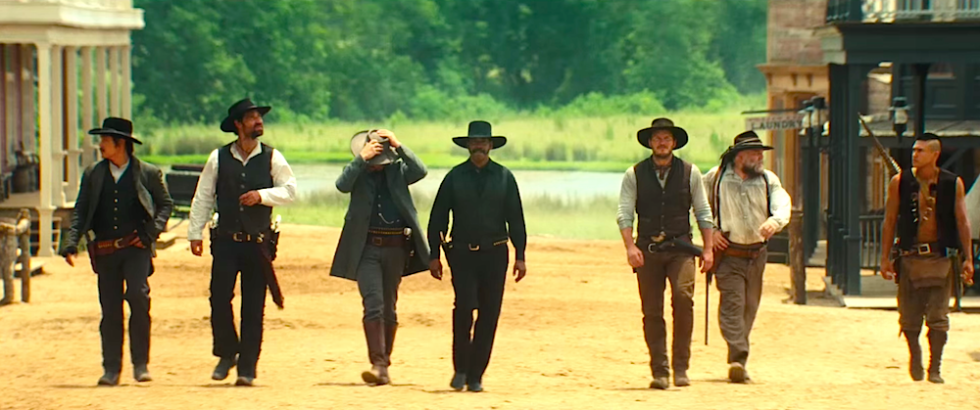
Then we watch as the rest of the seven are accumulated along the way. There’s gunslinger/gambler Josh Faraday,  (Pratt) former Confederate Sharp Shooter/legend Goodnight Robicheaux,  (Hawke) his friend and business associate Billy Rocks, (Byung-hun Lee) the outlaw Vasquez (Manuel Garcia-Rulfo). And finally we have the Comanche warrior Red Harvest (Martin Sensmeier) and the mountain man Jack Horne (Vincent D’Onofrio. After a few days of riding the group reaches Rosewood where they have eight days to militarize the town and fight Bart’s 200-man army.


That’s pretty much it as far as narrative is concerned and it all unfolds in a very neat and slick manner. There’s an action beat every five minutes or so with a minimum of five people getting killed, (although thanks to the PG-13 rating none of those casualties have any blood spewing out of them) which admittedly can get tedious and repetitive after a while.

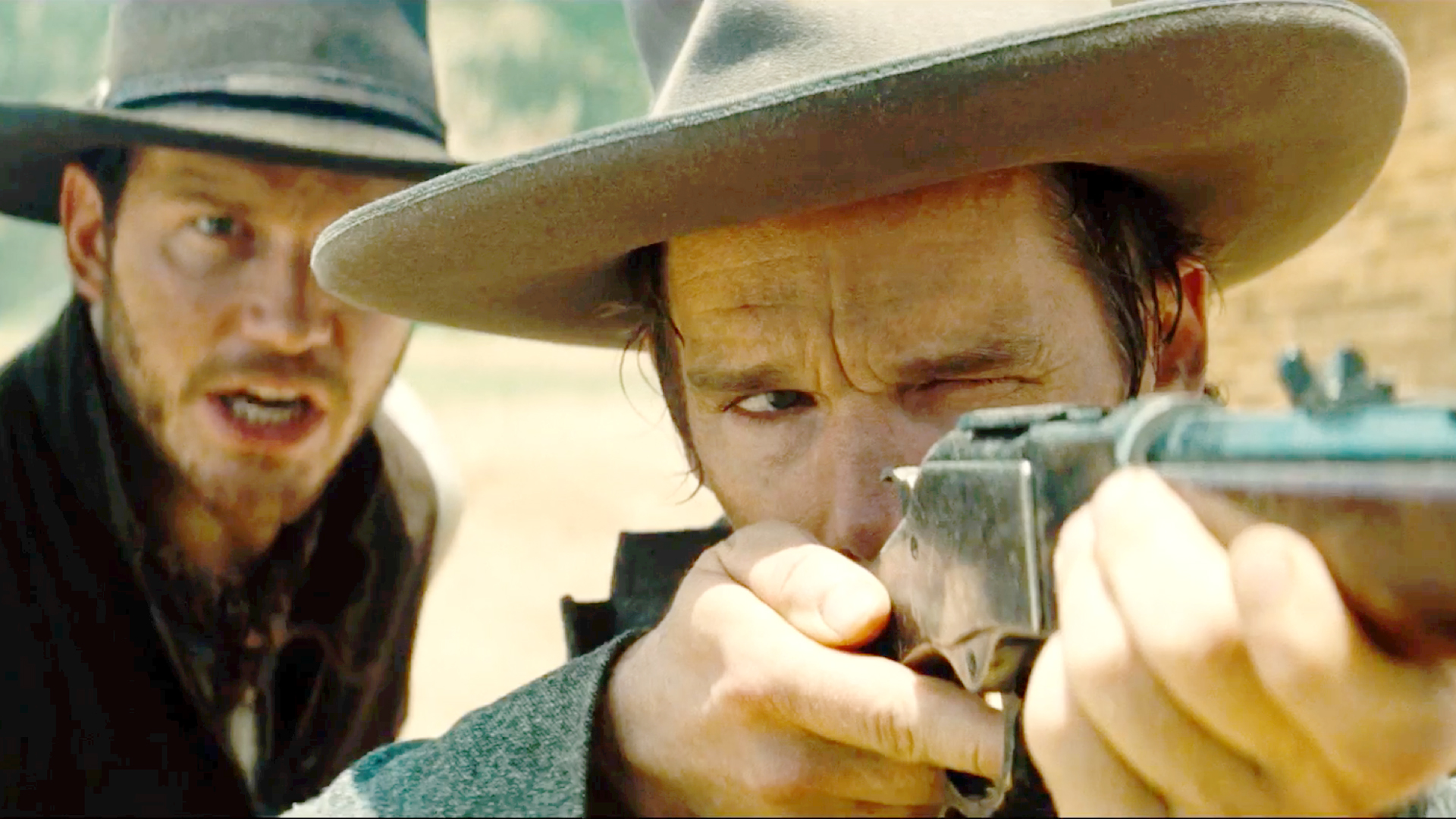
Thankfully, the cast makes this thin, action heavy movie worthwhile. I’m not going to say these are fully dimensional characters that go through major character arcs but much like in “Star Trek Beyond” the group is charismatic and entertaining enough that you enjoy spending time with them. And they know what kind of movie they’re in--meaning they don’t take their roles too seriously. Washington is his usual confident, calculated tough guy. At this point in his life all he has to do is show up in a movie and he’s immediately the coolest guy there. Meanwhile, Chris Pratt is playing his character from “Guardians of the Galaxy” if that character decided to do a silly (but knowingly silly) impression of a Western gunslinger. Multiple times he squints his eyes like a junior Clint Eastwood. D’Onofrio may be the biggest surprise of the film, playing a deranged but unexpectedly sweet and gentle mountain man and Hawke is amusing as a washed up frontier celebrity. I do wish Bennett was given more to do; even though it’s basically Emma’s idea to put the group together there are long stretches of film where she’s absent without explanation.


It also helps that Fuqua doesn’t seem to be taking “The Magnificent Seven” very seriously either. The movie is clogged with cheesy Western clichés; intense staring followed by gun duels, dramatic walking down dusty streets while pedestrians look on, and lots of gun twirling. All that’s missing are rogue tumbleweeds. At times it verges on parody; during one scene, Faraday uses a card trick to get out of being killed by two angry gamblers. After the melodramatic schmaltz that was “Southpaw” it’s nice to see Fuqua tackle something so unhinged and campy in tone. However, “Magnificent Seven” runs into trouble when it slows down and tries to be serious. Material involving Robicheaux’s post war stress and Chisolm’s secret, deep seeded motive for taking the job are underdeveloped and feel like they were ripped from a completely different movie.

There’s little in the way of conflict amongst the group. Outside of the usual tough guy ribbing they all seem to be fine with one another and the high-chance-of-death nature of the job. If the group was strictly made up of white males I think this would be more of a flaw but the fact that the group is racially diverse makes the lack of conflict oddly refreshing. I mean, we’re talking about a situation where a white mountain man (whose reputation is based on killing hundreds of Native Americans) is fighting side by side with a Comanche warrior with no tension, or an African American bounty hunter who immediately commands respect when he enters a new town and as the group’s leader.

While the Seven are aware of their racial differences it’s never a significant conflict in the narrative. They see each other as equals, as fellow mercenaries and associates doing a job. Their enemy is Bart, not each other. And that awareness allows them to be a cohesive, well oiled unit. It’s not the most thorough examination of race but it’s welcome in an otherwise extremely goofy action movie.

C+