Showing posts with label Robert Downey Jr.. Show all posts

Friday, June 30, 2017

Spider-Man:Homecoming Review (2017)


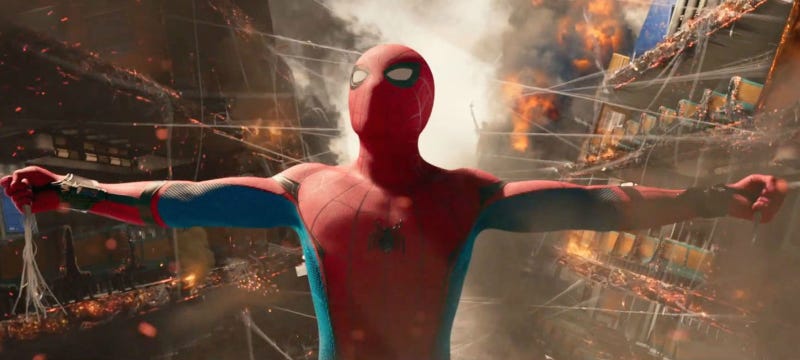
One of the best things about Jon Watts' “Spider-Man: Homecoming,” (the second “Spider-Man” reboot in three years and third overall) is that it isn’t saddled with burden of delivering Spider-Man’s exhaustive origin story yet again. He was already introduced in last years “Captain America: Civil War” (Spidey is now officially part of the MCU, instead of having a standalone franchise) and therefore we don’t have to watch fifteen minutes of “pre Spider-Man” Peter Parker.

We don’t have to watch him get bit by a radioactive spider or comfort his dying Uncle Ben in a dark alley again. It makes for a faster, less bloated, less redundant “Spider-Man” picture. If I had to watch Uncle Ben get killed for the third time this century, or watch a bewildered Parker discover his abilities while starring at himself in a mirror, I might have walked out. This new iteration of Spiderman is ready to go: a vigilante with spiderlike powers and snazzy red and blue tights. Thank god.

Of course, Parker is still a dorky teen with dorky teen troubles. “Spider-Man: Homecoming” finds a sweet spot between goofy, enduring teen movie and goofy superhero movie. We’re dropped in the middle of Parker’s (Tom Holland) hectic life as he balances normal adolescent struggles (fitting in at school, girl crushes, parties, dances) with crime fighting. These competing lives often clash in nutty and unexpected: we get an Academic Decathlon trip that doubles as a superhero mission, that later turns into a rescue at the Washington Monument. In another scene, Parker and his friend Ned (Jacob Batalon) dissect an alien weapon during wood shop class. And later on there’s a delightful superhero inspired twist on the classic “boy-meeting-his-date’s-father-for-the-first-time” moment.


“Spider-Man: Homecoming” captures the immaturity and inexperience of its teen protagonist extremely well. Parker is hyper and overly excited, eager to become a member of The Avengers but is far too undisciplined and unprepared. His attempt to interrogate a criminal goes horribly wrong, as do his attempts to stop a bank robbery and save a ferry full of civilians. Parker bites off more than he can chew when he launches his own investigation into underground arms dealer Adrian Toomes (Michael Keaton). Parker can certainly walk the Spider-Man walk but in big moments he’s, more often than not, amusingly incompetent.

“Spider-Man: Homecoming” is about the consequences of wanting to grow up too fast, and learning to enjoy just being a kid. Spidey’s not quite ready to fight with the big boys and that’s okay. It’s a teen angst movie with a superhero. More so than any other “Spider-Man” movie, “Homecoming” emphasizes the naive adolescent angle of the character in an appealing and genuine way. Holland is fantastic, playing Parker with the right amount of awkward charm and ADD tinged annoyance. Sometimes it’s a blast following him around and other times I felt kind of embarrassed to be in his presence. Like any good, well-rounded teen movie protagonist, Parker is adorable and kind of a nuisance--very relatable in both cases, especially the latter.


Though, perhaps the most enjoyable aspect of “Homecoming” is just how fun it is. The film zips by and has an easy-going, laissez-faire attitude It’s a teen angst film that isn’t too angsty; in fact it takes plenty of opportunities to mock Parker’s angst and the high school film all together.

It’s also very funny; the screenplay by Jonathan Goldstein, John Francis Daley, Watts, Christopher Ford, Chris Mckenna and Erik Sommers is packed with jokes and witty banter. Everyone, including the supporting characters who peek their head in for a scene or two (Hannibal Buress as a gym teacher) gets be snarky and quick witted. Batalon is a magnificent comedic sidekick; the montage in which Ned asks Parker an endless barrage of questions about being Spider-Man is among the film’s highlights. Marissa Tomei has a few memorably kooky scenes as Aunt May, as does Tony Revolori as a bully of sorts who is also a DJ and a member of the school’s Academic Decathlon team. All of which make “Homecoming” irresistibly charming.


As the primary villain, Toomes is solid. He’s not very memorable, despite Keaton’s hammy, intimidating performance but at least he’s not the usual power hungry supervillain who wants to level New York City or raise a drone army or something. He’s just an average, non-flashy, blue-collar criminal trying to support his family and receive his fair share. As a result of this, the climactic third act battle ends up being a drastic improvement over a majority of recent superhero flicks, including “Wonder Woman.” It doesn’t involve an excessive amount of city damage or an interdimensional portal having to be closed. It’s refreshingly small scale, coherently staged and even inventive.

Tony Stark, aka Iron Man (Robert Downey Jr.) shows up occasionally as a parental figure to give Parker a few “be responsible” speeches (You know you’re undisciplined when Tony Stark tells you to shape up) and to remind us that this is an Avengers movie. The efforts to connect Spidey to the larger MCU can cause the film to lag, especially when it suddenly becomes an “Iron Man” reunion. Both Jon Favreau and Gwyneth Paltro show up. That being said, I’ll gladly take an “Iron Man” reunion over watching Uncle Ben die again.

“Spider-Man: Homecoming” is imperfect but for being the third “Spider-Man” reboot in fifteen years, it’s pretty damn good and one of the better recent MCU films.

B 

Tuesday, May 17, 2016

X-Men: Apocalypse Review (2016)


On the outside, Bryan Singer’s “X-Men Apocalypse” (the third “X-Men” film in a new series, preceded by “X-Men: First Class” and “X-Men: Days of Future Past”) seems unremarkable, especially when compared to the other big budget superhero extravaganzas that have already come out.

 In “Batman v Superman: The Dawn of Justice” and “Captain America: Civil War” the superheroes fight each other instead of some maniacal villain hell bent on world domination. In theory, it’s a great idea not only because it bucks convention but because most of the recent superhero movie villains have been well, pretty lame. Aside from a few exceptions they are one-dimensional after thoughts--shoehorned into the action because superhero movies need villains.

In contrast, “X-Men Apocalypse” follows the more familiar, tried and true superhero film structure: there’s a new powerful bad guy who wants to destroy the world, so a group of heroes must unite and stop him. To make up for the stale plot structure, Singer’s film has a sense of danger and urgency that the superhero-on-superhero conflicts of “Captain America” and “Batman v Superman” lack.

In “X-Men: Apocalypse,” the threat of world destruction feels more significant and plausible because the bad guy making said threat means business. And the film doesn’t shy away from showing the ugly repercussions of his wrath. To put it in simpler terms, we see people die.

All three films attempt to deal with the heavy themes of collateral damage and the cost of war, in an attempt to ground these often outlandish situations in the real world and raise the stakes. While these superheroes are off fighting evil, causing thousands of dollars worth of city damage, what about the hundreds of innocent civilians that are caught in the crossfire? However, “Batman v Superman” and “Captain America” address these issues in a fairly safe and impersonal way.

In the case of “Captain America,” government people and politicians tell the heroes about the damage they’ve caused and the innocent lives lost. A random woman confronts Tony Stark (Robert Downy Jr.) telling him that her son died inadvertently during one of the Avenger’s scuffles. In other words, we’re mainly told about the collateral damage without seeing it.


On the other hand, “X-Men: Apocalypse” explicitly deals with the costs of conflict and terrorism. The film has the courage to show people dying (innocent civilians as well as a few of the supporting mutants) on screen in abrupt and sometimes disturbing ways. During a sequence that takes place on the dusty crowded streets of Cairo, a row of four civilians is instantly decapitated while a fifth guy is grotesquely melded into a cement wall, a moment treated so casually and coldly that it made my eyes widen.

It may seem peculiar to want death in a PG-13 superhero flick but seeing some casualties of war and terrorism (it doesn’t have to be excessive) increases the level of danger; too often the threat of world domination/destruction in these movies feels hollow. In “X-Men,” blood is shed and the cost is felt.

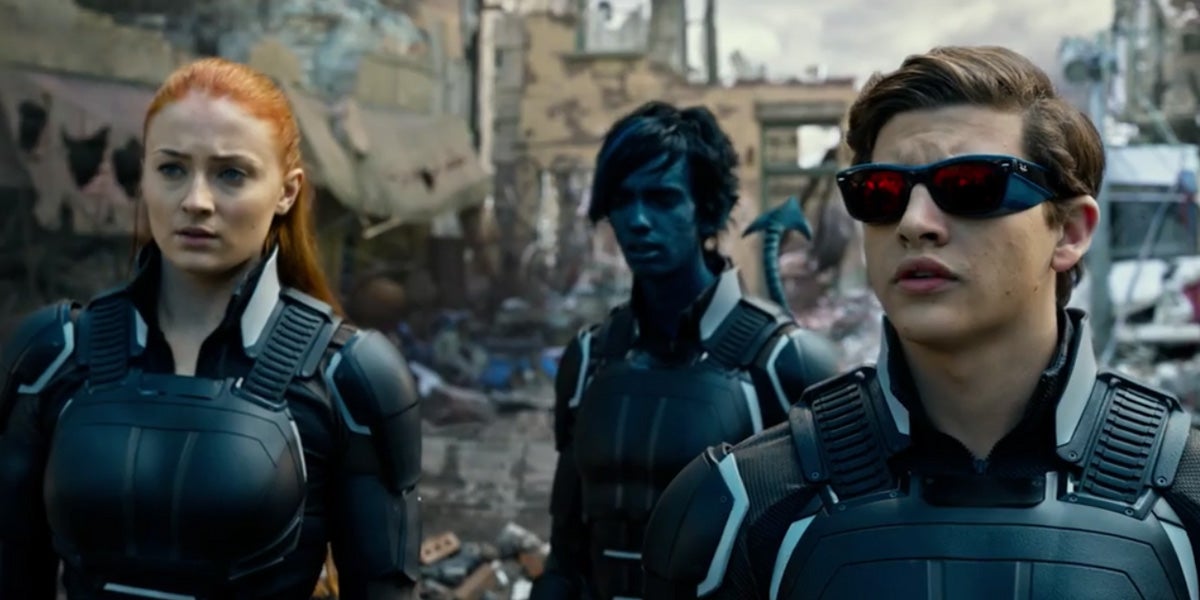
I suppose now is a good time to cover the plot basics. The year is 1983 and the world doesn’t know how to feel about mutants; should we fear them or accept them? Professor Charles Xavier (James McAvoy) is busy running his special mutant school, teaching younger mutants like Cyclops, (Tye Sheridan) Jean Grey (Sophie Turner) and Nightcrawler (Kodie Smit-Mcphee) to control and come to terms with their abilities.


Meanwhile the film’s baddie, Apocalypse (Oscar Isaac) has been resurrected after spending well over a thousand years trapped in an ancient Egyptian tomb. Apocalypse isn’t all that different from Xavier; they’re both extremely powerful and influential “super mutants” that want to unite fellow mutants. It’s just that Xavier wants peace and assimilation and Apocalypse wants to…“cleanse” the earth of non-mutants, if you catch his drift.

With his demon-like appearance (smooth bald head and sickly blue-grey skin) and whispery voice, Apocalypse isn’t the most charismatic comic book villain but he’s damned intimidating. From the beginning he’s established as an ominous, substantial presence in the action. He kills people with such calm, taciturn malice that’s slightly bone chilling. In one sequence, set in a Polish factory, he kills about seven or eight innocent factory workers instantly (with his mind) like it’s no big deal. Another moment that made my eyes widen.

The fact that we see people die so casually and abruptly like this makes the character and the film all the more unsettling and alarming. When Apocalypse says he wants to “cleanse” the earth you know he’s fully capable of doing so.

And then there’s Magneto (Michael Fassbender), who turns out to be one of the most compelling and conflicted characters. He spends most of the film walking the line between good guy and bad guy. So much of his life has been characterized by tragedy and anger up to this point that he simply wants to live a normal life. However the world won't let him, so he’s driven back into the realm of vengeance and hatred, vengeance and hatred not towards a single person or even a group of people but rather towards the human race in general. There’s a point in the film where wants to inflict harm on innocent people; he has a withdrawn look of disdain in his eyes that's unnerving.  As usual, Fassbender is in top form—playing Magneto with an understated sense of pain and fury.

Another key area “X-Men: Apocalypse” succeeds in is feeling like a complete and self-sufficient movie that can stand alone outside its franchise. Some many recent super hero flicks feel like extended teasers for future films because they’re part of an expanded, ever-growing cinematic universe. Part of the reason why “Batman v Superman” was so lackluster is because it had to set up characters and plotlines for future films, (“The Justice League” and “Wonder Woman”) which cluttered and trivialized the current narrative.

On the flip side, “X-Men: Apocalypse,” is self-contained. With the exception of one scene, all of the characters and plot strands work in service of the central narrative. Everything is fully realized and instead of looking towards future installments, “X-Men Apocalypse” keeps its feet firmly planted in the here and now.


“X-Men: Apocalypse” suffers from some clunky expository dialogue and the ultra talented Rose Byrne (as a non-mutant C.I.A. agent) is given nothing to do except be a part of a poorly developed romantic side plot between her and Xavier. The picture certainly doesn’t reinvent the superhero movie; the broad strokes of the narrative are familiar and the resolution is what you’d expect. Yet, the heightened sense of danger pulsing throughout elevates this otherwise standard superhero narrative. Had “X-Men” not been constrained by a PG-13 rating and the need to maintain a franchise, it could have gone even further in showing the ugly, darker side of these onscreen superhero squabbles.

B