Showing posts with label X-Men. Show all posts

Sunday, February 26, 2017

Logan Review (2017)


Yes, James Mangold’s “Logan” is another “X-Men” film wherein mutants are pursued/hunted down by some ominous government or corporate entity. Yes, “Logan” is another “X-Men” film in which the grumpy and lonely Logan, aka Wolverine (Hugh Jackman) plays the reluctant hero and is forced to care about others. What’s fresh here (in the context of the superhero genre, particularly the Marvel films) is the tone, which is dark and vicious with an undercurrent of humor and fun, gleefully embracing the pulpier aspects of its narrative and genre. “Logan” hits hard while still being a fast paced, exciting, and accessible superhero picture.

Overall, Mangold’s film is a morose, intimate character-driven drama mixed with a stripped down old school action flick. Traces of the “Mad Max” and “Terminator” franchises can be detected (among others) and the film gives off a noticeable Western vibe in its visual and thematic elements--echoing such films as “Shane” and “Unforgiven.”

“Logan” is firmly grounded in reality; actions have consequences and people die. Not just evil henchmen but civilians--families, children. It’s the first “X-Men” movie to be rated R and it certainly takes advantage of that freedom. There are a number of vicious, bloody action sequences; within the first three minutes, as Logan fends off a group of carjackers, limbs are cut off and guts are slit open. “Logan” is the first superhero movie I’ve seen in a while where I’ve cringed during the action scenes. There’s visible and visceral pain being inflicted on screen.

While an R rating doesn’t guarantee a film will be good I think in the case of this character and this particular chapter in his life, the hard R is necessary. Wolverine may be the most tormented superhero outside of Batman. He’s lived for decades and has seen decades of pain and suffering. Time has molded him into a jaded loner—reluctant to help others because he’s afraid he’ll let them down, as he has before. In “Logan” we see Logan at his most angst-ridden and depressed. He basically wants to kill himself, or let himself be killed. He’s getting older, his wounds aren’t healing or they’re healing very slowly. He drinks at least a gallon of hard alcohol a day but that doesn’t appear to be numbing any pain.


However, as hard as he tries, he can’t get away from helping others. A young mutant named Laura, (Dafne Keen) being hunted by a shadowy corporation crosses his path. So, along with his old friend Charles Xavier aka Professor X, (Patrick Stewart) Logan attempts to bring Laura to safety. Mangold’s film provides a familiar but refreshing take on the Logan character. He’s as snarky and grouchy as he always is but this time there’s an additional dimension of vulnerability and mortality. This is a fading, more world-weary Logan who, when getting shot, isn’t so quick to get back up. Not just because he’s physically unable but also because he doesn’t want to. 

I also liked this version of Professor X, which, like Logan is familiar but different. Charles is getting older himself—deteriorating both physically and mentally. When we first see him (holed up in an old, rusty tank) babbling about whatever he resembles an old man in a nursing home with dementia. It’s a vulnerable side of the character we haven’t seen before. The theme of impending mortality resonates strongly throughout the picture.

And yet, for all this moroseness, Mangold doesn’t overdo it. He knows to balance it out with kinetic action sequences and visceral kills, along with moments of black comedy and comedic banter between Logan, Laura and Charles. This is after all still a movie about a muscular dude with metal claws in his hands, (who originated from a comic book) meaning it doesn’t have to be all brooding and depression. Near the end of the film there’s a shot of Logan charging after the bad guys, his claws out, arms facing forward, doing his best battle cry, an image that elicited a laugh from myself and the other critics at my screening. It’s a giddy, triumphant moment that embraces the inherent silliness found in all superhero movies, while also providing a brief and endearing glimpse at the Wolverine that once was. (The movie is full of these giddy moments).


Finally, “Logan” pretty much avoids all the annoying narrative tropes and clichés found in recent superhero movies. There’s no object McGuffin (no Infinity Gauntlet or Power Crystal to retrieve) or power-hungry villain who wants to destroy the world. The stakes are high without the whole world being in Jeopardy. The film’s road trip structure takes us out of the big city environment, instead being set in the wide-open plains of the Midwest and deserts of the southwest, (further giving the film a Western feel) meaning there’s no big city destruction. The protagonists don’t have to close a stupid interdimensional portal to save the day and there’s no cross promotion—which is by far the most annoying thing about superhero movies these days. It makes a lot potentially good films feel overstuffed and convoluted (“The Avengers: Age of Ultron”). “Logan” isn’t trying to set up future “X-Men” movies, meaning it stays focused on the narrative and characters at hand.

I have minor reservations concerning “Logan,” most notably involving an additional and superfluous antagonist who shows up part way through. But the more I think about Mangold’s picture the more I like it, which is rare for me. Even the recent superhero movies that I’ve liked somewhat (“The Avengers”) I don’t really have a desire to revisit them. I think “Logan” will have staying power; it’s dark and nuanced, appropriately bloody, and also fun (in the way that 80’s and 90’s hyper violent action movies were). It’s the best superhero movie I’ve seen in a long time.

A- 

Tuesday, May 17, 2016

X-Men: Apocalypse Review (2016)


On the outside, Bryan Singer’s “X-Men Apocalypse” (the third “X-Men” film in a new series, preceded by “X-Men: First Class” and “X-Men: Days of Future Past”) seems unremarkable, especially when compared to the other big budget superhero extravaganzas that have already come out.

 In “Batman v Superman: The Dawn of Justice” and “Captain America: Civil War” the superheroes fight each other instead of some maniacal villain hell bent on world domination. In theory, it’s a great idea not only because it bucks convention but because most of the recent superhero movie villains have been well, pretty lame. Aside from a few exceptions they are one-dimensional after thoughts--shoehorned into the action because superhero movies need villains.

In contrast, “X-Men Apocalypse” follows the more familiar, tried and true superhero film structure: there’s a new powerful bad guy who wants to destroy the world, so a group of heroes must unite and stop him. To make up for the stale plot structure, Singer’s film has a sense of danger and urgency that the superhero-on-superhero conflicts of “Captain America” and “Batman v Superman” lack.

In “X-Men: Apocalypse,” the threat of world destruction feels more significant and plausible because the bad guy making said threat means business. And the film doesn’t shy away from showing the ugly repercussions of his wrath. To put it in simpler terms, we see people die.

All three films attempt to deal with the heavy themes of collateral damage and the cost of war, in an attempt to ground these often outlandish situations in the real world and raise the stakes. While these superheroes are off fighting evil, causing thousands of dollars worth of city damage, what about the hundreds of innocent civilians that are caught in the crossfire? However, “Batman v Superman” and “Captain America” address these issues in a fairly safe and impersonal way.

In the case of “Captain America,” government people and politicians tell the heroes about the damage they’ve caused and the innocent lives lost. A random woman confronts Tony Stark (Robert Downy Jr.) telling him that her son died inadvertently during one of the Avenger’s scuffles. In other words, we’re mainly told about the collateral damage without seeing it.


On the other hand, “X-Men: Apocalypse” explicitly deals with the costs of conflict and terrorism. The film has the courage to show people dying (innocent civilians as well as a few of the supporting mutants) on screen in abrupt and sometimes disturbing ways. During a sequence that takes place on the dusty crowded streets of Cairo, a row of four civilians is instantly decapitated while a fifth guy is grotesquely melded into a cement wall, a moment treated so casually and coldly that it made my eyes widen.

It may seem peculiar to want death in a PG-13 superhero flick but seeing some casualties of war and terrorism (it doesn’t have to be excessive) increases the level of danger; too often the threat of world domination/destruction in these movies feels hollow. In “X-Men,” blood is shed and the cost is felt.

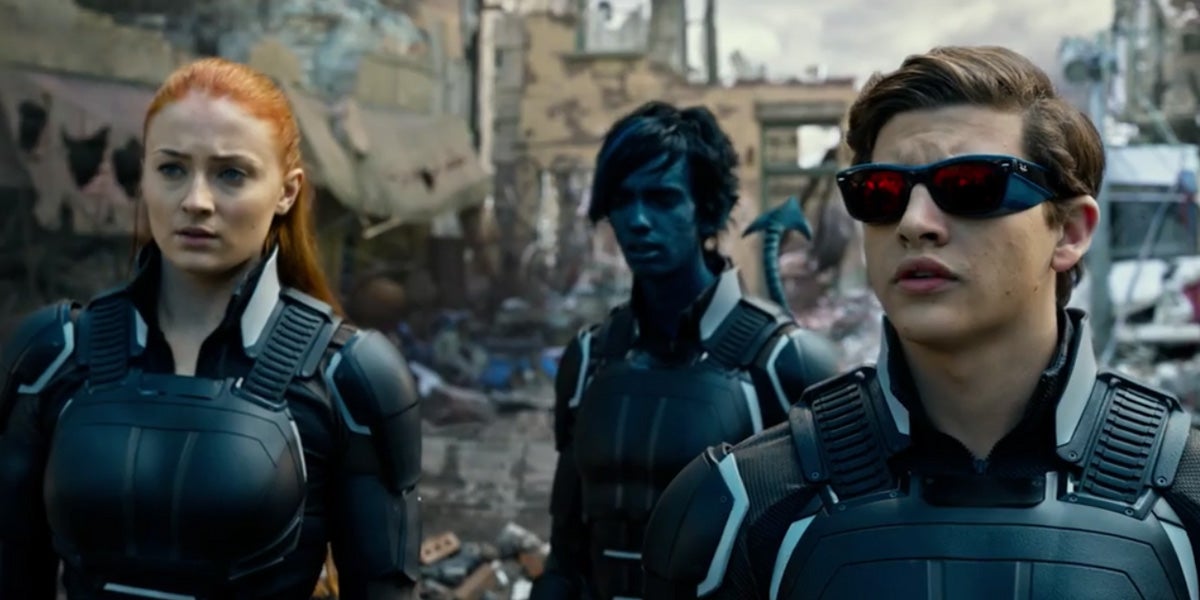
I suppose now is a good time to cover the plot basics. The year is 1983 and the world doesn’t know how to feel about mutants; should we fear them or accept them? Professor Charles Xavier (James McAvoy) is busy running his special mutant school, teaching younger mutants like Cyclops, (Tye Sheridan) Jean Grey (Sophie Turner) and Nightcrawler (Kodie Smit-Mcphee) to control and come to terms with their abilities.


Meanwhile the film’s baddie, Apocalypse (Oscar Isaac) has been resurrected after spending well over a thousand years trapped in an ancient Egyptian tomb. Apocalypse isn’t all that different from Xavier; they’re both extremely powerful and influential “super mutants” that want to unite fellow mutants. It’s just that Xavier wants peace and assimilation and Apocalypse wants to…“cleanse” the earth of non-mutants, if you catch his drift.

With his demon-like appearance (smooth bald head and sickly blue-grey skin) and whispery voice, Apocalypse isn’t the most charismatic comic book villain but he’s damned intimidating. From the beginning he’s established as an ominous, substantial presence in the action. He kills people with such calm, taciturn malice that’s slightly bone chilling. In one sequence, set in a Polish factory, he kills about seven or eight innocent factory workers instantly (with his mind) like it’s no big deal. Another moment that made my eyes widen.

The fact that we see people die so casually and abruptly like this makes the character and the film all the more unsettling and alarming. When Apocalypse says he wants to “cleanse” the earth you know he’s fully capable of doing so.

And then there’s Magneto (Michael Fassbender), who turns out to be one of the most compelling and conflicted characters. He spends most of the film walking the line between good guy and bad guy. So much of his life has been characterized by tragedy and anger up to this point that he simply wants to live a normal life. However the world won't let him, so he’s driven back into the realm of vengeance and hatred, vengeance and hatred not towards a single person or even a group of people but rather towards the human race in general. There’s a point in the film where wants to inflict harm on innocent people; he has a withdrawn look of disdain in his eyes that's unnerving.  As usual, Fassbender is in top form—playing Magneto with an understated sense of pain and fury.

Another key area “X-Men: Apocalypse” succeeds in is feeling like a complete and self-sufficient movie that can stand alone outside its franchise. Some many recent super hero flicks feel like extended teasers for future films because they’re part of an expanded, ever-growing cinematic universe. Part of the reason why “Batman v Superman” was so lackluster is because it had to set up characters and plotlines for future films, (“The Justice League” and “Wonder Woman”) which cluttered and trivialized the current narrative.

On the flip side, “X-Men: Apocalypse,” is self-contained. With the exception of one scene, all of the characters and plot strands work in service of the central narrative. Everything is fully realized and instead of looking towards future installments, “X-Men Apocalypse” keeps its feet firmly planted in the here and now.


“X-Men: Apocalypse” suffers from some clunky expository dialogue and the ultra talented Rose Byrne (as a non-mutant C.I.A. agent) is given nothing to do except be a part of a poorly developed romantic side plot between her and Xavier. The picture certainly doesn’t reinvent the superhero movie; the broad strokes of the narrative are familiar and the resolution is what you’d expect. Yet, the heightened sense of danger pulsing throughout elevates this otherwise standard superhero narrative. Had “X-Men” not been constrained by a PG-13 rating and the need to maintain a franchise, it could have gone even further in showing the ugly, darker side of these onscreen superhero squabbles.

B