Showing posts with label Jennifer Jason Leigh. Show all posts

Thursday, February 22, 2018

Annihilation Review (2018)


Grade: B+

Through the advent of science we’ve been able to rationalize a number of processes and events that have happened (and continue to happen) regarding the development of life but we still haven’t been able to answer the “big questions.” Why is there life? Is it all a matter of dumb luck or was there some intelligent force out in the universe that caused the dominos to fall? And if so, why did this intelligent force set all of this into motion?

Writer-director Alex Garland indirectly addresses this profound dilemma regarding the meaning of life and the limitations of science in his latest film “Annihilation”-- a tense, tightly constructed and unexpectedly bonkers Sci fi thriller involving trippy extraterrestrial forces and genetic mutation. It doesn’t always work; the reliance on flashbacks can interrupt the narrative flow. Additionally, the film ends on a cheap cliffhanger but for the most part Garland effectively balances big ideas and visceral thrills, making for an entertaining and elusive Sci fi picture.

Loosely based on the book by Jeff VanderMeer, the film revolves around biologist Lena (Natalie Portman) who has been tasked with exploring and rationalizing the mysterious phenomenon known as The Shimmer, which seems to alter and refract every living organism it encounters. Numerous expeditions have attempted to figure out what exactly is going on but no one has returned, with the exception of Lena’s husband Kane (Oscar Isaac) who has a bad case of amnesia. Accompanying Lena is psychologist Dr. Ventress, (Jennifer Jason Leigh) paramedic Anya, (Gina Rodriguez) Physicist Josie (Tessa Thompson) and anthropologist Cass (Tuva Novotny). Once they pass through The Shimmer’s liquid-y barrier things get progressively freaky. The laws of nature are seemingly shattered before our eyes.


“Annihilation” is endlessly engrossing. Garland moves the action along at a meticulous, near perfect pacing. We’re placed firmly in the shoes of our all female crew as they try to make sense of the seemingly unnatural and increasingly bizarre occurrences within The Shimmer.  The film is defined by eerie atmosphere and tension. It’s ambitious and meditative but also genuinely unsettling, providing a handful of disturbing body horror scenarios (at one point, a man’s intestines slither around in his torso like a snake) and hallucinogenic Sci fi images. All of this is heightened by a haunting, whirring soundscape that pulsates throughout every scene. Moment to moment, “Annihilation” is utterly hypnotic

Garland takes the time to develop his central characters, fleshing out their personal lives (fraught with tragedy and emotional damage) and giving them time on screen to interact with one another in between bouts of chaos. These aren’t one-dimensional women there simply to be bumped off by some malevolent force. Furthermore, Garland never betrays their intelligence. There’s a tendency for smart characters in Sci fi thrillers like this to inexplicably act like total idiots (I’m looking at you, “Prometheus”). “Annihilation” goes to some crazy places thematically and plot wise but the characters never make any frustratingly stupid mistakes.

Ultimately, the narrative reaches an ambiguous conclusion. The mechanics of The Shimmer itself are developed and partly explained but the movie never really accounts for why any of what’s happening is happening. This perplexing finale is a little unsatisfying but also fitting. Going back to what I discussed at the beginning of the review, perhaps there are certain phenomena’s that can’t be concretely explained using the traditional laws of nature and science. We probably wont discover the true meaning of life through scientific inquiry, just as Lena cannot definitively rationalize the enigmas within the bounds of The Shimmer. Garland leaves the audience with plenty to discuss and mull over.


Thursday, August 24, 2017

Good Time Review (2017)


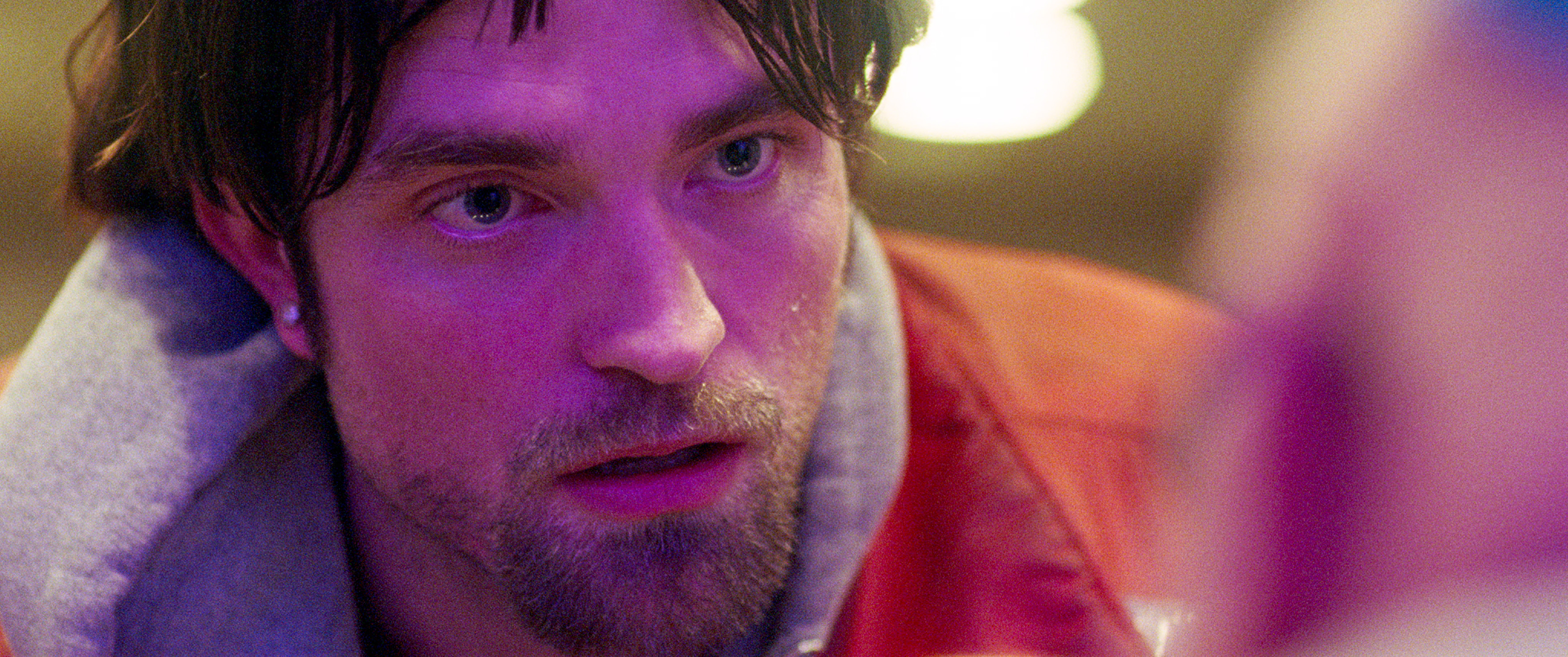
Good Time” is a tense and hypnotic ride through the streets of New York. Directed by up and comers Josh and Benny Safdie, the film tells the story of degenerate bank robber Connie Nikas (Robert Pattinson) who tries to get his mentally handicapped younger brother Nick (Benny Safdie) out of police custody following a heist. However, over the course of one exhausting night, with the cops on his trail, his life collapses into queasy neon lit chaos.

The Safdie Brothers, along with cinematographer Sean Price Williams capture this chaos via kinetic and intimate hand held photography— most of the time the characters are framed through tight, claustrophobic close ups. Accompanying this oppressive visual style is a loud, grinding, frenzied electronic score by composer Oneohtrix Point Never (complete with arcade game bleeps and blorps and even horror movie strings) that makes even the most mundane run through a deserted hospital hallway nail bitingly intense. Sometimes the score can feel overbearing and unnecessary, especially when it blares up during a casual conversation, undercutting the drama. But by and large it gives the film an eerie, otherworldly dimension.

 “Good Time” finds a sweet spot between rough around the edges realism and a disorienting, semi psychedelic stylishness. On the one hand, it uses handheld cameras, real locations, a low budget, and nonprofessional actors mixed in with established ones. The performances are energetic but natural, while the dialogue sounds conversational and unscripted. At the same time, the film is very deliberate in its frenetic editing, score and narrative tightness. The film is both freewheeling and meticulously crafted-- a dreamy and gritty urban odyssey.


Narratively, the picture is a high-octane tour through dingy, unglamorous New York and a visceral, dour crime film (a sort of modern, ADHD tinged “Mean Streets”) featuring a truly detestable screwup protagonist.

From the very beginning Connie is actively unlikable. He drags Nick out of a psychiatric program that he thinks is damaging to Nick and proceeds to immediately throw him into harms way, via the bank robbery. Connie is reckless and self-centered. He sets out on his mission to bail Nick out of jail, relying on the generosity and resources of friends (his older girl friend, played by Jennifer Jason Leigh, tries to use her mother’s credit card) and random strangers. In his reckless and single-minded ways, Connie screws over just about every person he comes into contact with, including a sixteen-year-old girl (played by Taliah Webster). He’s a running disaster.

It can be difficult to watch “Good Time” because of all this; many times I wished for Connie to get apprehended or simply hit by a bus. He’s not even a sympathetic or a tragic figure and there isn’t much character growth. Scene after scene he continues on a downward spiral, on a mission that was doomed from the start. By the end, I rooted for his inevitable demise. However, what makes Connie’s disastrous odyssey at least partially fascinating is his delusional and gradually destructive entitlement. Connie spends the entirety of “Good Time” taking advantage of others (taking their cars, phones, apartments) while still viewing himself as the victim--blaming others for his own idiotic screw-ups. At one point he even accuses another person he meets named Ray (Buddy Duress) of being entitled and dependent on welfare. Uh, didn’t you just force your girlfriend to use her mother’s credit card for bail money a few hours ago?


As the film moves along Connie’s sense of entitlement strengthens and his actions become increasingly heinous. His lowest moment comes near the end when he and Ray break into a closed amusement park to retrieve a hidden sack of drug money. When he encounters the security guard, (played by Oscar nominee Barkhad Abdi) Connie beats him to a pulp, force feeds him liquid LSD and takes his uniform as the cops arrive, essentially stealing his identity and framing this poor man for his own crime.


Pattinson is terrific as Connie—nervous and unhinged in a way that never turns into caricature or becomes melodramatic. Like Kristen Stewart, he’s blossomed into a superb actor post “Twilight,” able to disappear completely into every role he takes on. As gloomy and infuriating as “Good Time” can be, Pattinson’s commitment and energy to such an unpleasant character, along with the Shafdi Brother’s kinetic style, make it intense and absorbing.

B

Wednesday, December 23, 2015

The Hateful Eight Review (2015)


Quentin Tarantino’s latest picture “The Hateful Eight”--a meticulously crafted Western thriller set in Wyoming and shot on 70mm Panavision*—is an odd duck; both admirable and frustrating. While it contains familiar “Tarantino-isms” it feels very different from his other works. In a lot of ways it’s his darkest, most pessimistic feature and his most politically charged (it’s critique on racism in Post-Civil War America is far more scathing and didactic than it was in “Django Unchained,” his Blaxploitation/Spaghetti Western set in the Antebellum South).  It contains plenty of gratuitous violence and has a dark comedic bite as ferocious as a Grizzly bear’s. Traditional notions of “good” and “evil” are nowhere to be found. In Tarantino movies there are no truly innocent characters but in “The Hateful Eight” they range from kind of bad to just plain vile. And yet, my reaction is mixed; I love certain aspects of the film but it also has flaws, flaws that are too big to overlook.

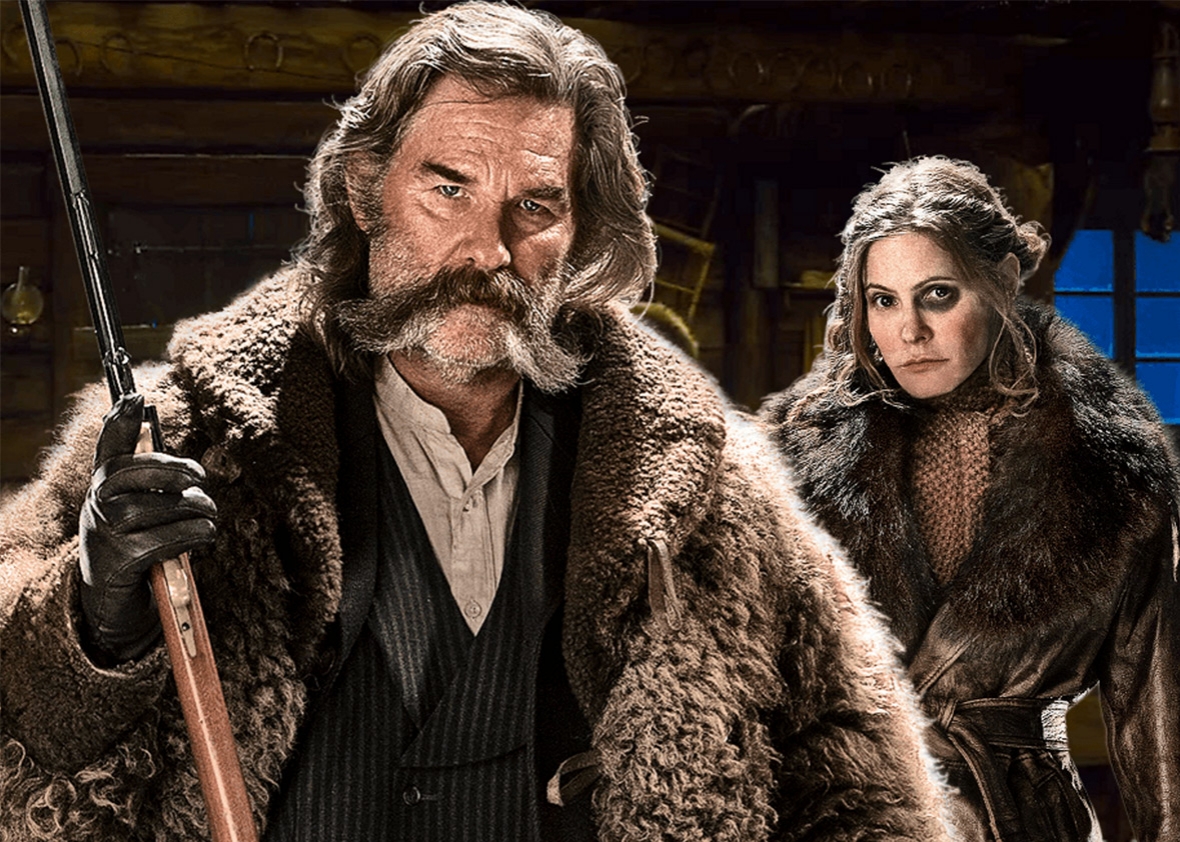
The film moves at a leisurely but comfortable pace; Tarantino is in no hurry to tell his tale and he shouldn’t be.  After opening with epic wide-angle shots of the gorgeous snow-covered Wyoming landscape we’re taken into the confines of a stagecoach. There, we meet bounty hunter John Ruth (Kurt Russell, doing a John Wayne impersonation of sorts) who’s taking criminal Daisy Domergue (Jennifer Jason Leigh) to the town of Red Rock to hang. Along the way he picks up fellow bounty hunter Major Marquis Warren (Samuel Jackson) and Chris Mannix, (Walton Goggins) the new sheriff of Red Rock. Due to an impeding Blizzard the stagecoach has to stop at Minnie’s Haberdashery for the night, currently full of other weary travelers. For this motely crew Tarantino has assembled an impressive cast containing the likes of Tim Roth, Michael Madsen, Bruce Dern and Demian Bichir. From here on out the action is confined to Minnie’s. “The Hateful Eight” is Tarantino’s stagiest film—Robert Richardson’s crisp cinematography magnifies the cramped interior of the place, accenting the earthy textures, making it feel more like a theater stage than a real Haberdashery in the West. Meanwhile, the actors give eccentric theatrical performances, taking turns speaking and going on intellectual, articulate Tarantino-esque monologues, monologues that occasionally ramble.


In the first half (before a twelve-minute intermission) Tarantino creates an entertaining, multifaceted atmosphere of intrigue and suspense, partly resembling an Agatha-Christie style murder mystery sans the murder. Deep seeded tensions (between Union and Confederacy, black and white etc.) come screaming to the surface. There’s a persistent lack of trust among the characters---just about everyone has something to hide. Even the characters that know one another still aren’t totally happy to see each other again. The actors look like they’re having a grand old time chewing scenery in their Western getup (Russell can wear the hell out of handlebar mustache). And it’s fun to watch them mingle, trade insults and pass the time while the storm rages on outside. Frequent Tarantino collaborator Jackson is the best of the bunch. Warren is consistently the most compelling character, easy-going but extremely perceptive and intelligent at the same time-- catching on to things long before other characters do and of course, he has plenty to hide.

In terms of screenplay and story structure, the first half of “The Hateful Eight” is close to brilliant. Tarantino has become such a big personality (by his own doing) that I think now we sometimes forget how great of a writer he is. He has an uncanny ability to craft tense sequences that stretch and stretch and stretch like a rubber band before finally snapping. In “The Hateful Eight,” Tarantino’s subtle handling of character dynamics-- the shifts in power among the eight, secret alliances forming on the side (characters who didn’t trust each other initially form a pact under new circumstances) and major character revelations is near flawless and difficult to do when everything takes place in a single location and is primarily driven by talk. Tarantino is renowned for his punchy, energetic dialogue but his precision and dedication to story/scene structure is a crucial component in crafting said dialogue; Details and anecdotes that seem superfluous at the time comeback later on in a major way.


However after the intermission things take a peculiar and not entirely successful turn. The tone darkens considerably and Tarantino hammers home his political agenda. To try and go into all it would take too long but let’s just say said political agenda is hammered a little too hard. The film comes off heavy-handed, almost didactic at times, the dialogue feeling too on the nose. On top of that, in terms of a mystery/thriller the second half is considerably less intriguing; major moments feel more telegraphed than they should, a lengthy flashback sequence depicting what happened at Minnie’s before Ruth’s party showed up lacks the surprise and tension of anything in the first half. And at three hours and seven minutes the movie is too long. Tarantino is one of the privileged few directors who has free reign over his work and this time it hurts him. There’s a lot of excess fat that could be trimmed from this half. Tarantino wants to create an epic Western experience but for a single location narrative three hours is too long. Part of me wishes he had taken advantage of the rugged, beautiful frontier environment more instead of keeping the narrative so contained. That may have justified the length.

There are other issues, like the depiction of violence. In general I think Tarantino uses violence intelligently. He uses a lot of it, which may not be your cup of tea, but he rarely uses it haphazardly and he recognizes the distinction between cartoony genre movie violence (Nazi’s being scalped in “Inglorious Basterds”) and disturbing, realistic violence (a runaway slave being ripped apart by dogs in “Django Unchained”) and he knows when each type should be used and how it should be presented. In the second half of “The Hateful Eight” he goes overboard on the cartoon violence and it doesn’t fit at all. “The Hateful Eight” isn’t revenge fantasy or twisted fairly tale like “Basterds” and “Django” but a very bleak politically charged picture, so the excess of silly cartoon violence (along with slow motion and other stylistic flourishes) feels inappropriate and sloppy and confuses the tone.


And then there’s Domergue, the film’s only primary female character. During the first half she resembles a rabid animal more than a human and spends all her time at Ruth’s side--occasionally getting punched and being laughed at. In the second half I kept waiting for her character to slip out of her captive role and spring into action, make some big power moves. Leigh does the best she can but her character never really takes off. She has a handful of great moments but I wish she had figured more prominently into the homestretch of the narrative. Instead she kind of fizzles out and comes off looking pathetic, which is surprising considering Tarantino has written a number of strong female characters in the past. Furthermore, while Domergue definitely isn’t a saint her treatment at the hands of the male characters comes off a little too mean spirited; often times the violence towards her is played for laughs. Overall, I wanted more from her character.

Tarantino is among my favorite filmmakers working today. I love his enthusiasm for cinema and I love how that enthusiasm figures into his work. He can take pieces from a wide variety of old movies (mainly low budget exploitation pictures) and blend them together to form something boldly original. All of which makes this review somewhat difficult to write. I liked “The Hateful Eight.” In fact there are aspects of it I loved; it’s beautifully shot, the acting is top notch and I think the first half is great. But the movie loses its way in the second half and never fully recovers.

B-


*”The Hateful Eight” is being released in two versions: the first is a one-hundred and eighty seven minute cut that’s being shown in 70mm in select theaters on Christmas Day. It comes complete with an overture and an intermission. The other version is one hundred and sixty seven minutes and will be released wide on January 1st. I saw the 70mm version.