Showing posts with label Samuel L Jackson. Show all posts

Wednesday, March 8, 2017

Kong: Skull Island Review (2017)


“Kong: Skull Island” takes a classic cheesy monster movie premise (a group of explorers encountering a new land/frontier and having to fight its strange, vicious inhabitants in order to survive) and infuses it with the turbulence and “war-is-hell” mindset of the Vietnam War/ counter-culture movement era. The picture is set days after the war’s conclusion and tension is still in the air. There are anti- war protesters demonstrating in Washington and returning soldiers are still haunted by the horror’s they’ve experienced.

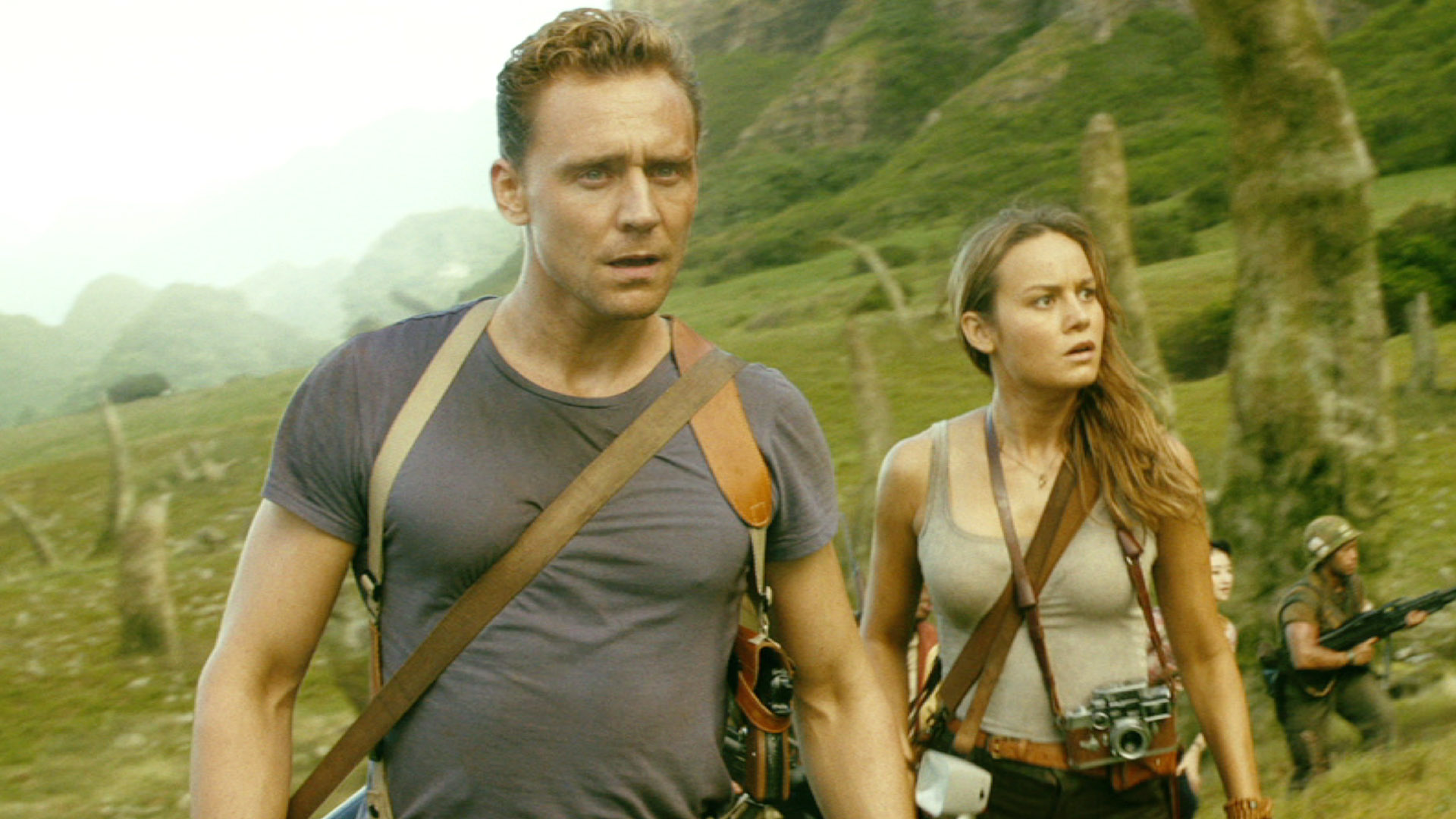
We observe this post war disillusionment most clearly in Preston Packard (Samuel L Jackson), a bitter, slightly deranged, battle worn colonel who isn’t quite over the war. He’s been tasked with escorting a group of assorted travelers (made up of fellow soldiers, scientists, photographers and mercenaries) to a recently discovered Island in the Pacific wherein a variety of undiscovered monsters reside, including the titanic gorilla Kong.

This is an intriguing concept that sadly doesn’t hold together from a tonal standpoint and its execution is so sloppy and bland that you’re bored to tears when there isn’t a monster fight going on or a gnarly death scene.

The heavy-handed screenplay by Dan Gilroy, Max Borenstein and Derek Connolly talks down to us like we’re eleven years old. Everything-- plot, exposition and major themes, is explained and over explained to the point of tedium. The opening fifteen minutes, as expedition leader Bill Randa (John Goodman) rounds up his rag tag group of travelers, consists of one boring and contrived expository scene after another. For example, we first meet tracker James Conrad (Tom Hiddelson) when he gets into a random scuffle with a switchblade wielding punk in the middle of a Bangkok bar while “While Rabbit” plays in the background. Later on, in a lame attempt to build anticipation and tension, the team has to fly through a CGI storm to reach the island.


Any interesting Vietnam/anti war subtext (the idea that war is hell, the idea that war can numb you to the point where seeing a giant gorilla isn’t very shocking, the idea that “the enemy” is a subjective construct) is violently pulled up to the surface during every scene through painfully clunky dialogue exchanges. Little is left for the audience to interpret or discover on their own. During one scene, in which war photographer Mason Weaver (Brie Larson) and Conrad talk about the negative effects of the conflict, Conrad says bluntly: “I suppose no man really comes home from the war.” Yeah. Cool. Thanks James.

Though it isn’t just the Vietnam/anti war stuff that’s heavy-handed. Any and all basic plot/expository developments are sounded out for the viewer. In a later scene, when the team encounters a ditch containing the bones of other giant apes, island inhabitant Hank Marlow (John C Reilly) remarks that they are “the remains of Kong’s parents.” Gee, Hank, I think the other characters (and the audience) can come to that conclusion without your interjection. And Weaver then saying that she’s seen “enough mass graves to recognize one” further emphasizes just how little nuance/subtlety there is in the storytelling. Director Jordan Vogt-Roberts rarely just lets the images speak for themselves.

Speaking of characters, with the exception of Packard and Marlow, the explorers are entirely unmemorable-- they’re empty vessels used to explain plot points and themes to the audience…or get killed. Somehow the film manages to waste Brie Larson, Tom Hiddelson and John Goodman, an impressive and somewhat depressing feat. In fact, there are long stretches of time where Goodman is absent from the film, making you forget he even exists. It’s a sin for a movie to make you forget about John Goodman. For shame “Kong.” For shame.


Tonally, “Skull Island” is constantly at odds with itself as it tries to balance comedy and drama. While there’s nothing wrong with mixing drama with comedy, the tonal shifts here almost too abrupt and the comedy is played too broadly. Extremely silly screwball exchanges are immediately followed by intense, “war-is-hell, man!” moments. A stirring, unsettling homage to “Apocalypse Now” (this movie quotes excessively from Francis Ford Coppola’s film) is followed by a ludicrous, out of left field sequence in which a Samurai sword wielding gas mask wearing Tom Hiddelson charges in slow motion through a cloud of poisonous gas slicing and dicing some creepy-crawlies. Reilly, playing a bumbling and eccentric castaway, can be a hoot to watch but it feels like he’s in an entirely different movie. Most of the time the comedy grinds the action to a halt rather than propelling it forward. And ultimately, it undermines the Vietnam/anti war material—rendering it facile and cartoonish.

In the end, the only material that consistently works involves the monsters. It’s exciting and occasionally absurd--there are a number of memorable character deaths and man vs. creature (or creature vs. creature) fight scenes. You’ll be bored to tears one minute as characters take turns explaining the plot to each other and then suddenly someone will get carried off by a flock of winged reptiles or getting eaten by a giant lizard, making you perk up in delight.


But then the characters will go back to explaining the plot and you’ll wish you were the one who got carried off by winged reptiles. Much like “Jurassic World,” when the monsters are onscreen causing mayhem and killing people, “Kong: Skull Island” is watchable. Otherwise, the film is a powerful sleep aid.

D+

Wednesday, December 23, 2015

The Hateful Eight Review (2015)


Quentin Tarantino’s latest picture “The Hateful Eight”--a meticulously crafted Western thriller set in Wyoming and shot on 70mm Panavision*—is an odd duck; both admirable and frustrating. While it contains familiar “Tarantino-isms” it feels very different from his other works. In a lot of ways it’s his darkest, most pessimistic feature and his most politically charged (it’s critique on racism in Post-Civil War America is far more scathing and didactic than it was in “Django Unchained,” his Blaxploitation/Spaghetti Western set in the Antebellum South).  It contains plenty of gratuitous violence and has a dark comedic bite as ferocious as a Grizzly bear’s. Traditional notions of “good” and “evil” are nowhere to be found. In Tarantino movies there are no truly innocent characters but in “The Hateful Eight” they range from kind of bad to just plain vile. And yet, my reaction is mixed; I love certain aspects of the film but it also has flaws, flaws that are too big to overlook.

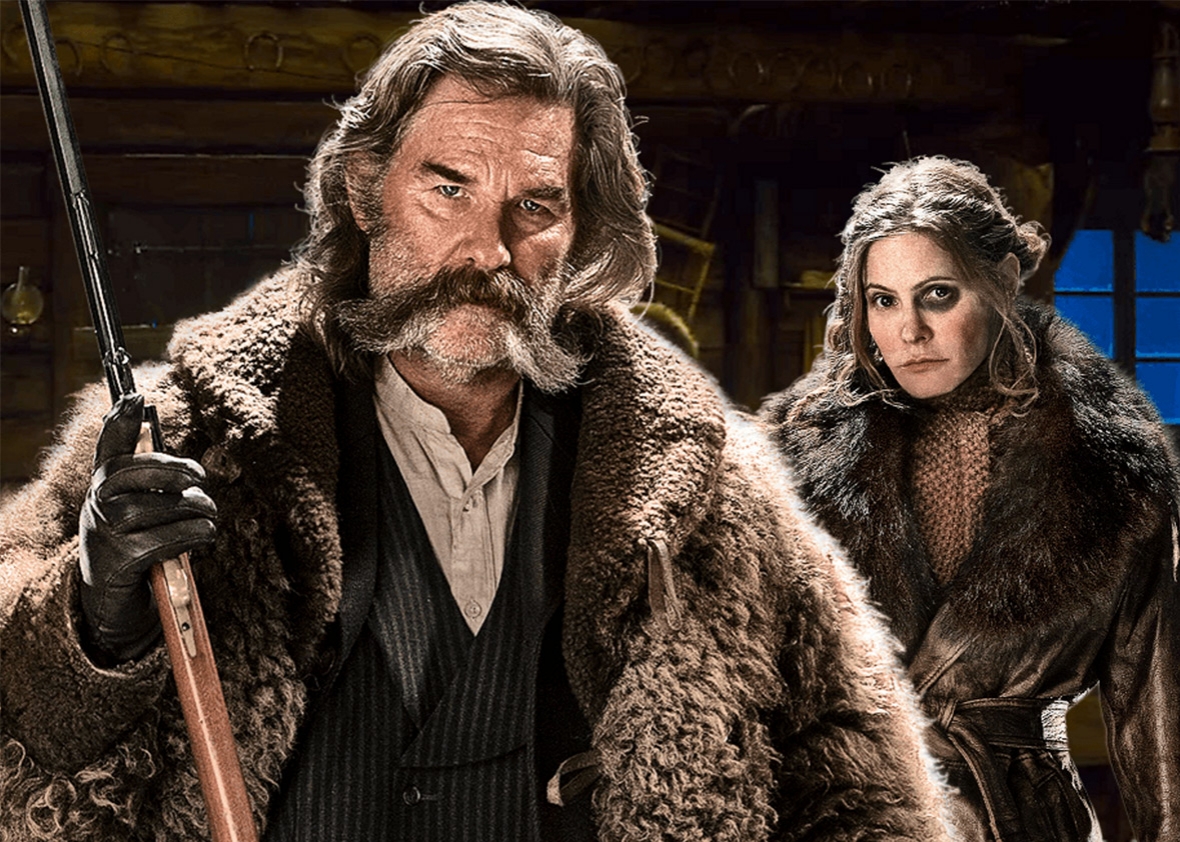
The film moves at a leisurely but comfortable pace; Tarantino is in no hurry to tell his tale and he shouldn’t be.  After opening with epic wide-angle shots of the gorgeous snow-covered Wyoming landscape we’re taken into the confines of a stagecoach. There, we meet bounty hunter John Ruth (Kurt Russell, doing a John Wayne impersonation of sorts) who’s taking criminal Daisy Domergue (Jennifer Jason Leigh) to the town of Red Rock to hang. Along the way he picks up fellow bounty hunter Major Marquis Warren (Samuel Jackson) and Chris Mannix, (Walton Goggins) the new sheriff of Red Rock. Due to an impeding Blizzard the stagecoach has to stop at Minnie’s Haberdashery for the night, currently full of other weary travelers. For this motely crew Tarantino has assembled an impressive cast containing the likes of Tim Roth, Michael Madsen, Bruce Dern and Demian Bichir. From here on out the action is confined to Minnie’s. “The Hateful Eight” is Tarantino’s stagiest film—Robert Richardson’s crisp cinematography magnifies the cramped interior of the place, accenting the earthy textures, making it feel more like a theater stage than a real Haberdashery in the West. Meanwhile, the actors give eccentric theatrical performances, taking turns speaking and going on intellectual, articulate Tarantino-esque monologues, monologues that occasionally ramble.


In the first half (before a twelve-minute intermission) Tarantino creates an entertaining, multifaceted atmosphere of intrigue and suspense, partly resembling an Agatha-Christie style murder mystery sans the murder. Deep seeded tensions (between Union and Confederacy, black and white etc.) come screaming to the surface. There’s a persistent lack of trust among the characters---just about everyone has something to hide. Even the characters that know one another still aren’t totally happy to see each other again. The actors look like they’re having a grand old time chewing scenery in their Western getup (Russell can wear the hell out of handlebar mustache). And it’s fun to watch them mingle, trade insults and pass the time while the storm rages on outside. Frequent Tarantino collaborator Jackson is the best of the bunch. Warren is consistently the most compelling character, easy-going but extremely perceptive and intelligent at the same time-- catching on to things long before other characters do and of course, he has plenty to hide.

In terms of screenplay and story structure, the first half of “The Hateful Eight” is close to brilliant. Tarantino has become such a big personality (by his own doing) that I think now we sometimes forget how great of a writer he is. He has an uncanny ability to craft tense sequences that stretch and stretch and stretch like a rubber band before finally snapping. In “The Hateful Eight,” Tarantino’s subtle handling of character dynamics-- the shifts in power among the eight, secret alliances forming on the side (characters who didn’t trust each other initially form a pact under new circumstances) and major character revelations is near flawless and difficult to do when everything takes place in a single location and is primarily driven by talk. Tarantino is renowned for his punchy, energetic dialogue but his precision and dedication to story/scene structure is a crucial component in crafting said dialogue; Details and anecdotes that seem superfluous at the time comeback later on in a major way.


However after the intermission things take a peculiar and not entirely successful turn. The tone darkens considerably and Tarantino hammers home his political agenda. To try and go into all it would take too long but let’s just say said political agenda is hammered a little too hard. The film comes off heavy-handed, almost didactic at times, the dialogue feeling too on the nose. On top of that, in terms of a mystery/thriller the second half is considerably less intriguing; major moments feel more telegraphed than they should, a lengthy flashback sequence depicting what happened at Minnie’s before Ruth’s party showed up lacks the surprise and tension of anything in the first half. And at three hours and seven minutes the movie is too long. Tarantino is one of the privileged few directors who has free reign over his work and this time it hurts him. There’s a lot of excess fat that could be trimmed from this half. Tarantino wants to create an epic Western experience but for a single location narrative three hours is too long. Part of me wishes he had taken advantage of the rugged, beautiful frontier environment more instead of keeping the narrative so contained. That may have justified the length.

There are other issues, like the depiction of violence. In general I think Tarantino uses violence intelligently. He uses a lot of it, which may not be your cup of tea, but he rarely uses it haphazardly and he recognizes the distinction between cartoony genre movie violence (Nazi’s being scalped in “Inglorious Basterds”) and disturbing, realistic violence (a runaway slave being ripped apart by dogs in “Django Unchained”) and he knows when each type should be used and how it should be presented. In the second half of “The Hateful Eight” he goes overboard on the cartoon violence and it doesn’t fit at all. “The Hateful Eight” isn’t revenge fantasy or twisted fairly tale like “Basterds” and “Django” but a very bleak politically charged picture, so the excess of silly cartoon violence (along with slow motion and other stylistic flourishes) feels inappropriate and sloppy and confuses the tone.


And then there’s Domergue, the film’s only primary female character. During the first half she resembles a rabid animal more than a human and spends all her time at Ruth’s side--occasionally getting punched and being laughed at. In the second half I kept waiting for her character to slip out of her captive role and spring into action, make some big power moves. Leigh does the best she can but her character never really takes off. She has a handful of great moments but I wish she had figured more prominently into the homestretch of the narrative. Instead she kind of fizzles out and comes off looking pathetic, which is surprising considering Tarantino has written a number of strong female characters in the past. Furthermore, while Domergue definitely isn’t a saint her treatment at the hands of the male characters comes off a little too mean spirited; often times the violence towards her is played for laughs. Overall, I wanted more from her character.

Tarantino is among my favorite filmmakers working today. I love his enthusiasm for cinema and I love how that enthusiasm figures into his work. He can take pieces from a wide variety of old movies (mainly low budget exploitation pictures) and blend them together to form something boldly original. All of which makes this review somewhat difficult to write. I liked “The Hateful Eight.” In fact there are aspects of it I loved; it’s beautifully shot, the acting is top notch and I think the first half is great. But the movie loses its way in the second half and never fully recovers.

B-


*”The Hateful Eight” is being released in two versions: the first is a one-hundred and eighty seven minute cut that’s being shown in 70mm in select theaters on Christmas Day. It comes complete with an overture and an intermission. The other version is one hundred and sixty seven minutes and will be released wide on January 1st. I saw the 70mm version.