Showing posts with label Tom Hiddelson. Show all posts

Sunday, October 29, 2017

Thor: Ragnorak Review (2017)


Grade: C+

“Thor: Ragnorak” (the latest entry in the ever expanding Marvel Cinematic Universe) is at its most fun when the action takes place two or three realms away from the usual noise and CGI chaos that plagues the MCU. The middle chunk of the film (directed by New Zeland born up and comer Taika Waititi) takes place in a bizarre alien settlement known as Sakaar. There’s a massive junk pile wherein garbage from other realms are dumped via portal as well as a futuristic city with skyscrapers.

After a slightly tedious set up that prepares us for the predictable MCU movie “Thor: Ragnorak” is inevitably going to turn into, the God of thunder Thor (Chris Hemsworth) finds himself in a Sakaar. He’s hammerless, fatherless and in the captive hands of Grandmaster, (Jeff Goldblum being his usual Jeff Goldblum-y self) a kooky, deranged fellow with jelled grey hair, a blue soul patch and a gold bathrobe. Thor faces off in a gladiator style death match against his old friend and co Avenger The Incredible Hulk, aka Bruce Banner (Mark Ruffalo) who has, since the last “Avengers” film, gone mad and become a Sakaarian gladiator legend. At one point, Sakaarian citizens dance in the street wearing Hulk costumes and blow green powder into the air. “Dear White People” actress Tessa Thompson also makes her superhero film debut as an alcoholic Valkyrie warrior that downs half gallons like water.

Like the “Guardians of the Galaxy” movies, “Thor: Ragnorak” benefits from being gleefully weird and isolated from the rest of the MCU. Amidst the political intrigue involving Captain America and Tony Stark, it’s nice to be blasted off into a strange new world where Jeff Goldblum portrays a flamboyant weirdo tyrant that forcefully pits two Avengers against each other. In these scenes, the picture plays like a goofy, freewheeling spinoff adventure in the Marvel universe: “Thor’s Trip to the Outer Rim.” There aren’t any blatant attempts to set up future “Avenger” films or characters.


The movie also benefits from the hotheaded comedic chemistry of Thor and Hulk, an excellent comic duo you probably hadn’t considered before. “Thor: Ragnorak” goes full on comedy, which is for the best considering these films involve literal Nordic Gods and other mythical beings fighting one other. Waititi and screenwriters Eric Pearson, Craig Kyle and Christopher Yost keep the jokes coming at rapid-fire speed. Everyone is so casual and snarky about everything. Yet to the filmmakers’ credit, the humor never hinders the action or stalls the pace.

Unfortunately, it’s not long before Thor, Hulk, the Valkyrie and Thor’s mischievous brother Loki (oh yes, Loki’s back and Tom Hiddleson is back to play him) must team up and go back to Asgard to save the universe from a supervillian and her undead horde. That villain is Thor’s spiteful older sister Hela (Cate Blanchett, whose black eyeliner, armor and headdress gives her the appearance of a gothic deer) who wants to conquer Asgard and take over the rest of the universe.  Why do these movies always have to come back to the world being in danger? Why can’t Thor just be tired of doing Avenger stuff, go soul searching in the universe somewhere and end up as a gladiator slave? Why couldn’t the film be an offbeat, intergalactic, superhero riff on “Spartacus”? Why couldn’t there be a final confrontation between Thor and bizarro Jeff Goldblum? I wanted Waititi to stay in Sakaar and explore its eccentric texture and junk piles a little more. It’s far more exciting than the massive CGI battle that occupies the final third of this movie.

Aside from being rote, there’s no dramatic weight behind Hela’s threat to Asgard. Making a full on superhero comedy is great but you’re not going to also convince me that an entire race of people (the common folk of Asgard) is in any sort of real danger.  I imagine Waititi knows that and yet he still has to go through the bland motions out of professional obligation. The film goes from being silly and spontaneous to exhaustingly predictable. I felt like I could have got up and left the movie during this climax and not really missed anything. “Thor: Ragnorak” is a fun diversion until it has to turn into the same old superhero film.


Wednesday, March 8, 2017

Kong: Skull Island Review (2017)


“Kong: Skull Island” takes a classic cheesy monster movie premise (a group of explorers encountering a new land/frontier and having to fight its strange, vicious inhabitants in order to survive) and infuses it with the turbulence and “war-is-hell” mindset of the Vietnam War/ counter-culture movement era. The picture is set days after the war’s conclusion and tension is still in the air. There are anti- war protesters demonstrating in Washington and returning soldiers are still haunted by the horror’s they’ve experienced.

We observe this post war disillusionment most clearly in Preston Packard (Samuel L Jackson), a bitter, slightly deranged, battle worn colonel who isn’t quite over the war. He’s been tasked with escorting a group of assorted travelers (made up of fellow soldiers, scientists, photographers and mercenaries) to a recently discovered Island in the Pacific wherein a variety of undiscovered monsters reside, including the titanic gorilla Kong.

This is an intriguing concept that sadly doesn’t hold together from a tonal standpoint and its execution is so sloppy and bland that you’re bored to tears when there isn’t a monster fight going on or a gnarly death scene.

The heavy-handed screenplay by Dan Gilroy, Max Borenstein and Derek Connolly talks down to us like we’re eleven years old. Everything-- plot, exposition and major themes, is explained and over explained to the point of tedium. The opening fifteen minutes, as expedition leader Bill Randa (John Goodman) rounds up his rag tag group of travelers, consists of one boring and contrived expository scene after another. For example, we first meet tracker James Conrad (Tom Hiddelson) when he gets into a random scuffle with a switchblade wielding punk in the middle of a Bangkok bar while “While Rabbit” plays in the background. Later on, in a lame attempt to build anticipation and tension, the team has to fly through a CGI storm to reach the island.


Any interesting Vietnam/anti war subtext (the idea that war is hell, the idea that war can numb you to the point where seeing a giant gorilla isn’t very shocking, the idea that “the enemy” is a subjective construct) is violently pulled up to the surface during every scene through painfully clunky dialogue exchanges. Little is left for the audience to interpret or discover on their own. During one scene, in which war photographer Mason Weaver (Brie Larson) and Conrad talk about the negative effects of the conflict, Conrad says bluntly: “I suppose no man really comes home from the war.” Yeah. Cool. Thanks James.

Though it isn’t just the Vietnam/anti war stuff that’s heavy-handed. Any and all basic plot/expository developments are sounded out for the viewer. In a later scene, when the team encounters a ditch containing the bones of other giant apes, island inhabitant Hank Marlow (John C Reilly) remarks that they are “the remains of Kong’s parents.” Gee, Hank, I think the other characters (and the audience) can come to that conclusion without your interjection. And Weaver then saying that she’s seen “enough mass graves to recognize one” further emphasizes just how little nuance/subtlety there is in the storytelling. Director Jordan Vogt-Roberts rarely just lets the images speak for themselves.

Speaking of characters, with the exception of Packard and Marlow, the explorers are entirely unmemorable-- they’re empty vessels used to explain plot points and themes to the audience…or get killed. Somehow the film manages to waste Brie Larson, Tom Hiddelson and John Goodman, an impressive and somewhat depressing feat. In fact, there are long stretches of time where Goodman is absent from the film, making you forget he even exists. It’s a sin for a movie to make you forget about John Goodman. For shame “Kong.” For shame.


Tonally, “Skull Island” is constantly at odds with itself as it tries to balance comedy and drama. While there’s nothing wrong with mixing drama with comedy, the tonal shifts here almost too abrupt and the comedy is played too broadly. Extremely silly screwball exchanges are immediately followed by intense, “war-is-hell, man!” moments. A stirring, unsettling homage to “Apocalypse Now” (this movie quotes excessively from Francis Ford Coppola’s film) is followed by a ludicrous, out of left field sequence in which a Samurai sword wielding gas mask wearing Tom Hiddelson charges in slow motion through a cloud of poisonous gas slicing and dicing some creepy-crawlies. Reilly, playing a bumbling and eccentric castaway, can be a hoot to watch but it feels like he’s in an entirely different movie. Most of the time the comedy grinds the action to a halt rather than propelling it forward. And ultimately, it undermines the Vietnam/anti war material—rendering it facile and cartoonish.

In the end, the only material that consistently works involves the monsters. It’s exciting and occasionally absurd--there are a number of memorable character deaths and man vs. creature (or creature vs. creature) fight scenes. You’ll be bored to tears one minute as characters take turns explaining the plot to each other and then suddenly someone will get carried off by a flock of winged reptiles or getting eaten by a giant lizard, making you perk up in delight.


But then the characters will go back to explaining the plot and you’ll wish you were the one who got carried off by winged reptiles. Much like “Jurassic World,” when the monsters are onscreen causing mayhem and killing people, “Kong: Skull Island” is watchable. Otherwise, the film is a powerful sleep aid.

D+

Thursday, April 28, 2016

High Rise Review (2016)


Ben Wheatley’s weird, ambitious new feature “High Rise” (based on the 1975 novel by famed post-modern author JG Ballard) certainly sticks with you long after the end credits. It’s a surrealistic black comedy and a macabre nightmare about urban living rolled into one.

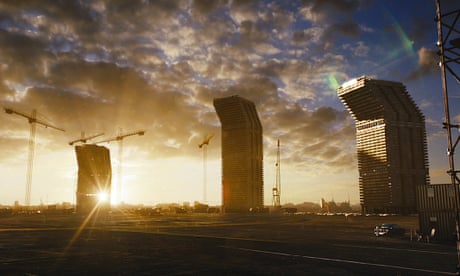
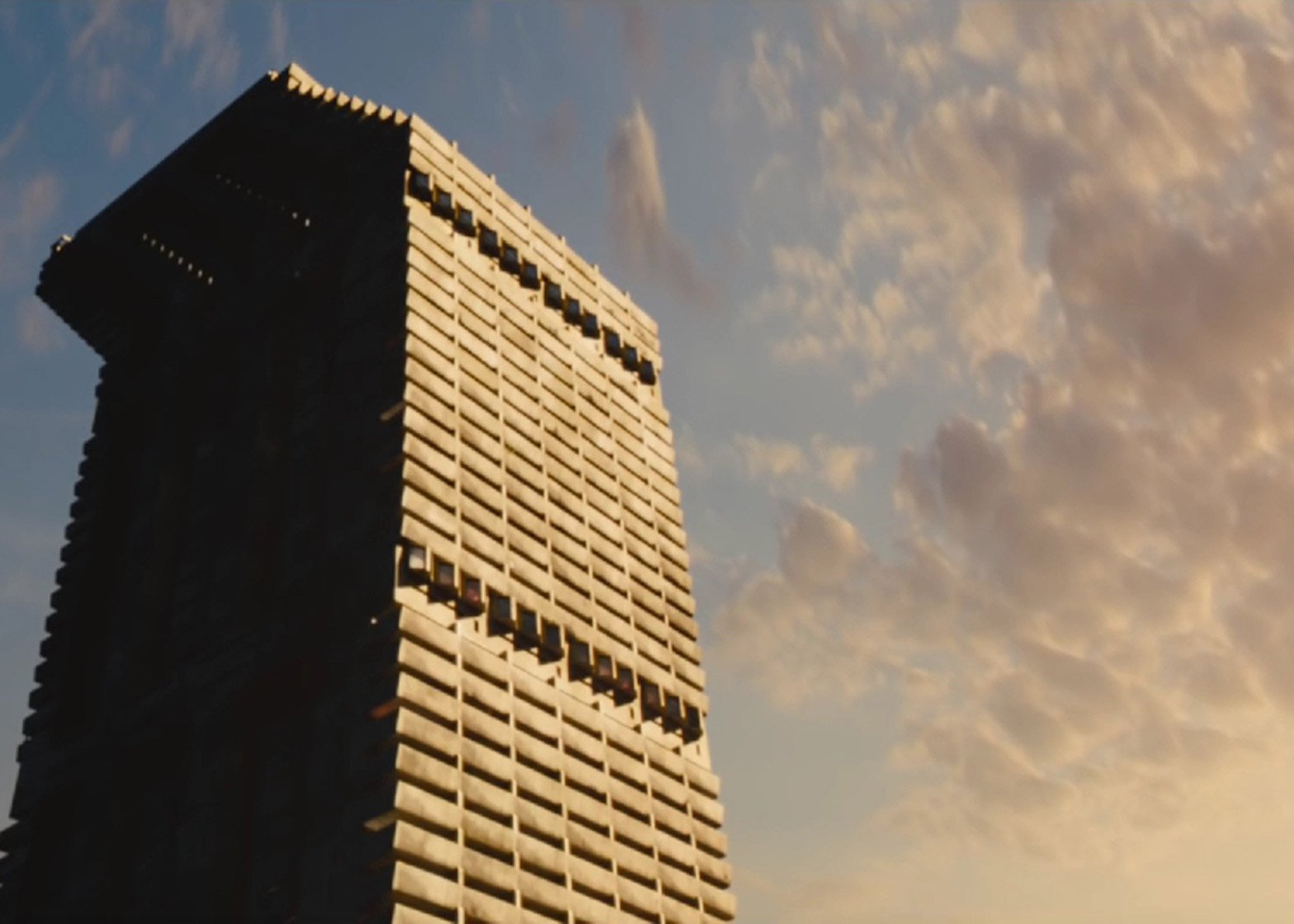
As the title suggests, most of the action takes place at a massive high-rise apartment building. While located in London, the building is nevertheless isolated from the rest of the city. With its slanted and jagged modern art design (inside doorways and archways are mostly triangular in shape), the building is luxurious and welcoming. At the same time, it’s overwhelmingly grey in color (the entire building is made of concrete) and the barren, shabby parking lot surrounding it makes the structure look like an ominous, rundown prison. In fact, as the film goes on, “prison” becomes a more apt term to describe the building rather than “luxury high rise” and both the residents trapped inside the building and the viewer experience an intense feeling of claustrophobia.

In England during the 1950’s, 60’s and 70’s, there was a boom in high-rise construction. These structures were meant to exhibit post-war progress and modernity; instead they were a hassle. Often times they were cheaply and hastily made, leading to frequent maintenance problems. There were also issues of security (break ins, vandalism etc.) and an unpleasant feeling of isolation; residents felt cut off from society.  

Ballard’s original novel was clearly addressing this unsavory situation, however, the book (as well as the movie) goes much further by presenting a far more bleak, apocalyptic vision of high-rise living and modern life in general. This state of the art structure, that’s supposed to signal progress, causes societal regression and the de-evolution of our species.  Bleak indeed.

Complementing this apocalyptic viewpoint is the film’s overt themes of class division and warfare. Due to its all-inclusive nature (a shopping mall, swimming pool and even a school are included) the building becomes a microcosm for society, with the wealthier residents living on the top floors and poorer residents near the bottom. In between lies the film’s protagonist Dr. Robert Laing (Tom Hiddelson, equal parts understated and sinister) the building’s newest resident, who makes friends from both the lower and higher floors, most notably Anthony Royal (Jeremy Irons) the building’s architect and “ruler” of sorts. The upper floor residents are grotesque caricatures of wealthy people, who frequently throw elaborate parties (involving booze and orgies) that take power away from the lower floor rooms. This tension between the upper and lower floor residents drives the action of the first half.

Can the movie feel a little too blatant and heavy-handed? Yes. Wheatley hits the “building-is-society” and “class divide” themes pretty hard talking down to his audience in the process. The screenplay by Amy Jump contains some stupid, ham-fisted dialogue that tends to over explain and snaps you out of the moment. For example, during a scene where Laing is walking up the stairs, he’s stopped by a wealthy tenant who says, “Social climbing…are we?” And later on Laing tells Royal right out: “you hold the key to the building…symbolically.”

However, “High Rise” remains watchable thanks to its sheer nuttiness and unpredictability. The film is a hypnotic fever dream that becomes more delirious and dislocated from our reality with each passing minute. The focus shifts from class warfare to chaos and anarchy, a trajectory that proves to be far more compelling and terrifying than a simply rich vs. poor conflict because there are no clear-cut good and bad guys.


Everyone, upper floor and lower floor, goes mad-- reverting back to savagery, roaming around in small factions causing damage and mayhem. Socioeconomic status becomes superfluous.   The building itself eventually loses power for good while the hallways and corridors become trashed. The once luxurious, all-inclusive high rise is now a disheveled industrial ruin populated by deranged squatters who seem to have no regard for one another. In this feverish state, the picture inspires both moments of inspired, twisted humor and horror in equal measure. A rape sequence (or rather the moment right before the rape and after) involving two supporting characters that used to be friends is genuinely disturbing and icky.

“High Rise” can be repetitive and tedious; there are too many slow motion party/orgy montages that cause the film to drag every now and then. Additionally, some people may find the movie difficult to enjoy because Laing and the rest of the residents are so emotionally distant as characters. There isn’t anyone you can fully connect or sympathize with mainly because they don’t connect or sympathize with one another, especially when all hell breaks loose.


Even so, Wheatley has crafted a bizarre, thought provoking feature about modernity and urban living gone horribly wrong.


B-