Friday, July 14, 2017

Valerian and the City of a Thousand Planets Review (2017)


“Valerian and the City of a Thousand Planets,” is a sprawling, overwhelming, exhausting Sci fi epic.  Writer/director Luc Besson (“The Fifth Element,” “Lucy”) crafts a weird, vibrant Sci fi world bursting at the seams with creativity and visual splendor. A plethora of diverse alien cultures, civilizations, eco systems and nifty gadgets mesh together in absurd and exhilarating ways. As in “The Fifth Element,” world building is this film’s greatest strength and it almost distracts you from the bland protagonists and overly convoluted plot.

The titular ‘City of a Thousand Planets” (known as Alpha in the movie) is actually the new and improved International Space Station. As we see in the film’s inventive opening credit montage, what was once a station inhabited by humans from thousands of countries around the world has slowly grown into a home for hundreds of alien races and species from across the universe. In another section, we’re transported to a seemingly barren desert planet called Kyrien that’s home to a massive, bustling marketplace that exists in another dimension and can only be accessed via special equipment.

Besson and production designer Hugues Tissandier create a living, breathing cinematic environment. The City of a Thousand Planets isn’t just a one-dimensional backdrop for the characters to stand in front of and play out the central plot; it’s a character in and of itself. There’s a lot of detail and texture here; you’re overwhelmed by it but you also can’t get enough. The first hour and a half of the picture is an immersive, breathless wonder-- Besson guides us through this chaotic and intricate filmic space, introducing us to dozens of eccentric bit characters and creatures (that could have their own movies) along the way.


If only the rest of “Valerian” had been better. The plot is that of a socially conscious mystery involving government cover-ups, alien refugees and the importance of not covering up ones ugly past. This all sounds intriguing enough and it can be but it also gets needlessly convoluted. During the last third the cool and irreverent world building ceases and the film just becomes a confusing slog. When we reach the pivotal moment, wherein all facets of the central mystery are finally revealed, a lot of additional exposition is shoehorned in, making for a tedious and mind-numbing finale. Besson ties up all the narrative lose ends in sloppy, overly melodramatic and even heavy-handed ways.

“Valerian” also suffers from ho hum main characters. Our protagonists are Valerian (Dane DeHaan) and Laureline, (Cara Delevinge) two young agents that work for Alpha and are semi dating. Valerian and Laureline are standard issue: he’s the laid back, cocky playboy while she’s uptight and no nonsense. Pretty much all of their personal and romantic drama consists of Valerian trying to prove to Laureline he’s mature enough for her. Yawn. For a movie that takes place in such a vivid futuristic world and loaded with various alien species, it’s kind of disappointing that our protagonists are so run of the mill. There’s nothing particularly memorable or unique about them.

DeHaan does his best to play slick and charming but his low voiced, too-cool-for- school attitude is affected to the point of obnoxiousness. He consistently takes you out of the film. Delevinge fairs a little better but even her performance, her runway model-esque body movements and facial expressions, can come off robotic. Although Besson’s screenplay doesn’t do either actor any favors. It’s full of terribly cliché dialogue—the romantic banter is cloying while the comedic banter is painfully awkward and unfunny. Valerian and Laureline’s romance is cornball to say the least, which isn’t inherently a bad thing but the script renders it inauthentic.

Ultimately, I stopped caring about Valerian and Laureline, instead wanting to go exploring in this rich and colorful Sci fi world on my own. There’s a lot to look at and experience in “Valerian,” which means I can’t totally dismiss the film. But it certainly could have been better.


C+ 

Sunday, July 9, 2017

War for the Planet of the Apes Review (2017)


Matt Reeves’ “War for the Planet of the Apes,” the third and final installment of this new “Apes” series, is a big bummer. We’re a long way from the rousingly cheesy, self-reflexivity of “Rise of the Planet of the Apes,” and even the somber tone of “Dawn of the Planet of the Apes” seems light when compared this film’s apocalyptic outlook.

An impending, unavoidable sense of doom lingers in every scene. Michael Seresin’s cinematography is muted and grey hued; death and destruction is everywhere. There’s no getting around it: you’re screwed. Well, you’re screwed if you're a human. Humans were the ones who experimented on apes in the first place, indirectly sparking a smart ape rebellion, and they’re the ones who developed the virus that wiped out a sizable chunk of the population, a virus that’s still inflicting damage. And now the humans want to blame the apes for the human concocted devastation. In “Dawn,” ape-human conflict was also unavoidable but the ending provided a modicum of hope; humans and apes could get along. In this film, there is no hope. Humans are determined to annihilate the apes…and each other.

“War for the Planet of the Apes” is an uncomfortable, morose drama about the sheer ugliness of humanity. “Rise” and “Dawn” tried to create sympathetic, likable human characters but in “War” there are none. * In fact, the only fleshed out human is a delusional, psychopathic military colonel simply known as The Colonel (Woody Harrelson, bald, menacing, resembling Colonel Kurtz) who’s leading the charge against the intelligent simians and even runs an ape concentration camp. Yes, an ape concentration camp. Watching the film, you can’t help but root for humanity’s demise. And honestly, that’s okay. The sympathetic human characters were always the weakest links in “Rise” and “Dawn.” Talented actors like James Franco, Jason Clarke and Keri Russell played such thin, inconsequential characters whose sole purpose was to demonstrate that not all humans were cruel or obsessed with senseless destruction.


The apes are who we really care about--especially their noble and assertive leader Caesar (Andy Serkis, remarkable as always). These movies have always been about Caesar and his coming of age, from carefree chimp raised in a human environment, to the gracious but fierce leader of the apes he is now, trying to find an ape paradise and live in peace away from brutal, self imploding humanity. We always rooted for the apes to rebel against their cruel captors. What visceral joy we felt when a young Caesar stood up to Draco Malfoy and defiantly roared “No!” breaking his kind out of captivity and running amuck in San Francisco.

Instead of trying to create more James Franco’s and Jason Clarke’s, “War” gives us nothing but Draco Malfoy’s. This decision feels appropriate given the series’ tonal shift from silly popcorn action to somber, end of the world drama and it makes for a more focused movie.  Now we don’t have to pretend we care about the humans. Just go ahead and destroy yourselves, please!


Reeves’ frames the narrative entirely from the point of view of the apes. The film takes place a few years after the turbulent events of “Dawn,” as Caesar and his tribe of simians have taken refuge in a cave deep in the forest. Now grizzled and battle worn, Cesar desperately wants peace but that’s not possible right now. Caesar is compassionate and clear-headed, with a violent and sometimes uncontrollable temper. “War for the Planet of the Apes” sees him grapple with his impulsive, animalistic tendencies. After suffering heavy, personal losses at the hands of The Colonel, Caesar loses his cool and embarks on an admirable but single-minded quest for vengeance that puts his entire tribe in jeopardy. Instead of getting satisfaction, Caesar gets more suffering.


Despite what the title suggests, there’s very little in the way of action in the film, outside of an introductory forest set battle and a climactic battle set near a small mountain. It’s more of a misanthropic drama about the costs of war and impulsive aggression than a full-fledged war movie.

One of this franchise’s greatest strengths is the way it emphasizes character and emotional vitality over spectacle and action. In “War,” the action is pared down to the essentials, making room for more intimate character interactions— conversations between Caesar and Maurice (Karin Konoval) and Rocket (Terry Notary) his loyal comrades who accompany him on his journey. Understated, poignant moments are prioritized over large, bombastic ones. Caesar’s conversation with The Colonel where we catch a glimpse inside the soldier’s dark and tormented soul is bone chilling, while the look of immense pain and regret on Caesar’s face when he first discovers the damage his revenge quest has done is heartbreaking.

I’ll be curious to see how well this film does with general audiences. It’s not action packed and it’s not very fun. It’s one of the most cynical blockbusters I’ve ever seen. Additionally, the marketing has been all over the place, with TV spots suggesting plotlines that don’t exist and a string of wildly misleading patriotic themed posters. 20th Century Fox is having trouble selling “War for the Planet of the Apes” because it’s a hard sell. It’s deeply unsettling, with a very ugly view of humanity. But it’s also a very moving, rewarding experience and an excellent conclusion to a superb trilogy.  

 A-


*That’s not entirely true. There is a little blonde girl, Nova (Amiah Miller) who is picked up by Caesar during his journey. It’s difficult to not care about a child in a movie but there isn’t much to her character. Despite what certain trailers will tell you, Nova does very little. In the end, she does sort of serve a purpose but she could have been removed from the film without any problems.  

Friday, June 30, 2017

Spider-Man:Homecoming Review (2017)


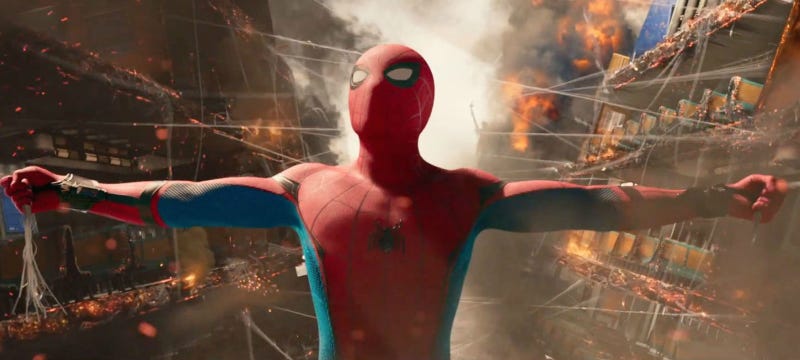
One of the best things about Jon Watts' “Spider-Man: Homecoming,” (the second “Spider-Man” reboot in three years and third overall) is that it isn’t saddled with burden of delivering Spider-Man’s exhaustive origin story yet again. He was already introduced in last years “Captain America: Civil War” (Spidey is now officially part of the MCU, instead of having a standalone franchise) and therefore we don’t have to watch fifteen minutes of “pre Spider-Man” Peter Parker.

We don’t have to watch him get bit by a radioactive spider or comfort his dying Uncle Ben in a dark alley again. It makes for a faster, less bloated, less redundant “Spider-Man” picture. If I had to watch Uncle Ben get killed for the third time this century, or watch a bewildered Parker discover his abilities while starring at himself in a mirror, I might have walked out. This new iteration of Spiderman is ready to go: a vigilante with spiderlike powers and snazzy red and blue tights. Thank god.

Of course, Parker is still a dorky teen with dorky teen troubles. “Spider-Man: Homecoming” finds a sweet spot between goofy, enduring teen movie and goofy superhero movie. We’re dropped in the middle of Parker’s (Tom Holland) hectic life as he balances normal adolescent struggles (fitting in at school, girl crushes, parties, dances) with crime fighting. These competing lives often clash in nutty and unexpected: we get an Academic Decathlon trip that doubles as a superhero mission, that later turns into a rescue at the Washington Monument. In another scene, Parker and his friend Ned (Jacob Batalon) dissect an alien weapon during wood shop class. And later on there’s a delightful superhero inspired twist on the classic “boy-meeting-his-date’s-father-for-the-first-time” moment.


“Spider-Man: Homecoming” captures the immaturity and inexperience of its teen protagonist extremely well. Parker is hyper and overly excited, eager to become a member of The Avengers but is far too undisciplined and unprepared. His attempt to interrogate a criminal goes horribly wrong, as do his attempts to stop a bank robbery and save a ferry full of civilians. Parker bites off more than he can chew when he launches his own investigation into underground arms dealer Adrian Toomes (Michael Keaton). Parker can certainly walk the Spider-Man walk but in big moments he’s, more often than not, amusingly incompetent.

“Spider-Man: Homecoming” is about the consequences of wanting to grow up too fast, and learning to enjoy just being a kid. Spidey’s not quite ready to fight with the big boys and that’s okay. It’s a teen angst movie with a superhero. More so than any other “Spider-Man” movie, “Homecoming” emphasizes the naive adolescent angle of the character in an appealing and genuine way. Holland is fantastic, playing Parker with the right amount of awkward charm and ADD tinged annoyance. Sometimes it’s a blast following him around and other times I felt kind of embarrassed to be in his presence. Like any good, well-rounded teen movie protagonist, Parker is adorable and kind of a nuisance--very relatable in both cases, especially the latter.


Though, perhaps the most enjoyable aspect of “Homecoming” is just how fun it is. The film zips by and has an easy-going, laissez-faire attitude It’s a teen angst film that isn’t too angsty; in fact it takes plenty of opportunities to mock Parker’s angst and the high school film all together.

It’s also very funny; the screenplay by Jonathan Goldstein, John Francis Daley, Watts, Christopher Ford, Chris Mckenna and Erik Sommers is packed with jokes and witty banter. Everyone, including the supporting characters who peek their head in for a scene or two (Hannibal Buress as a gym teacher) gets be snarky and quick witted. Batalon is a magnificent comedic sidekick; the montage in which Ned asks Parker an endless barrage of questions about being Spider-Man is among the film’s highlights. Marissa Tomei has a few memorably kooky scenes as Aunt May, as does Tony Revolori as a bully of sorts who is also a DJ and a member of the school’s Academic Decathlon team. All of which make “Homecoming” irresistibly charming.


As the primary villain, Toomes is solid. He’s not very memorable, despite Keaton’s hammy, intimidating performance but at least he’s not the usual power hungry supervillain who wants to level New York City or raise a drone army or something. He’s just an average, non-flashy, blue-collar criminal trying to support his family and receive his fair share. As a result of this, the climactic third act battle ends up being a drastic improvement over a majority of recent superhero flicks, including “Wonder Woman.” It doesn’t involve an excessive amount of city damage or an interdimensional portal having to be closed. It’s refreshingly small scale, coherently staged and even inventive.

Tony Stark, aka Iron Man (Robert Downey Jr.) shows up occasionally as a parental figure to give Parker a few “be responsible” speeches (You know you’re undisciplined when Tony Stark tells you to shape up) and to remind us that this is an Avengers movie. The efforts to connect Spidey to the larger MCU can cause the film to lag, especially when it suddenly becomes an “Iron Man” reunion. Both Jon Favreau and Gwyneth Paltro show up. That being said, I’ll gladly take an “Iron Man” reunion over watching Uncle Ben die again.

“Spider-Man: Homecoming” is imperfect but for being the third “Spider-Man” reboot in fifteen years, it’s pretty damn good and one of the better recent MCU films.

B 

Wednesday, June 28, 2017

The Beguiled Review (2017)


What happens when a group of horny, restless people are cut off from the world and stuck in a confined space with little to do? As Sofia Coppola’s delicate and explosive “The Beguiled” shows us, they lose their minds.

Based on the book by Thomas Cullian, (and a remake of Don Siegel’s 1971 film starring Clint Eastwood) “The Beguiled” is a tight, wildly entertaining psychological thriller about repressed desires and primal urges exploding out into the open in tense and often violent ways. It’s mild mannered and chaste, yet scenes drip with sexual tension and crackle with devious energy.  The film is playful, with its sexual innuendos and Freudian undertones, and appropriately restrained—operating with subtlety and nuance. Writer/director Coppola brings precision and intelligence to what could easily be an overly trashy and toothless erotic thriller.

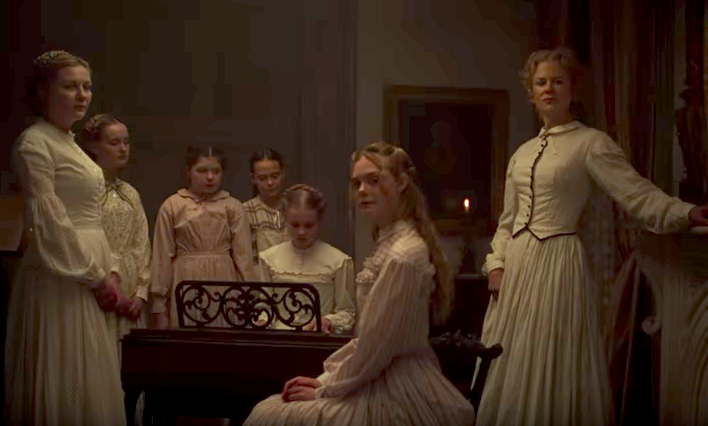
The film is set in Virginia during the last years of the Civil War. At a girl’s school, two women and five girls live an isolated, austere existence. The resilient schoolmarm, Miss Martha (Nichol Kidman) keeps the girls busy with schoolwork, religion and farm labor. Her second in command is Edwina (Kirsten Dunst) and the girls consist of: Amy, (Oona Lawrence) Alicia, (Elle Fanning) Jane, (Angourie Rice) Marie, (Addison Riecke) and Emily (Emma Howard).  “The Beguiled” assembles a superb cast that all give layered, understated performances. Kidman, in particular, shows that she’s one of the best actors working today.


The situation changes when Amy brings a wounded Union soldier, Corporal McBurney (Colin Farrell) through the school’s front gates, disrupting the routine. At first, McBurney is greeted with fear and mistrust but as he spends more time at the school, the women begin to view him as desirable. He has a calm, down to earth demeanor-- sensitive and quietly smooth. First, Edwina and Alicia develop feelings for him and take turns flirting with him in secret. Soon, everyone is enamored by McBurney, which leads to a wonderfully ridiculous dinnertime scene in which they all vie for his attention and affections, without directly coming onto him. McBurney happily obliges. He knows full well the kind of effect he has in this all female setting and slyly plays the women against one another.

However, said playfulness gets out of hand and gradually morphs into to conflict, taking the film down a tensely feverish path. The characters in “The Beguiled” let their silly romantic feelings and urges turn to jealousy, bitterness and even vengeance--bringing out the worst in one another and losing a part of their humanity in the process. When his charming ways eventually backfire on him, McBurney reveals an antagonistic side of his personality that takes us by surprise. Even the stern, deeply religious Miss Martha shows an ugly, spiteful side to her that we didn’t know was there. Coppola’s screenplay avoids clear-cut good guys and bad guys; her characters are at once sympathetic and recklessly petty, their emotions sometimes leading them to exhibit borderline psychopathic behavior.


Additional conflicts and suppressed desires (Edith being unhappy at the school and wanting to leave) make their presence known, causing further internal disarray.  Miss Martha tries to shield her girls from the senseless realities of the war but ugly, senseless conflicts burrow their way in anyway. Coppola directs the picture with such a sure hand, moving the action along at a slow but thrilling pace, like she’s gently stretching a rubber band out, giddily waiting for the right time to let it snap. Coppola’s film is a worthy companion piece to the superb Siegel version and a wickedly thrilling picture on its own.

B+

Monday, June 26, 2017

Baby Driver Review (2017)


Perhaps the best thing about Edgar Wright as a filmmaker is that he really uses the medium. Unlike, say, Judd Apatow, who’s enamored by the long winded riffing between two experienced comedians (interactions that are generally captured in boring medium and close up shots) Wright shrewdly marries editing, action choreography, sound and cinematography together to create zany, genre blending experiences.*  Yes, his hyper, always-moving style can sometimes feel relentless and wear thin (particularly during the third act) but for the most part they make for a fun time at the movies. Wright’s latest film, “Baby Driver” is no exception.

“Baby Driver” is exuberant, fast paced and tightly scripted. There’s not much in the way of fat—no scene goes on longer than it needs to. The picture isn’t just a collection of jokes and improve-y back and forths poorly glued together to resemble a feature length film. Wright firmly believes in narrative and structure to keep things organized and the action moving. Story and character come first, while the humor flows effortlessly out of them. “Baby Driver” keeps to a meticulous and playful comedic rhythm, sort of like a classic screwball comedy with more music, heavier cutting and a lot more action.

Wright also likes working within established genres. “Baby Driver” embraces a well-worn sub genre of the crime film—an expert criminal trying to get out that dangerous life but that life wont let him leave. In this case, that expert criminal is a young (talented) getaway driver known as “Baby” (Ansel Elgort). A good kid who mostly means well, he works for the master criminal Doc, (Kevin Spacey) doing jobs to pay off a debt he acquired years ago. Once he finishes paying off said debt, Baby wants to leave, especially after meeting diner waitress Debra (Lily James) but this proves to be more difficult than he thought.


“Baby Driver” is Wright’s hyper screwball take on films like “Thief” and “Drive.” It’s kinetic and cartoon-y, with a palpable undercurrent of violence and danger. The criminals that Baby brushes up against, including Bats (Jamie Foxx) and Buddy (Jon Hamm) are cold-blooded and sadistic.

The most inventive thing about “Baby Driver” is the way it uses music and sound. Baby’s most prominent characteristic is that he’s always listening to music on his IPod, to drown out the constant ringing in his ears caused by a childhood accident. As a result, Baby structures his entire life around the music he’s listening to, including his getaway driving. In one scene, just as the crew he’s working with is about to pull off a bank-robbing job, Baby makes them wait temporarily so he can sync it up with a song. Music is his way of dealing with his personal trauma as well as a method for maintaining order among disorder. He makes this dangerous life just a little more tolerable.

 Almost every scene is scored with some pop or rock song, which in turn informs everything else in the frame. The editing, the blocking, the choreography and all the individual Foley sounds are synched to whichever song Baby decides to play, making for vigorous, carefully constructed symphonies of action and sound. In another scene, an entire gunfight is synched to the song “Tequila.” (Wright is one of the few directors who can make a gunfight or a car chase funny). In this regard, “Baby Driver” is Wright’s manic, clever take on the musical.


Admittedly,  “Baby Driver” lacks the emotional and character depth of Wright’s best films. Outside of Baby, the other characters are thinly developed and his relationships, with Doc, Debora, or his deaf guardian Joseph (CJ Jones) aren’t as poignant or fleshed out as the bromantic bonds in films like “Hot Fuzz and “Shaun of the Dead.” Wright’s frequent collaborators Nick Frost and Simon Pegg are absent from this outing, both in front of and behind the camera, which can be felt.

Additionally, the picture goes off the rails during the last act; the action begins to get a little repetitive and tedious while the narrative loses focus. It takes a peculiar outlaw-lovers-on-the-run turn involving Baby and Debora that doesn’t quite work. The way Debora gets thrown into the central criminal action is too far fetched. In fact the romantic angle overall, while cute, feels a bit shallow and forced.

Even so, “Baby Driver” is a lot of fun and continually demonstrates just how great a comedic (and action) filmmaker Wright is. Lesser Wright is still worth experiencing on a big screen.

B


*
Here is an excellent video essay the goes into further depth about Wright’s filmmaking and the way he creates humor: https://www.youtube.com/watch?v=3FOzD4Sfgag


For the record, I don’t hate the Apatow style of filmmaking but I vastly prefer Wright’s method.