Tuesday, May 17, 2016

X-Men: Apocalypse Review (2016)


On the outside, Bryan Singer’s “X-Men Apocalypse” (the third “X-Men” film in a new series, preceded by “X-Men: First Class” and “X-Men: Days of Future Past”) seems unremarkable, especially when compared to the other big budget superhero extravaganzas that have already come out.

 In “Batman v Superman: The Dawn of Justice” and “Captain America: Civil War” the superheroes fight each other instead of some maniacal villain hell bent on world domination. In theory, it’s a great idea not only because it bucks convention but because most of the recent superhero movie villains have been well, pretty lame. Aside from a few exceptions they are one-dimensional after thoughts--shoehorned into the action because superhero movies need villains.

In contrast, “X-Men Apocalypse” follows the more familiar, tried and true superhero film structure: there’s a new powerful bad guy who wants to destroy the world, so a group of heroes must unite and stop him. To make up for the stale plot structure, Singer’s film has a sense of danger and urgency that the superhero-on-superhero conflicts of “Captain America” and “Batman v Superman” lack.

In “X-Men: Apocalypse,” the threat of world destruction feels more significant and plausible because the bad guy making said threat means business. And the film doesn’t shy away from showing the ugly repercussions of his wrath. To put it in simpler terms, we see people die.

All three films attempt to deal with the heavy themes of collateral damage and the cost of war, in an attempt to ground these often outlandish situations in the real world and raise the stakes. While these superheroes are off fighting evil, causing thousands of dollars worth of city damage, what about the hundreds of innocent civilians that are caught in the crossfire? However, “Batman v Superman” and “Captain America” address these issues in a fairly safe and impersonal way.

In the case of “Captain America,” government people and politicians tell the heroes about the damage they’ve caused and the innocent lives lost. A random woman confronts Tony Stark (Robert Downy Jr.) telling him that her son died inadvertently during one of the Avenger’s scuffles. In other words, we’re mainly told about the collateral damage without seeing it.


On the other hand, “X-Men: Apocalypse” explicitly deals with the costs of conflict and terrorism. The film has the courage to show people dying (innocent civilians as well as a few of the supporting mutants) on screen in abrupt and sometimes disturbing ways. During a sequence that takes place on the dusty crowded streets of Cairo, a row of four civilians is instantly decapitated while a fifth guy is grotesquely melded into a cement wall, a moment treated so casually and coldly that it made my eyes widen.

It may seem peculiar to want death in a PG-13 superhero flick but seeing some casualties of war and terrorism (it doesn’t have to be excessive) increases the level of danger; too often the threat of world domination/destruction in these movies feels hollow. In “X-Men,” blood is shed and the cost is felt.

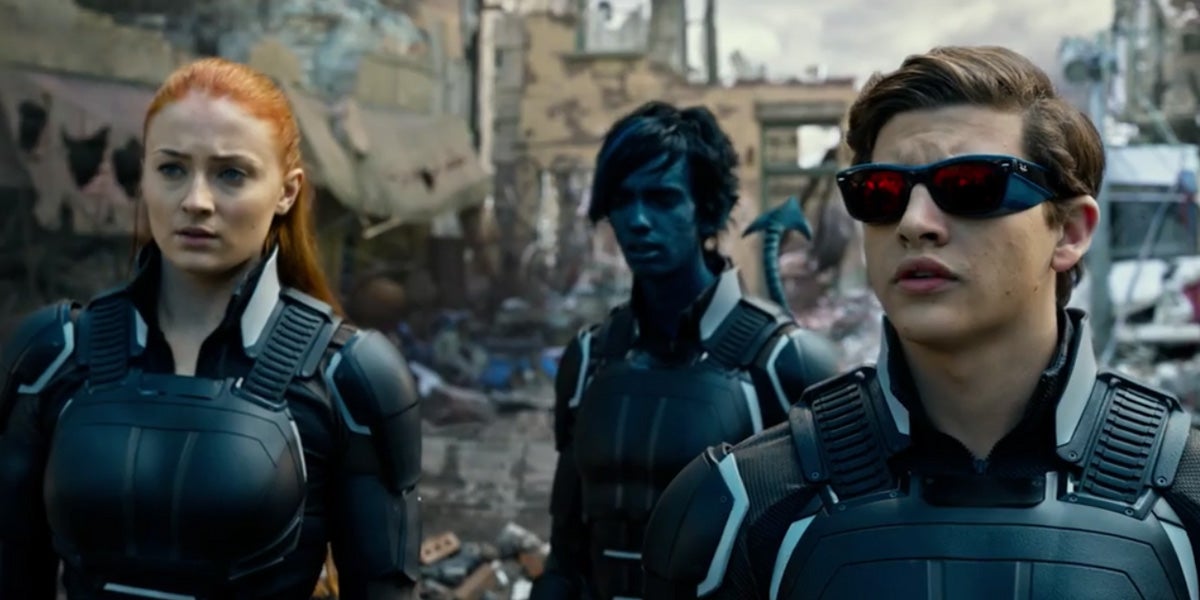
I suppose now is a good time to cover the plot basics. The year is 1983 and the world doesn’t know how to feel about mutants; should we fear them or accept them? Professor Charles Xavier (James McAvoy) is busy running his special mutant school, teaching younger mutants like Cyclops, (Tye Sheridan) Jean Grey (Sophie Turner) and Nightcrawler (Kodie Smit-Mcphee) to control and come to terms with their abilities.


Meanwhile the film’s baddie, Apocalypse (Oscar Isaac) has been resurrected after spending well over a thousand years trapped in an ancient Egyptian tomb. Apocalypse isn’t all that different from Xavier; they’re both extremely powerful and influential “super mutants” that want to unite fellow mutants. It’s just that Xavier wants peace and assimilation and Apocalypse wants to…“cleanse” the earth of non-mutants, if you catch his drift.

With his demon-like appearance (smooth bald head and sickly blue-grey skin) and whispery voice, Apocalypse isn’t the most charismatic comic book villain but he’s damned intimidating. From the beginning he’s established as an ominous, substantial presence in the action. He kills people with such calm, taciturn malice that’s slightly bone chilling. In one sequence, set in a Polish factory, he kills about seven or eight innocent factory workers instantly (with his mind) like it’s no big deal. Another moment that made my eyes widen.

The fact that we see people die so casually and abruptly like this makes the character and the film all the more unsettling and alarming. When Apocalypse says he wants to “cleanse” the earth you know he’s fully capable of doing so.

And then there’s Magneto (Michael Fassbender), who turns out to be one of the most compelling and conflicted characters. He spends most of the film walking the line between good guy and bad guy. So much of his life has been characterized by tragedy and anger up to this point that he simply wants to live a normal life. However the world won't let him, so he’s driven back into the realm of vengeance and hatred, vengeance and hatred not towards a single person or even a group of people but rather towards the human race in general. There’s a point in the film where wants to inflict harm on innocent people; he has a withdrawn look of disdain in his eyes that's unnerving.  As usual, Fassbender is in top form—playing Magneto with an understated sense of pain and fury.

Another key area “X-Men: Apocalypse” succeeds in is feeling like a complete and self-sufficient movie that can stand alone outside its franchise. Some many recent super hero flicks feel like extended teasers for future films because they’re part of an expanded, ever-growing cinematic universe. Part of the reason why “Batman v Superman” was so lackluster is because it had to set up characters and plotlines for future films, (“The Justice League” and “Wonder Woman”) which cluttered and trivialized the current narrative.

On the flip side, “X-Men: Apocalypse,” is self-contained. With the exception of one scene, all of the characters and plot strands work in service of the central narrative. Everything is fully realized and instead of looking towards future installments, “X-Men Apocalypse” keeps its feet firmly planted in the here and now.


“X-Men: Apocalypse” suffers from some clunky expository dialogue and the ultra talented Rose Byrne (as a non-mutant C.I.A. agent) is given nothing to do except be a part of a poorly developed romantic side plot between her and Xavier. The picture certainly doesn’t reinvent the superhero movie; the broad strokes of the narrative are familiar and the resolution is what you’d expect. Yet, the heightened sense of danger pulsing throughout elevates this otherwise standard superhero narrative. Had “X-Men” not been constrained by a PG-13 rating and the need to maintain a franchise, it could have gone even further in showing the ugly, darker side of these onscreen superhero squabbles.

B


Thursday, April 28, 2016

High Rise Review (2016)


Ben Wheatley’s weird, ambitious new feature “High Rise” (based on the 1975 novel by famed post-modern author JG Ballard) certainly sticks with you long after the end credits. It’s a surrealistic black comedy and a macabre nightmare about urban living rolled into one.

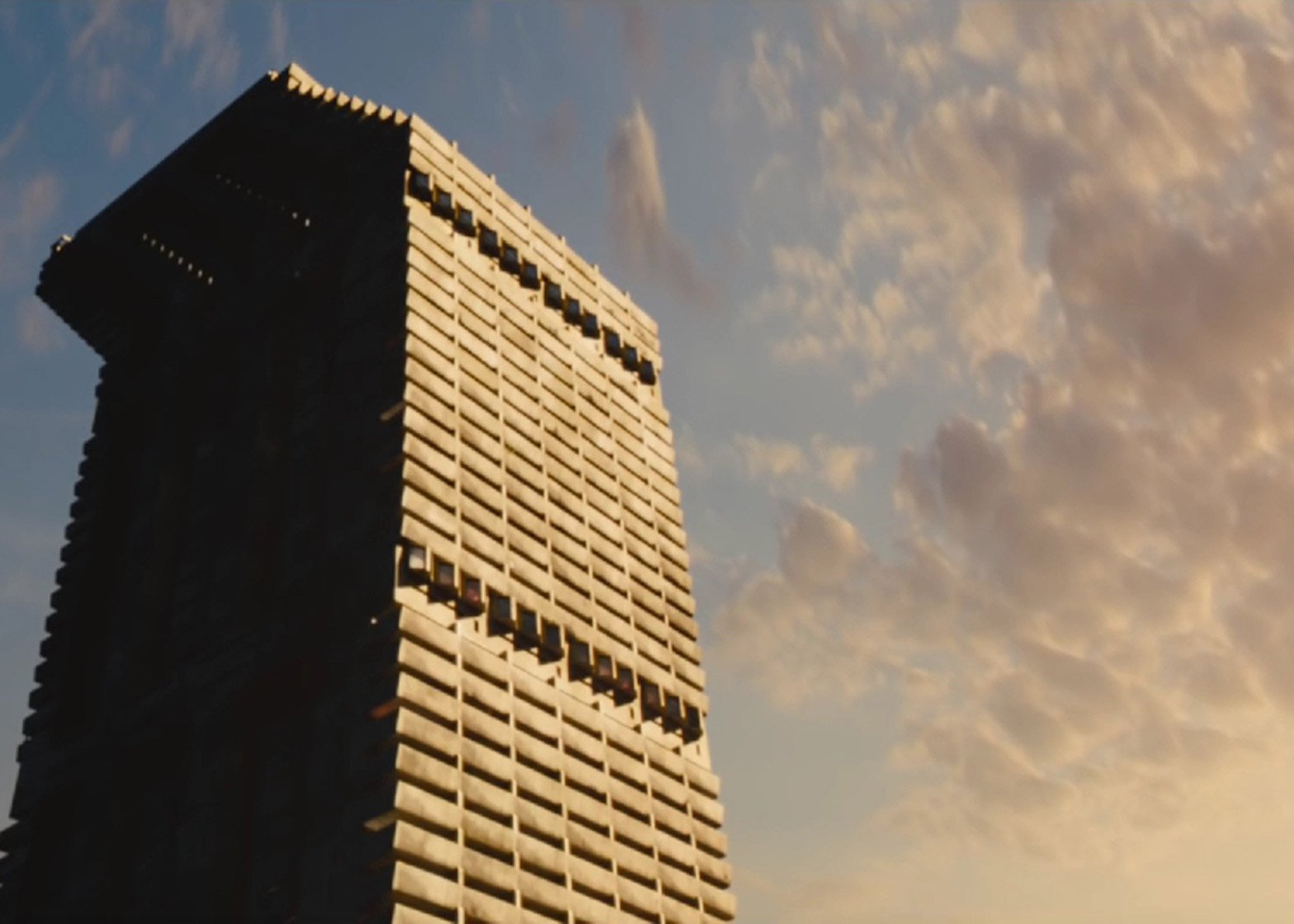
As the title suggests, most of the action takes place at a massive high-rise apartment building. While located in London, the building is nevertheless isolated from the rest of the city. With its slanted and jagged modern art design (inside doorways and archways are mostly triangular in shape), the building is luxurious and welcoming. At the same time, it’s overwhelmingly grey in color (the entire building is made of concrete) and the barren, shabby parking lot surrounding it makes the structure look like an ominous, rundown prison. In fact, as the film goes on, “prison” becomes a more apt term to describe the building rather than “luxury high rise” and both the residents trapped inside the building and the viewer experience an intense feeling of claustrophobia.

In England during the 1950’s, 60’s and 70’s, there was a boom in high-rise construction. These structures were meant to exhibit post-war progress and modernity; instead they were a hassle. Often times they were cheaply and hastily made, leading to frequent maintenance problems. There were also issues of security (break ins, vandalism etc.) and an unpleasant feeling of isolation; residents felt cut off from society.  

Ballard’s original novel was clearly addressing this unsavory situation, however, the book (as well as the movie) goes much further by presenting a far more bleak, apocalyptic vision of high-rise living and modern life in general. This state of the art structure, that’s supposed to signal progress, causes societal regression and the de-evolution of our species.  Bleak indeed.

Complementing this apocalyptic viewpoint is the film’s overt themes of class division and warfare. Due to its all-inclusive nature (a shopping mall, swimming pool and even a school are included) the building becomes a microcosm for society, with the wealthier residents living on the top floors and poorer residents near the bottom. In between lies the film’s protagonist Dr. Robert Laing (Tom Hiddelson, equal parts understated and sinister) the building’s newest resident, who makes friends from both the lower and higher floors, most notably Anthony Royal (Jeremy Irons) the building’s architect and “ruler” of sorts. The upper floor residents are grotesque caricatures of wealthy people, who frequently throw elaborate parties (involving booze and orgies) that take power away from the lower floor rooms. This tension between the upper and lower floor residents drives the action of the first half.

Can the movie feel a little too blatant and heavy-handed? Yes. Wheatley hits the “building-is-society” and “class divide” themes pretty hard talking down to his audience in the process. The screenplay by Amy Jump contains some stupid, ham-fisted dialogue that tends to over explain and snaps you out of the moment. For example, during a scene where Laing is walking up the stairs, he’s stopped by a wealthy tenant who says, “Social climbing…are we?” And later on Laing tells Royal right out: “you hold the key to the building…symbolically.”

However, “High Rise” remains watchable thanks to its sheer nuttiness and unpredictability. The film is a hypnotic fever dream that becomes more delirious and dislocated from our reality with each passing minute. The focus shifts from class warfare to chaos and anarchy, a trajectory that proves to be far more compelling and terrifying than a simply rich vs. poor conflict because there are no clear-cut good and bad guys.


Everyone, upper floor and lower floor, goes mad-- reverting back to savagery, roaming around in small factions causing damage and mayhem. Socioeconomic status becomes superfluous.   The building itself eventually loses power for good while the hallways and corridors become trashed. The once luxurious, all-inclusive high rise is now a disheveled industrial ruin populated by deranged squatters who seem to have no regard for one another. In this feverish state, the picture inspires both moments of inspired, twisted humor and horror in equal measure. A rape sequence (or rather the moment right before the rape and after) involving two supporting characters that used to be friends is genuinely disturbing and icky.

“High Rise” can be repetitive and tedious; there are too many slow motion party/orgy montages that cause the film to drag every now and then. Additionally, some people may find the movie difficult to enjoy because Laing and the rest of the residents are so emotionally distant as characters. There isn’t anyone you can fully connect or sympathize with mainly because they don’t connect or sympathize with one another, especially when all hell breaks loose.


Even so, Wheatley has crafted a bizarre, thought provoking feature about modernity and urban living gone horribly wrong.


B- 

Wednesday, March 30, 2016

Midnight Special Review (2015)


Writer/director Jeff Nichols’ “Midnight Special” is an ambitious amalgamation of different genres and styles of film. It’s constantly changing shape and evolving, making it difficult for the viewer to determine where its heading. The movie is mainly grounded in the mundane here and now, though it eventually pivots towards epic, awe-inspiring Sci fi. It’s a father-son drama and an “on-the-run-from-the-government” thriller. It’s a family friendly adventure flick with the same sense of mystery, wonder and excitement found in early Spielberg (think especially of “E.T. and “Close Encounters of the Third Kind”). It’s faith based but not in a heavy-handed, patronizing or even scathing way. In fact the faith aspect doesn’t have to do with a particular religion, but more that there are things in our world and the universe that are beyond our understanding and can’t be explained logically.

That sounds like a lot for one movie, and it is, but Nichols manages to weave all those ingredients (for the most part) into a cohesive narrative. It helps that he uses the road-trip/quest structuring device, which keeps the film moving at a snappy (but not too snappy) speed and from meandering too far off track. The characters are always on the move; they know where they need to go and what their objective is, although the audience doesn’t always know. More importantly, Nichols keeps the picture’s focus primarily on the father-son drama; their relationship is the guiding force through this wild, tense and emotionally poignant adventure.


“Midnight Special” gets going right away, beginning in aftermath of a child kidnapping. The two kidnappers Roy (Michael Shannon) and Lucas (Joel Edgerton) are holed up in a motel with the kid, Alton (Jaeden Lieberher). Roy and Lucas are dangerous and determined. Later, on the road, Lucas shoots and kills a state trooper. Getting caught and giving up the boy are the last things on their mind. We find out that Roy is Alton’s father and he’s taken him from a cult that worships him. Without going into much detail, lets just say Alton possesses extraordinary powers. Roy and Lucas meet up with Sarah (Kirsten Dunst), Roy’s ex wife and Alton’s mother. The ruptured familial unite has been temporarily restored and they continue on the run, while the cult and the government attempt to track them down.

That’s all I want to say in terms of plot because the mystery as to what exactly is going on (what’s up with Alton’s powers? Where is the family going?) is one of the most captivating things about “Midnight Special.” The picture is remarkably paced; the screenplay never reveals too much information at any one moment. Nichols keep the viewer in a consistent state of suspense; just when you think you have the film figured out it takes a left turn and throws you off its scent. There’s rarely a stagnant moment.

Yet, as exciting and tense as the film can be, it wouldn’t count for much without the strong emotional core brought on by the bond between Roy and Alton. Shannon is known for playing menacing, sometimes scene chewing, characters. He has a daunting physical appearance: an intimidating six foot three build, a rough looking face and a thousand yard stare that could melt ice. Here, however he’s appropriately low key and gentle, playing a father who would do anything to protect his son. At the same time, he’s still trying to full understand Alton and what he’s capable of doing. Ultimately, Roy has to do what’s best for him, even if it ultimately means letting Alton go, letting him go out into the world and find his place in it.

The young Lieberher is also quite strong (understated without becoming robotic) and I found his character’s growth to be one of the most emotionally resonant pieces of the movie. He begins as just another weird child with special abilities that we’ve seen a thousand times before. He’s an animate macguffin-- a living prop, objectified by those around him and misunderstood. To the cult, he’s their prophet; to the government he’s a weapon (he’s neither). In whatever context, he’s a valuable commodity. Though gradually, Alton transitions from object to subject, gaining awareness of himself (including his powers) and the world around him. Eventually, it’s Alton who confidently guides the family where they need to go. In this regard, “Midnight Special” is also a coming of age story; Alton’s evolution is handled with authenticity and tenderness.

Not surprisingly, “Midnight Special” can feel cluttered at times and certain intriguing aspects of the narrative are neglected. For example, the cult, lead by an old man named Calvin (Sam Shepard), plays a prominent role at the beginning of the film, but part way through Nichols abruptly tosses them to the side (after a somewhat superfluous scene involving a shootout at a motel) and we never hear about them again. It would have been nice had Nichols either kept them in or found a less sloppy way to write them out of the movie. Their bizarre devotion towards Alton’s make them a compelling antagonistic force, in addition to the pursuing government.  


Even so, “Midnight Special” is a fantastic movie, managing to be an exciting mystery/adventure/Sci fi and a poignant father/son drama. It gets better the more I think about it.

B+

Remember Review (2016)


Atom Egoyan’s “Remember” is frustrating, not because it’s necessarily bad but because it wastes an intriguing premise and a great performance by Christopher Plummer and settles for mediocrity. What could have been a superb drama/mystery about denial, repression and confronting the sins of one’s past is ultimately an instantly forgettable thriller with a twist ending.

Plummer plays Zev Guttman, an elderly former Auschwitz prisoner with Dementia. A few weeks after the death of his wife, Guttman breaks out of his nursing home and with the help of another former Auschwitz prisoner Max Rosenbaum (Martin Landau), who also lives at the rest home, he searches for the Nazi responsible for the death of his family. “Remember” is essentially a revenge/mystery picture--Guttman buys a handgun and travels to Cleveland, Canada and Boise. Egoyan handles the film with restraint and a deliberate pace and it isn’t dominated by excessive action or violence. Egoyan maintains a consistent atmosphere of suspense.

Is it somewhat ridiculous that an old man with Dementia could escape from his nursing home, visit multiple states, cross the Canadian boarder, threaten two innocent old men and draw next to no outside attention? Absolutely. In fact, Guttman’s son Charles (Henry Czerny) is somehow unable to get any leads on him. Yet, the narrative remains compelling enough to distract us from these logistical issues.

This may be the first revenge thriller where the protagonist is frail and suffering from Dementia. He forgets who he is and where he is, so often that you wonder if this guy even has the desire for this kind of vigilantism in the first place. Adding more intrigue is Rosenbaum who’s orchestrating this whole trip. He makes travel accommodations for Guttman, provides him the names and addresses of the potential Nazis, and a lengthy handwritten letter so Guttman can remember who he is and what his mission is. Rosenbaum is a manipulator and since we don’t know all the details of what went on all those years ago, it’s unclear as to whether Rosenbaum has any sinister/ mysterious motives or if he simply wants to help him. He spends practically all of his time confined in his room, looking through old historical documents and photos and frequently talks to Guttman on the phone. Hey, Charles…maybe go and question this guy?

Plummer is in top form. Even at eighty-six the legendary actor shows no signs of quitting--giving a fully engaging and enveloping performance. Guttman may be old and frail but he’s persistent, never letting his aging body keep him from going on his journey. I was getting tired and older just watching him.

But then, that twist ending happens and the movie jumps off a cliff. There’s nothing wrong with the content of the twist, which involves a major revelation about Guttman’s past (one he had forgotten). It’s a substantial, earth shattering revelation. It just shouldn’t have been contained in a twist ending. The revelation should have come sooner and the rest of the movie should have been about the aftermath-- how it impacts Guttman and the other characters. Instead, Egoyan treats it like the big twist at the end of a bad horror movie, saying “gotcha!” to the audience and abruptly ending the movie. When the end credits rolled I thought: “OK, and then what?” By not exploring revelation and the major dilemma it creates for Guttman in greater depth, Egoyan trivializes it and the whole movie, leaving the audience unsatisfied.

Furthermore, the supporting characters are frustratingly underdeveloped. As it turns out, Rosenbaum plays a rather substantial role in the final twist (hence his mysteriousness) but that doesn’t all of a sudden make his character three-dimensional. Meanwhile, Charles is basically superfluous; he’s given hardly any substance and we don’t get a sense of his relationship with Guttman. How does he feel about the revelation? How does he feel about his father’s past? We’ll never know. Both he and Rosenbaum are given scarce screen time.


In the end, “Remember” isn’t a bad movie; it’s just disappointing and leaves a lot to be desired. Christopher Plummer (and Landau) deserve better.

C+